
🚀 宇宙の記憶・カレンダー検索
🚀 象徴的な写真:
APOD第1回
🚀 創造の柱
🚀 スピリット火星着陸
🚀 ハッブル超深宇宙
🚀 地球へようこそ|ブルー・マーブル
🚀 エンケラドス
🚀 ベテルギウス
🚀 火星着陸
🚀 青い夕焼け
🚀 冥王星のハート
🚀 皆既日食
🚀 アースライズ再構築
🚀 ブラックホール
🚀 ウェッブ初画像
🚀 アポロ11着陸
APOD30周年(2025年6月16日)
SN 2014JからはX線は検出されなかった。
No X-rays from SN 2014J
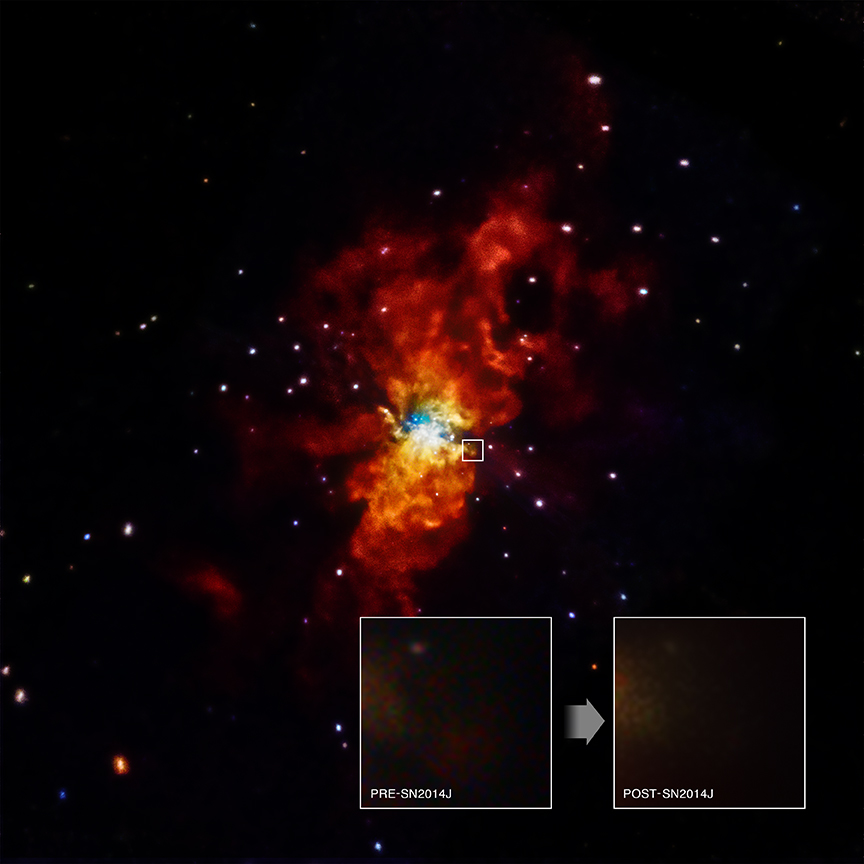
昨年1月、地球上の天文台の望遠鏡は、近傍の銀河M82で発生した明るい超新星SN 2014Jの出現を熱心に観測した。しかし、最も重要な観測は、チャンドラX線天文台が何も観測できなかった軌道上からのものだったかもしれない。Ia型超新星と特定されたSN2014Jの爆発は、伴星から着実に物質を降着する白色矮星の質量の蓄積によって引き起こされたと考えられている。このモデルでは、超新星の爆発波が白色矮星の周囲に残った物質に衝突したときにX線が発生すると予測されている。しかし、超新星からはX線は観測されなかった。チャンドラのM82銀河の擬似カラーX線画像の前後の挿入パネルには、超新星の位置を中心としたほとんど空白のクローズアップが示されている。 SN 2014JからX線がほとんど観測されなかったという驚くべき事実は、天文学者たちに、こうした宇宙爆発を引き起こす原因を説明するために、他のモデルを模索する必要性を生じさせるだろう。
原文(English)
Last January, telescopes in observatories around planet Earth were eagerly used to watch the rise of SN 2014J, a bright supernova in nearby galaxy M82. Still, the most important observations may have been from orbit where the Chandra X-ray Observatory saw nothing. Identified as a Type Ia supernova, the explosion of SN2014J was thought to be triggered by the buildup of mass on a white dwarf star steadily accreting material from a companion star. That model predicts X-rays would be generated when the supernova blastwave struck the material left surrounding the white dwarf. But no X-rays were seen from the supernova. The mostly blank close-ups centered on the supernova's position are shown in the before and after inset panels of Chandra's false color X-ray image of the M82 galaxy. The stunning lack of X-rays from SN 2014J will require astronomers to explore other models to explain what triggers these cosmic explosions.
\ この感動を宇宙仲間にシェア /
宇宙をXでシェア
© NASA / APOD