
🚀 宇宙の記憶・カレンダー検索
🚀 象徴的な写真:
APOD第1回
🚀 創造の柱
🚀 スピリット火星着陸
🚀 ハッブル超深宇宙
🚀 地球へようこそ|ブルー・マーブル
🚀 エンケラドス
🚀 ベテルギウス
🚀 火星着陸
🚀 青い夕焼け
🚀 冥王星のハート
🚀 皆既日食
🚀 アースライズ再構築
🚀 ブラックホール
🚀 ウェッブ初画像
🚀 アポロ11着陸
APOD30周年(2025年6月16日)
ロゼッタの自撮り
Rosetta's Selfie
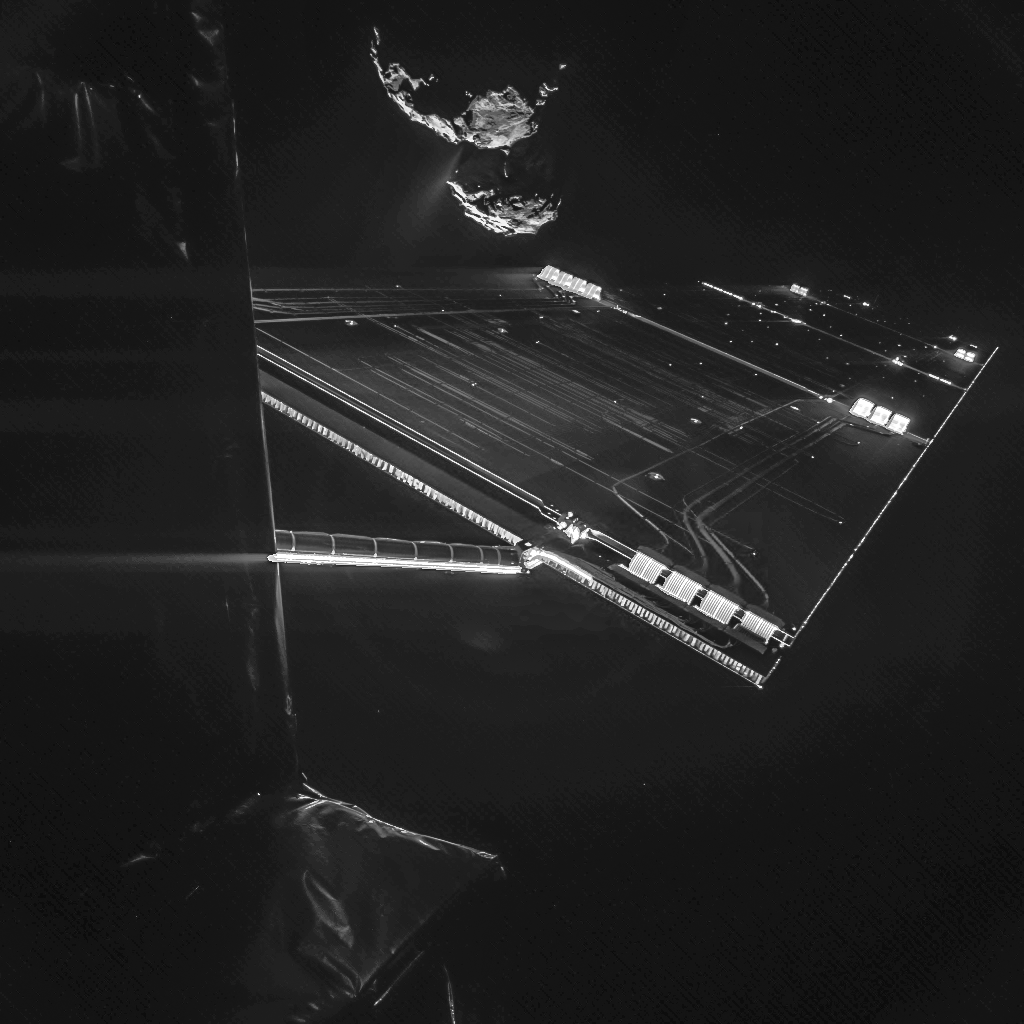
このロゼッタ探査機の自撮り写真は10月7日に撮影されました。当時、探査機は地球から約4億7200万キロメートル離れていましたが、67P/チュリュモフ・ゲラシメンコ彗星の表面からはわずか16キロメートルの距離にありました。フレーム上部付近、探査機の向こう側には、彗星の奇妙な二重ローブ状の核から塵とガスが流れ出ており、ロゼッタの14メートル長の太陽電池パネルの1つに明るい太陽光が反射しています。実際には、ロゼッタにまだ取り付けられているフィラエ着陸機のCIVAカメラシステムを使用して、短時間露光と長時間露光の2つの画像を合成し、この劇的な高コントラストのシーンを記録しました。着陸地点として選ばれた場所は、核の小さい方のローブに見えます。これは、11月12日にフィラエ着陸機がロゼッタ探査機から分離する前に、フィラエのカメラから撮影される最後の画像となる予定です。分離後まもなく、フィラエは周回機の方角を向いて別の画像を撮影し、彗星の核への降下を開始します。
原文(English)
This Rosetta spacecraft selfie was snapped on October 7th. At the time the spacecraft was about 472 million kilometers from planet Earth, but only 16 kilometers from the surface of comet 67P/Churyumov-Gerasimenko. Looming beyond the spacecraft near the top of the frame, dust and gas stream away from the comet's curious double-lobed nucleus and bright sunlight glints off one of Rosetta's 14 meter long solar arrays. In fact, two exposures, one short and one long, were combined to record the dramatic high contrast scene using the CIVA camera system on Rosetta's still-attached Philae lander. Its chosen primary landing site is visible on the smaller lobe of the nucleus. This is the last image anticipated from Philae's cameras before the lander separates from Rosetta on November 12. Shortly after separation Philae will take another image looking back toward the orbiter, and begin its descent to the nucleus of the comet.
\ この感動を宇宙仲間にシェア /
宇宙をXでシェア
© NASA / APOD