
🚀 宇宙の記憶・カレンダー検索
🚀 象徴的な写真:
APOD第1回
🚀 創造の柱
🚀 スピリット火星着陸
🚀 ハッブル超深宇宙
🚀 地球へようこそ|ブルー・マーブル
🚀 エンケラドス
🚀 ベテルギウス
🚀 火星着陸
🚀 青い夕焼け
🚀 冥王星のハート
🚀 皆既日食
🚀 アースライズ再構築
🚀 ブラックホール
🚀 ウェッブ初画像
🚀 アポロ11着陸
APOD30周年(2025年6月16日)
極環銀河NGC 660
Polar Ring Galaxy NGC 660
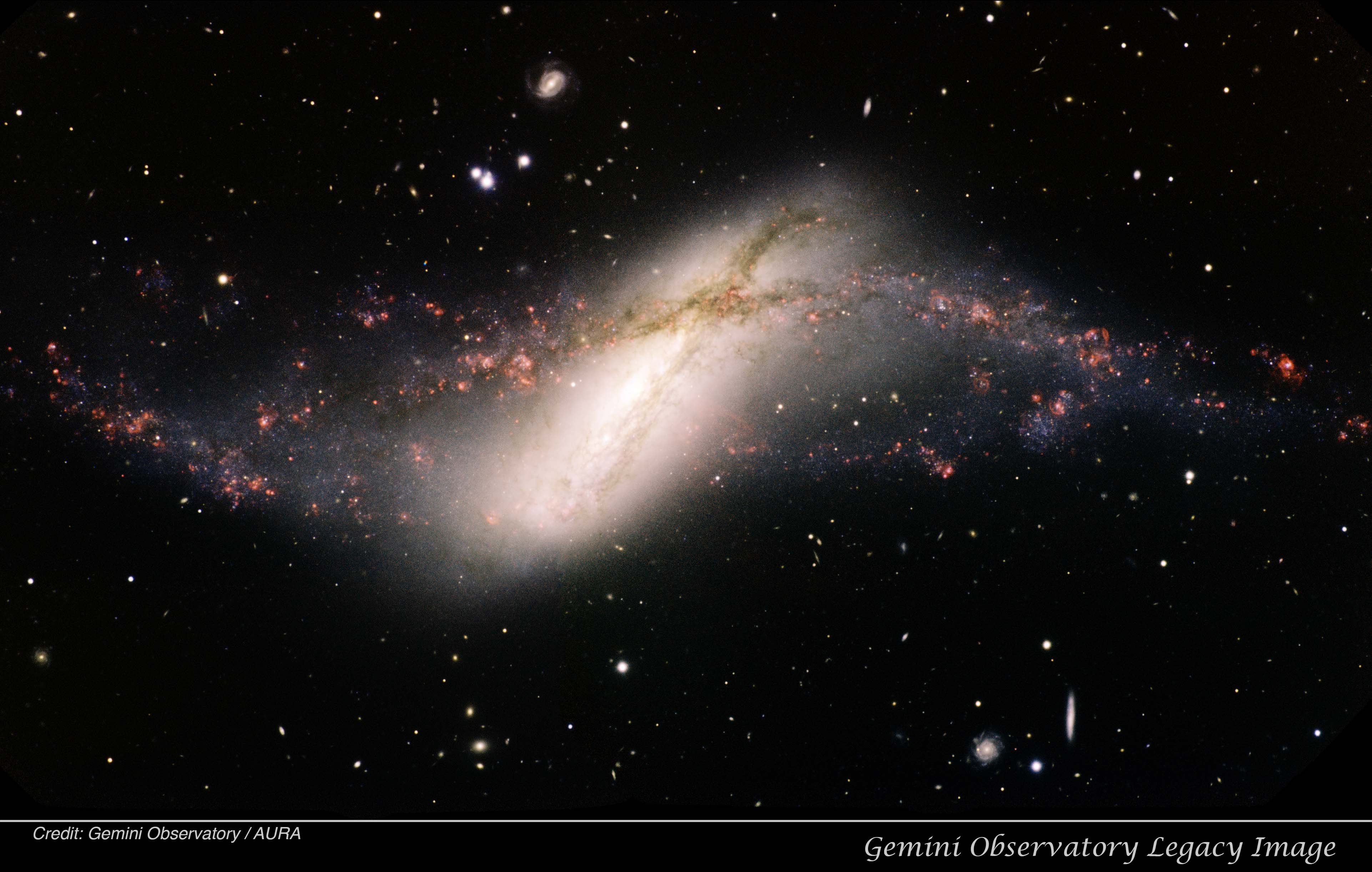
この宇宙のスナップショットにはNGC 660が写っています。これはマウナケアにあるジェミニ北望遠鏡の広帯域および狭帯域フィルター画像データを鮮明に合成したものです。2000万光年以上離れたうお座の領域内に位置するNGC 660は、その特異な外観から極環状銀河に分類されます。極環状銀河は珍しい銀河の一種で、銀河円盤の平面にほぼ垂直な環状に多数の星、ガス、塵が周回しています。この奇妙な形状は、円盤銀河が通過する銀河から偶然物質を捕獲し、捕獲された残骸が回転する環状に広がったことが原因である可能性があります。激しい重力相互作用によって、NGC 660の環状領域に散在する無数のピンク色の星形成領域が説明できます。極環成分は、暗黒物質が環と円盤の回転に及ぼす重力の影響を計算することで、通常は見えない銀河の暗黒物質ハローの形状を調べるためにも利用できます。円盤よりも広いNGC 660の環は、5万光年以上にわたって広がっています。
原文(English)
NGC 660 is featured in this cosmic snapshot, a sharp composite of broad and narrow band filter image data from the Gemini North telescope on Mauna Kea. Over 20 million light-years away and swimming within the boundaries of the constellation Pisces, NGC 660's peculiar appearance marks it as a polar ring galaxy. A rare galaxy type, polar ring galaxies have a substantial population of stars, gas, and dust orbiting in rings nearly perpendicular to the plane of the galactic disk. The bizarre-looking configuration could have been caused by the chance capture of material from a passing galaxy by a disk galaxy, with the captured debris eventually strung out in a rotating ring. The violent gravitational interaction would account for the myriad pinkish star forming regions scattered along NGC 660's ring. The polar ring component can also be used to explore the shape of the galaxy's otherwise unseen dark matter halo by calculating the dark matter's gravitational influence on the rotation of the ring and disk. Broader than the disk, NGC 660's ring spans over 50,000 light-years.
\ この感動を宇宙仲間にシェア /
宇宙をXでシェア
© NASA / APOD