
🚀 宇宙の記憶・カレンダー検索
🚀 象徴的な写真:
APOD第1回
🚀 創造の柱
🚀 スピリット火星着陸
🚀 ハッブル超深宇宙
🚀 地球へようこそ|ブルー・マーブル
🚀 エンケラドス
🚀 ベテルギウス
🚀 火星着陸
🚀 青い夕焼け
🚀 冥王星のハート
🚀 皆既日食
🚀 アースライズ再構築
🚀 ブラックホール
🚀 ウェッブ初画像
🚀 アポロ11着陸
APOD30周年(2025年6月16日)
ガス、塵、星々に囲まれたオリオン座
Orion in Gas, Dust, and Stars
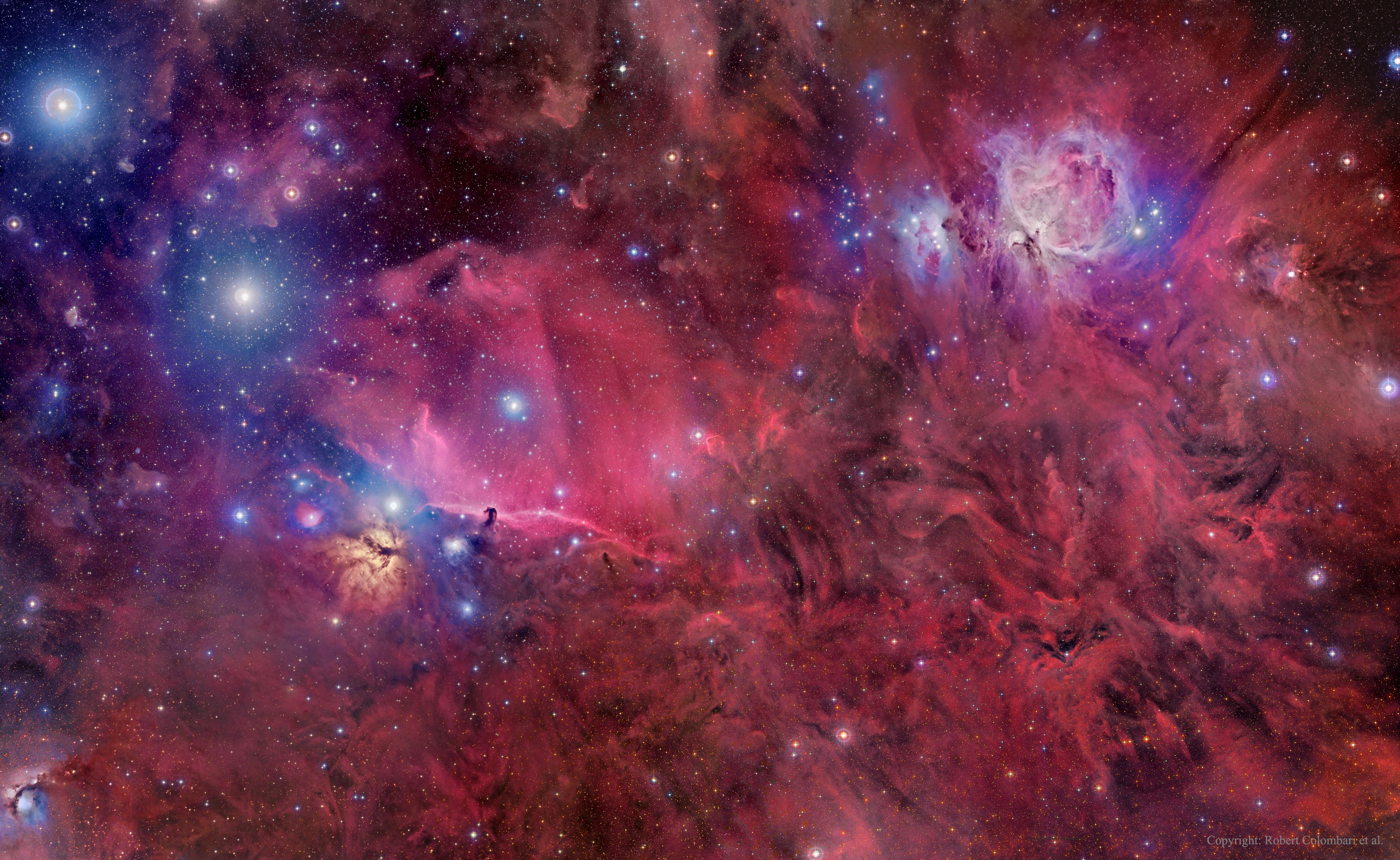
オリオン座には、ただ3つの星が並んでいるだけではありません。長時間露光で撮影すると、暗黒星雲から星団まで、オリオン分子雲複合体の広大なガス状の領域に埋め込まれたあらゆるものが写し出されます。左端の最も明るい3つの星は、まさにオリオン座の三つ星です。三つ星の中で最も低いアルニタクのすぐ下には、水素ガスが励起され、暗褐色の塵のフィラメントに包まれた炎星雲があります。画面中央の下、アルニタクのすぐ右には、おそらく空で最もよく知られた星雲の形をした、濃密な塵の暗い窪みである馬頭星雲があります。右上には、肉眼でも見える激しいガスの渦巻くエネルギーに満ちたオリオン大星雲M42があり、そこから新しい散開星団が誕生しています。 M42のすぐ左には、ランニングマンとも呼ばれる、青みがかった反射星雲が目立ち、そこには多くの明るい青い星が集まっている。掲載されている画像は、地球から約1500光年離れた天体群を含む領域を捉えたもので、その範囲は約75光年に及ぶ。
原文(English)
The constellation of Orion holds much more than three stars in a row. A deep exposure shows everything from dark nebulae to star clusters, all embedded in an extended patch of gaseous wisps in the greater Orion Molecular Cloud Complex. The brightest three stars on the far left are indeed the famous three stars that make up the belt of Orion. Just below Alnitak, the lowest of the three belt stars, is the Flame Nebula, glowing with excited hydrogen gas and immersed in filaments of dark brown dust. Below and left of the frame center and just to the right of Alnitak lies the Horsehead Nebula, a dark indentation of dense dust that has perhaps the most recognized nebular shapes on the sky. On the upper right lies M42, the Orion Nebula, an energetic caldron of tumultuous gas, visible to the unaided eye, that is giving birth to a new open cluster of stars. Immediately to the left of M42 is a prominent bluish reflection nebula sometimes called the Running Man that houses many bright blue stars. The featured image covers an area with objects that are roughly 1,500 light years away and spans about 75 light years.
\ この感動を宇宙仲間にシェア /
宇宙をXでシェア
© Roberto Colombari,
Robert Gendler &
Federico Pelliccia;
Data:
DSS PLOSS II / APOD