
🚀 宇宙の記憶・カレンダー検索
🚀 象徴的な写真:
APOD第1回
🚀 創造の柱
🚀 スピリット火星着陸
🚀 ハッブル超深宇宙
🚀 地球へようこそ|ブルー・マーブル
🚀 エンケラドス
🚀 ベテルギウス
🚀 火星着陸
🚀 青い夕焼け
🚀 冥王星のハート
🚀 皆既日食
🚀 アースライズ再構築
🚀 ブラックホール
🚀 ウェッブ初画像
🚀 アポロ11着陸
APOD30周年(2025年6月16日)
W5:星形成の柱
W5: Pillars of Star Formation
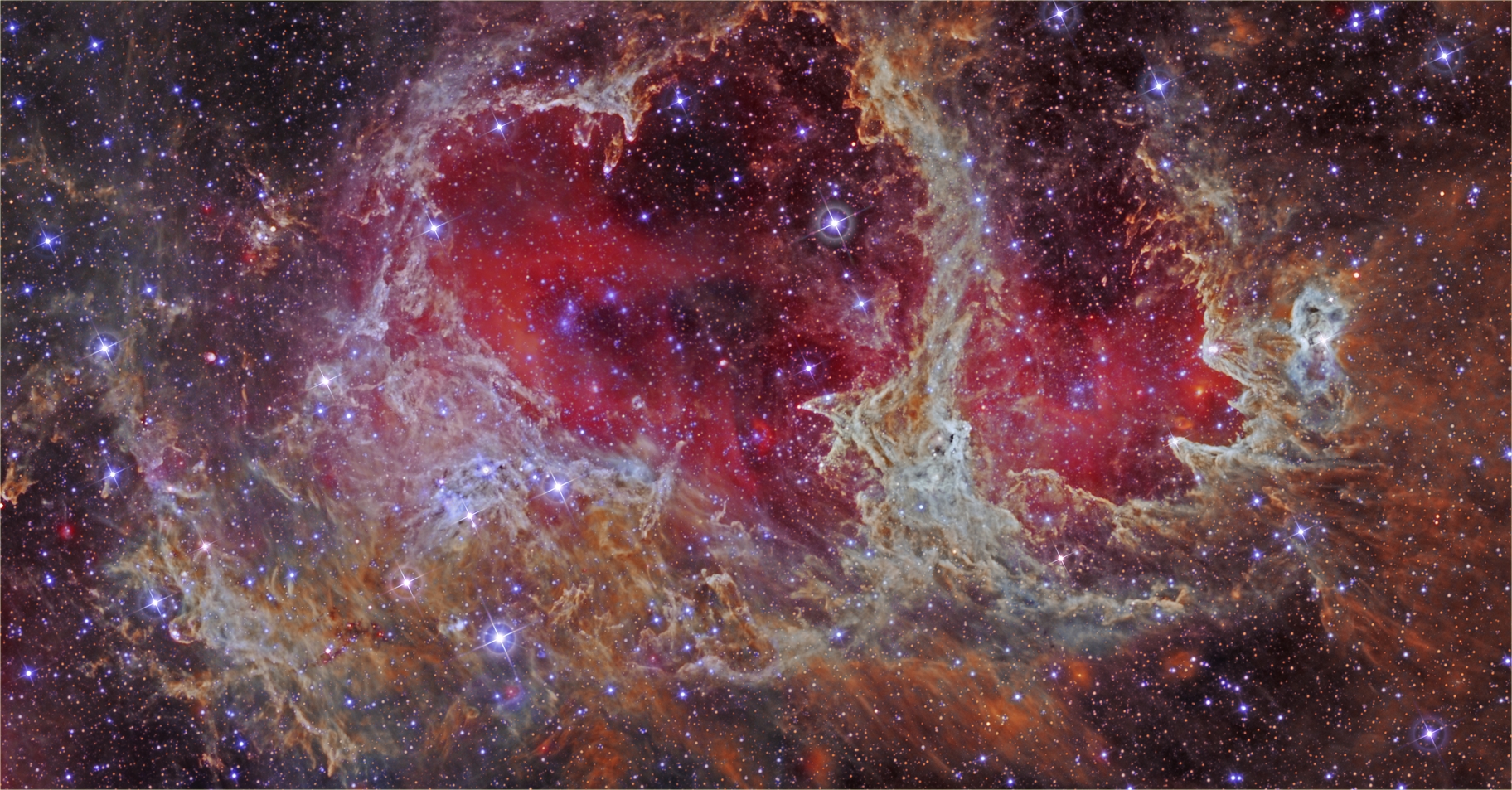
星はどのように形成されるのでしょうか?NASAの広視野赤外線探査衛星(WISE)による赤外線画像など、星形成領域W5の画像は、空洞の中心付近にある大質量星が端の方にある星よりも古いことを示す明確な手がかりを与えてくれます。その理由として考えられるのは、中心にある古い星が、実際には端の方にある若い星の形成を促しているということです。この星形成のきっかけは、高温の流出ガスが低温のガスを圧縮して、重力によって収縮して星になるのに十分な密度の塊にすることです。掲載されている科学的に着色された赤外線画像では、高温の流出ガスからゆっくりと蒸発してできた壮大な柱が、さらなる視覚的な手がかりを与えてくれます。W5はIC 1848としても知られており、IC 1805とともに、ハート星雲とソウル星雲と呼ばれる複雑な星形成領域を形成しています。上の画像は、星形成の柱が豊富なW5の約2,000光年にわたる部分を強調しています。 W5はカシオペヤ座の方向、約6,500光年離れた場所に位置しています。APOD 2015壁掛けカレンダー発売中
原文(English)
How do stars form? Images of the star forming region W5 like those in the infrared by NASA's Wide Field Infrared Survey Explorer (WISE) satellite provide clear clues with indications that massive stars near the center of empty cavities are older than stars near the edges. A likely reason for this is that the older stars in the center are actually triggering the formation of the younger edge stars. The triggered star formation occurs when hot outflowing gas compresses cooler gas into knots dense enough to gravitationally contract into stars. In the featured scientifically-colored infrared image, spectacular pillars, left slowly evaporating from the hot outflowing gas, provide further visual clues. W5 is also known as IC 1848, and together with IC 1805 form a complex region of star formation popularly dubbed the Heart and Soul Nebulas. The above image highlights a part of W5 spanning about 2,000 light years that is rich in star forming pillars. W5 lies about 6,500 light years away toward the constellation of Cassiopeia. Now Available: APOD 2015 Wall Calendars
\ この感動を宇宙仲間にシェア /
宇宙をXでシェア
© :
Francesco Antonucci / APOD