
🚀 宇宙の記憶・カレンダー検索
🚀 象徴的な写真:
APOD第1回
🚀 創造の柱
🚀 スピリット火星着陸
🚀 ハッブル超深宇宙
🚀 地球へようこそ|ブルー・マーブル
🚀 エンケラドス
🚀 ベテルギウス
🚀 火星着陸
🚀 青い夕焼け
🚀 冥王星のハート
🚀 皆既日食
🚀 アースライズ再構築
🚀 ブラックホール
🚀 ウェッブ初画像
🚀 アポロ11着陸
APOD30周年(2025年6月16日)
ベールの中のピッカリングの三角形
Pickering's Triangle in the Veil
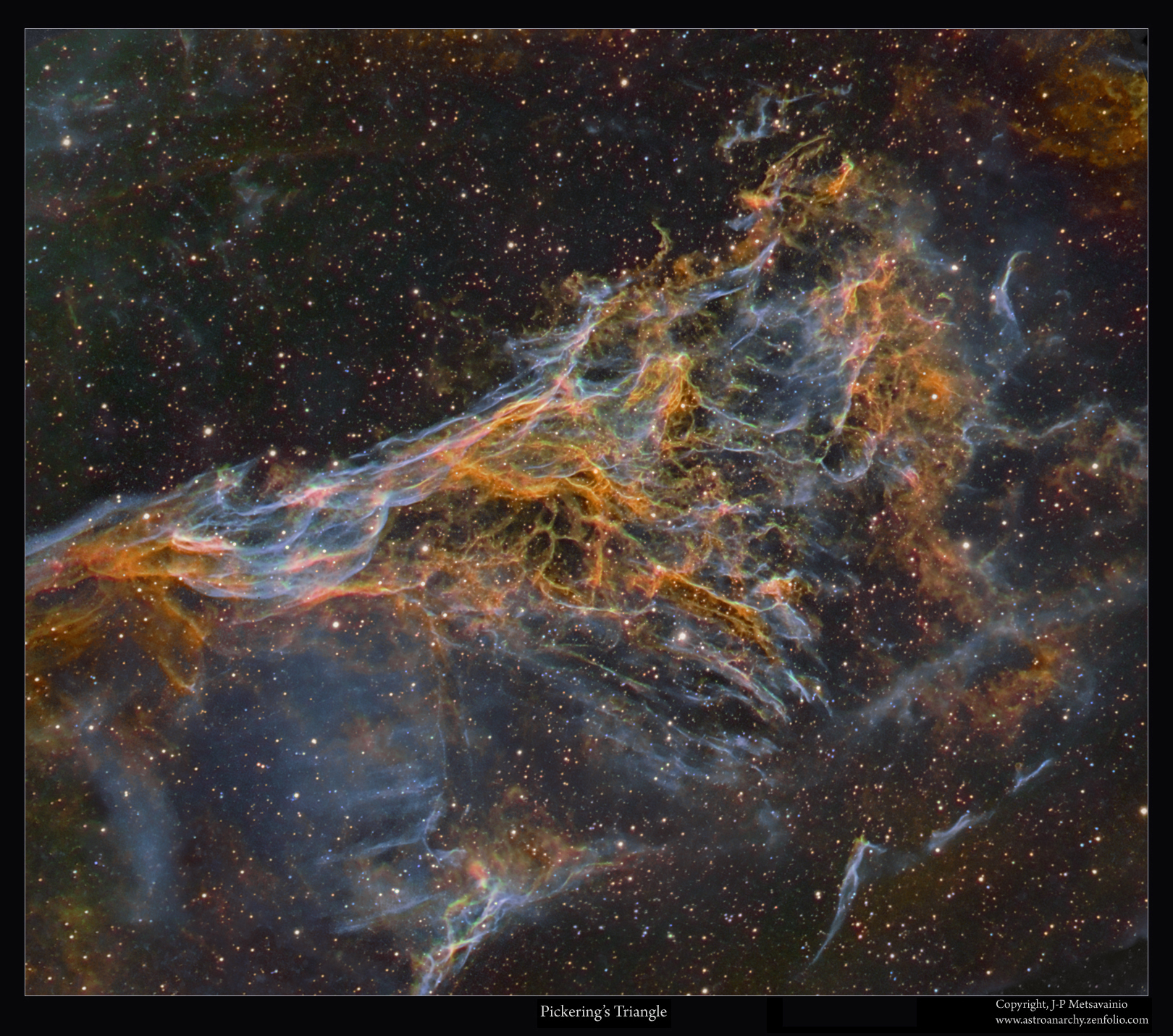
一見混沌としたように見えるこれらの衝撃を受けた光るガスのフィラメントは、ベール星雲の一部として、地球の空を横切って白鳥座に向かって伸びています。ベール星雲自体は巨大な超新星残骸であり、巨大な星の死の爆発によって生まれた膨張するガス雲です。最初の超新星爆発からの光は、おそらく5000年以上前に地球に到達しました。この大災害で噴出した星間衝撃波は、宇宙空間を突き進み、星間物質を掃き集めて励起します。光るフィラメントは、ほぼ真横から見たシートの長い波紋のようなもので、赤と緑で示される電離した水素原子と硫黄原子、そして青で示される酸素の輝きに驚くほどよく分離されています。白鳥座ループとしても知られるベール星雲は、現在、約3度、つまり満月の直径の約6倍に広がっています。推定距離1,500光年で計算すると70光年以上になるが、この視野はその距離の3分の1にも満たない。ハーバード大学天文台の所長にちなんでピッカリングの三角形と名付けられ、NGC 6979としてカタログ化されているこのフィラメント状の構造は、ウィリアミナ・フレミングの三角形のウィスプと呼ぶ方がより適切かもしれない。
原文(English)
Chaotic in appearance, these filaments of shocked, glowing gas break across planet Earth's sky toward the constellation of Cygnus, as part of the Veil Nebula. The Veil Nebula itself is a large supernova remnant, an expanding cloud born of the death explosion of a massive star. Light from the original supernova explosion likely reached Earth over 5,000 years ago. Blasted out in the cataclysmic event, the interstellar shock waves plow through space sweeping up and exciting interstellar material. The glowing filaments are really more like long ripples in a sheet seen almost edge on, remarkably well separated into the glow of ionized hydrogen and sulfur atoms shown in red and green, and oxygen in blue hues. Also known as the Cygnus Loop, the Veil Nebula now spans nearly 3 degrees or about 6 times the diameter of the full Moon. While that translates to over 70 light-years at its estimated distance of 1,500 light-years, this field of view spans less than one third that distance. Identified as Pickering's Triangle for a director of Harvard College Observatory and cataloged as NGC 6979, the complex of filaments might be more appropriately known as Williamina Fleming's Triangular Wisp.
\ この感動を宇宙仲間にシェア /
宇宙をXでシェア
© Astro Anarchy / APOD