
🚀 宇宙の記憶・カレンダー検索
🚀 象徴的な写真:
APOD第1回
🚀 創造の柱
🚀 スピリット火星着陸
🚀 ハッブル超深宇宙
🚀 地球へようこそ|ブルー・マーブル
🚀 エンケラドス
🚀 ベテルギウス
🚀 火星着陸
🚀 青い夕焼け
🚀 冥王星のハート
🚀 皆既日食
🚀 アースライズ再構築
🚀 ブラックホール
🚀 ウェッブ初画像
🚀 アポロ11着陸
APOD30周年(2025年6月16日)
逆行する火星と土星
Retrograde Mars and Saturn
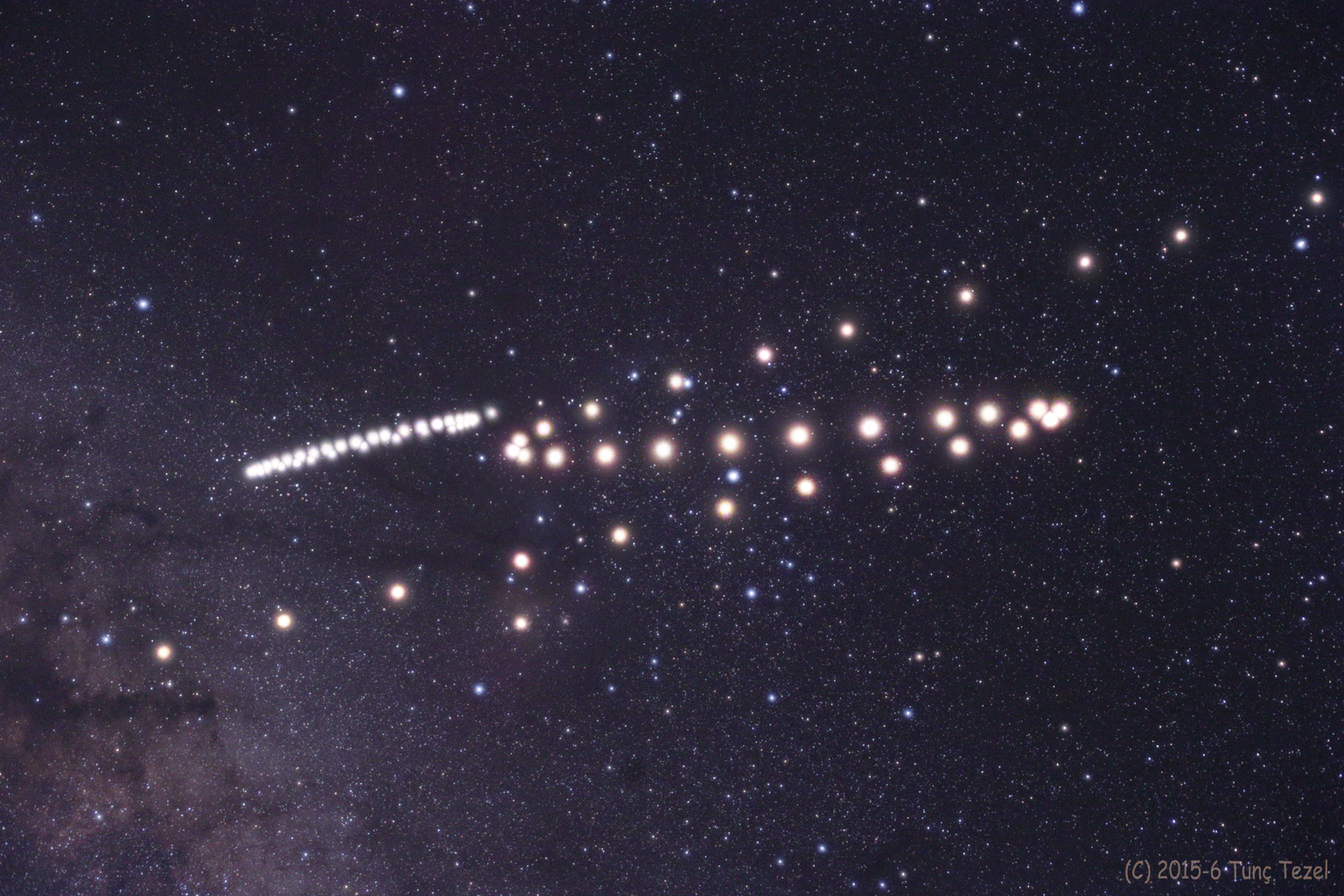
火星と土星は、今年に入ってから地球の夜空で驚くほど接近した状態で過ごしました。2015年12月中旬から今週初めにかけて撮影された一連の画像から、この合成画像は、天の川銀河の中心バルジ付近の明るい星アンタレスのすぐ北で、両星が衝に近づく様子を捉えています。対応する動画では、土星の見かけの動きは、平らでコンパクトなループに沿って行ったり来たりしているのがわかります。一方、火星は、画面右上から左下にかけて、より幅の広い逆向きのS字型の軌跡を描いています。日付と点をつなげるには、カーソルを画像の上にスライドさせるか、このリンクをクリックしてください。そう見えるかもしれませんが、火星と土星は実際に軌道に沿って方向を反転しているわけではありません。背景の星々に対する見かけの逆行運動は、地球自体の公転運動を反映しているのです。逆行運動は、地球が太陽から遠く離れた軌道を周回する惑星を追い越すたびに観測され、地球は比較的太陽に近い自身の軌道をより速く移動する。
原文(English)
Wandering Mars and Saturn have spent much of this year remarkably close in planet Earth's night sky. In a sequence of exposures spanning mid-December 2015 through the beginning of this week, this composited skyview follows their time together, including both near opposition, just north of bright star Antares near the Milky Way's central bulge. In the corresponding video, Saturn's apparent movement is seen to be back and forth along the flattened, compact loop, while Mars traces the wider, reversing S-shaped track from upper right to lower left through the frame. To connect the dots and dates just slide your cursor over the picture (or follow this link). It looks that way, but Mars and Saturn don't actually reverse direction along their orbits. Instead, their apparent backwards or retrograde motion with respect to the background stars is a reflection of the orbital motion of the Earth itself. Retrograde motion can be seen each time Earth overtakes and laps planets orbiting farther from the Sun, the Earth moving more rapidly through its own relatively close-in orbit.
\ この感動を宇宙仲間にシェア /
宇宙をXでシェア
© Tunç Tezel / APOD