
🚀 宇宙の記憶・カレンダー検索
🚀 象徴的な写真:
APOD第1回
🚀 創造の柱
🚀 スピリット火星着陸
🚀 ハッブル超深宇宙
🚀 地球へようこそ|ブルー・マーブル
🚀 エンケラドス
🚀 ベテルギウス
🚀 火星着陸
🚀 青い夕焼け
🚀 冥王星のハート
🚀 皆既日食
🚀 アースライズ再構築
🚀 ブラックホール
🚀 ウェッブ初画像
🚀 アポロ11着陸
APOD30周年(2025年6月16日)
ロゼッタの別れ
Rosetta's Farewell
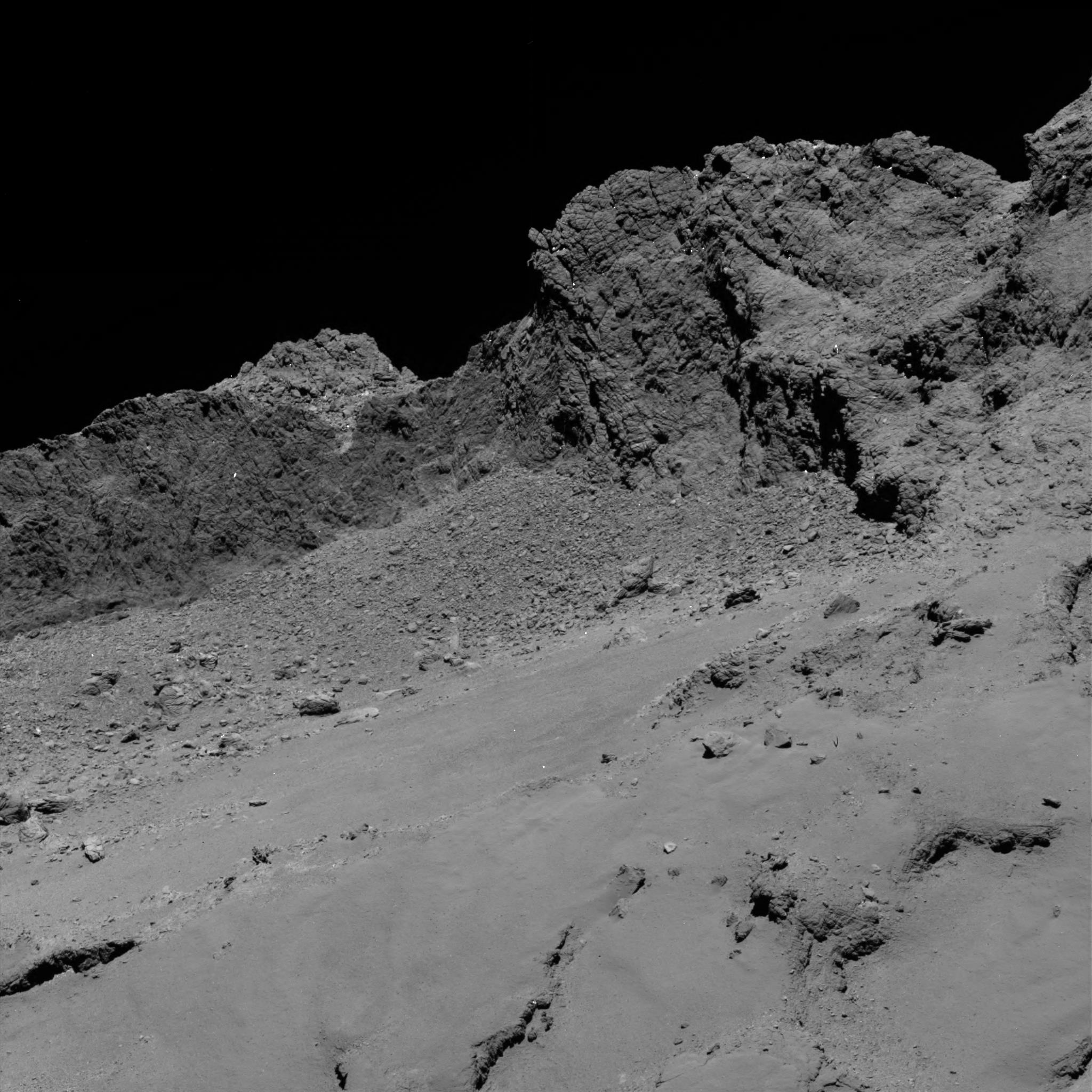
ロゼッタ探査機は、太陽を周回する67P/チュリュモフ・ゲラシメンコ彗星を786日間追跡した後、2016年9月30日に探査機からの信号が途絶えたことで、彗星表面への制御された衝突が確認されました。最終降下中に撮影された画像の1つであるこの高解像度画像は、彗星の荒涼とした風景を捉えています。このシーンは600メートル(2,000フィート)強に及び、ロゼッタが彗星表面から約16キロメートル離れたときに撮影されました。ロゼッタの彗星への降下は、感動的な宇宙探査ミッションの運用段階の終了を告げるものでした。ロゼッタは、太陽系で最も原始的な世界の1つである彗星の表面に着陸機を展開し、太陽放射の強度の増加にさらされると彗星がどのように変化するかを直接目撃しました。探査ミッションを地表で終了するという決定は、彗星の軌道が木星のさらに外側の暗い領域へと移動し、探査機を稼働させるための電力が不足するようになったためである。また、ミッション運用チームは、太陽が地球とロゼッタ探査機の視線上に接近する時期が近づいており、無線通信がますます困難になるという問題にも直面していた。
原文(English)
After closely following comet 67P/Churyumov-Gerasimenko for 786 days as it rounded the Sun, the Rosetta spacecraft's controlled impact with the comet's surface was confirmed by the loss of signal from the spacecraft on September 30, 2016. One of the images taken during its final descent, this high resolution view looks across the comet's stark landscape. The scene spans just over 600 meters (2,000 feet), captured when Rosetta was about 16 kilometers from the comet's surface. Rosetta's descent to the comet brought to an end the operational phase of an inspirational mission of space exploration. Rosetta deployed a lander to the surface of one of the Solar System's most primordial worlds and witnessed first hand how a comet changes when subject to the increasing intensity of the Sun's radiation. The decision to end the mission on the surface is a result of the comet's orbit now taking it to the dim reaches beyond Jupiter where there would be a lack of power to operate the spacecraft. Mission operators also faced an approaching period where the Sun would be close to line-of-sight between Earth and Rosetta, making radio communications increasingly difficult.
\ この感動を宇宙仲間にシェア /
宇宙をXでシェア
© ESA,
Rosetta,
MPS, OSIRIS;
UPD/LAM/IAA/SSO/INTA/UPM/DASP/IDA / APOD