
🚀 宇宙の記憶・カレンダー検索
🚀 象徴的な写真:
APOD第1回
🚀 創造の柱
🚀 スピリット火星着陸
🚀 ハッブル超深宇宙
🚀 地球へようこそ|ブルー・マーブル
🚀 エンケラドス
🚀 ベテルギウス
🚀 火星着陸
🚀 青い夕焼け
🚀 冥王星のハート
🚀 皆既日食
🚀 アースライズ再構築
🚀 ブラックホール
🚀 ウェッブ初画像
🚀 アポロ11着陸
APOD30周年(2025年6月16日)
ジェミニ天文台北
Gemini Observatory North
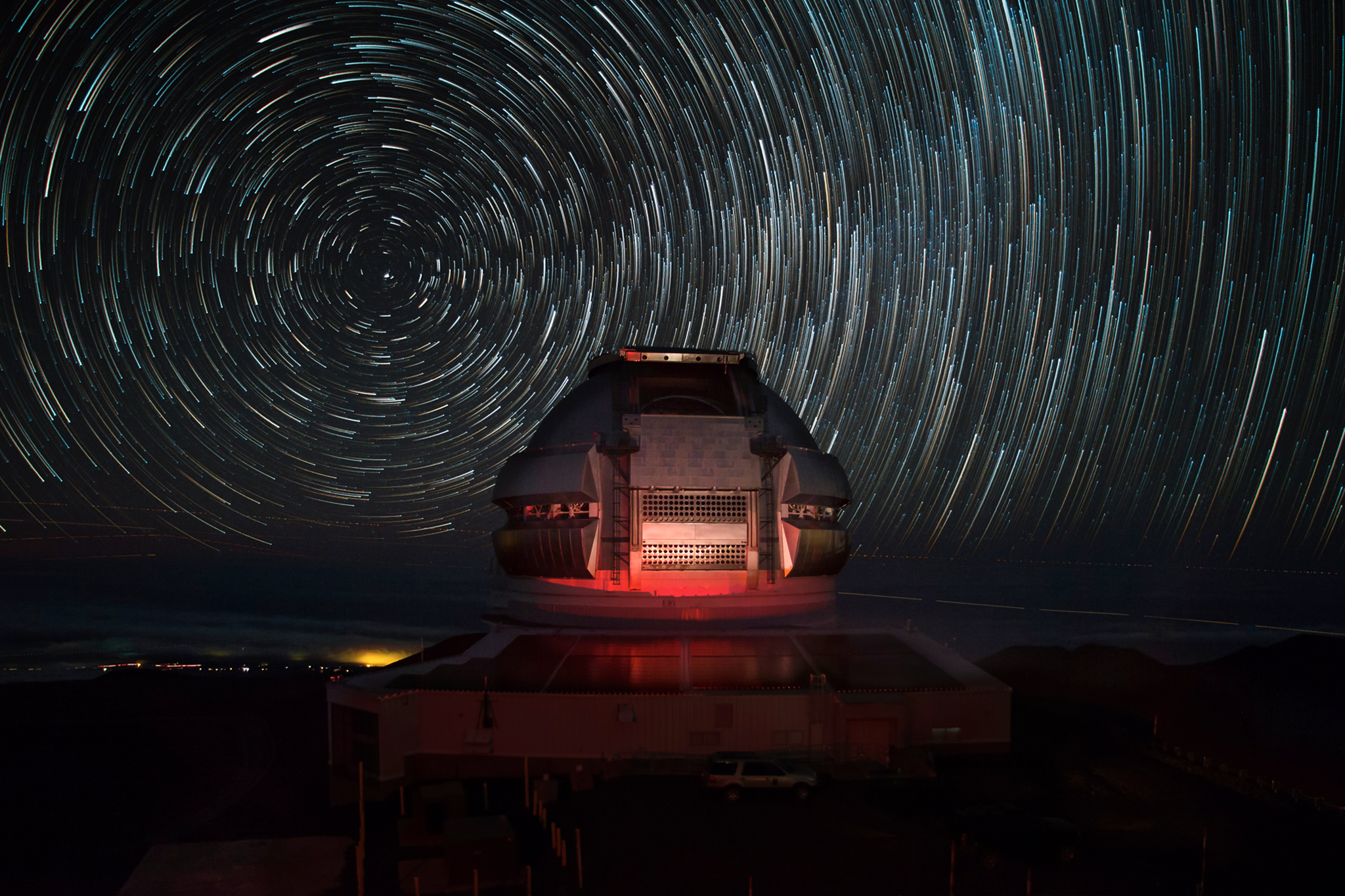
空飛ぶ円盤のように見えるが、この高度な技術構造物は、SF映画の古典『地球の静止する日』に登場する賢い地球外生命体を届けるためにここにあるのではない。しかし、宇宙についての知識を深めるためにここにあるのだ。ハワイの山の頂上近くに設置されたジェミニ北天文台のドームには、直径8.1メートルの同一の望遠鏡が2台設置されている。チリにある南半球の双子天文台と併用することで、この2台は地球から全天を観測できる。三脚に固定したカメラでそれぞれ30秒間露光した85枚の画像から構成されたこの画像は、地球が静止していなかったことも明確に示している。北天の極を中心とした同心円状の星の軌跡は、弧の端がより明るくなるように調整されており、地球の自転を反映している。ハワイの緯度では、地平線に近い北極星が最も短い星の軌跡を描いている。右側に見える、より淡く密集した星の軌跡の森は、昇りゆく天の川の一部である。
原文(English)
It does look like a flying saucer, but this technologically advanced structure is not here to deliver the wise extraterrestrial from the scifi classic movie The Day the Earth Stood Still. It is here to advance our knowledge of the Universe though. Shown sitting near the top of a mountain in Hawaii, the dome of the Gemini Observatory North houses one of two identical 8.1-meter diameter telescopes. Used with its southern hemisphere twin observatory in Chile, the two can access the entire sky from planet Earth. Constructed from 85 exposures lasting 30 seconds each with camera fixed to a tripod, the image also clearly demonstrates that the Earth did not stand still. Adjusted to be brighter at the ends of their arcs, the concentric star trails centered on the North Celestial Pole are a reflection of Earth's rotation around its axis. Close to the horizon at Hawaiian latitudes, Polaris, the North Star, makes the shortest star trail. The fainter denser forest of star trails toward the right is part of the rising Milky Way.
\ この感動を宇宙仲間にシェア /
宇宙をXでシェア
© Gemini Observatory / APOD