
🚀 宇宙の記憶・カレンダー検索
🚀 象徴的な写真:
APOD第1回
🚀 創造の柱
🚀 スピリット火星着陸
🚀 ハッブル超深宇宙
🚀 地球へようこそ|ブルー・マーブル
🚀 エンケラドス
🚀 ベテルギウス
🚀 火星着陸
🚀 青い夕焼け
🚀 冥王星のハート
🚀 皆既日食
🚀 アースライズ再構築
🚀 ブラックホール
🚀 ウェッブ初画像
🚀 アポロ11着陸
APOD30周年(2025年6月16日)
大マゼラン雲のN159
N159 in the Large Magellanic Cloud
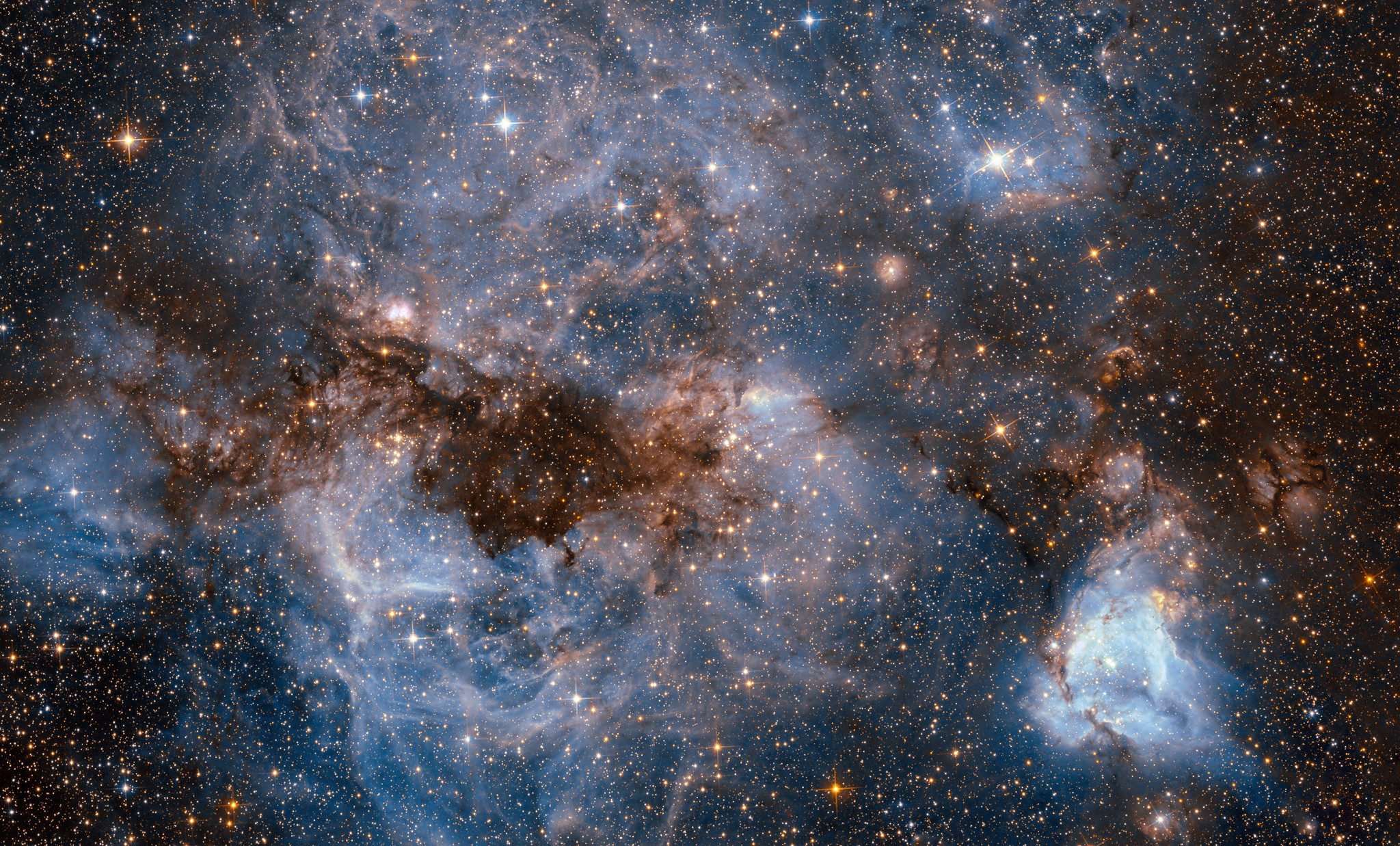
直径150光年以上にも及ぶこのガスと塵の宇宙の渦は、それほど遠くありません。私たちの伴銀河である大マゼラン雲のタランチュラ星雲の南に位置し、わずか18万光年の距離です。内部では巨大な星が形成されています。それらの高エネルギー放射と強力な恒星風がガスと塵を形作り、このHII領域の輝きを生み出しています。このHII領域は、マゼラン雲の輝線星と星雲のヘニゼカタログにN159として登録されています。中心の左上にある明るくコンパクトな蝶の形をした星雲には、形成のごく初期段階にある巨大な星が含まれていると考えられます。ハッブル宇宙望遠鏡の画像で初めて解像されたこのコンパクトな電離ガスの塊は、パピヨン星雲として知られるようになりました。参加しよう:美学と天文学に関するアンケートにご協力ください。
原文(English)
Over 150 light-years across, this cosmic maelstrom of gas and dust is not too far away. It lies south of the Tarantula Nebula in our satellite galaxy the Large Magellanic Cloud a mere 180,000 light-years distant. Massive stars have formed within. Their energetic radiation and powerful stellar winds sculpt the gas and dust and power the glow of this HII region, entered into the Henize catalog of emission stars and nebulae in the Magellanic Clouds as N159. The bright, compact, butterfly-shaped nebula above and left of center likely contains massive stars in a very early stage of formation. Resolved for the first time in Hubble images, the compact blob of ionized gas has come to be known as the Papillon Nebula. Participate: Take an Aesthetics & Astronomy Survey
\ この感動を宇宙仲間にシェア /
宇宙をXでシェア
© NASA / APOD