
🚀 宇宙の記憶・カレンダー検索
🚀 象徴的な写真:
APOD第1回
🚀 創造の柱
🚀 スピリット火星着陸
🚀 ハッブル超深宇宙
🚀 地球へようこそ|ブルー・マーブル
🚀 エンケラドス
🚀 ベテルギウス
🚀 火星着陸
🚀 青い夕焼け
🚀 冥王星のハート
🚀 皆既日食
🚀 アースライズ再構築
🚀 ブラックホール
🚀 ウェッブ初画像
🚀 アポロ11着陸
APOD30周年(2025年6月16日)
レーザー光線のある星雲
Nebula with Laser Beams
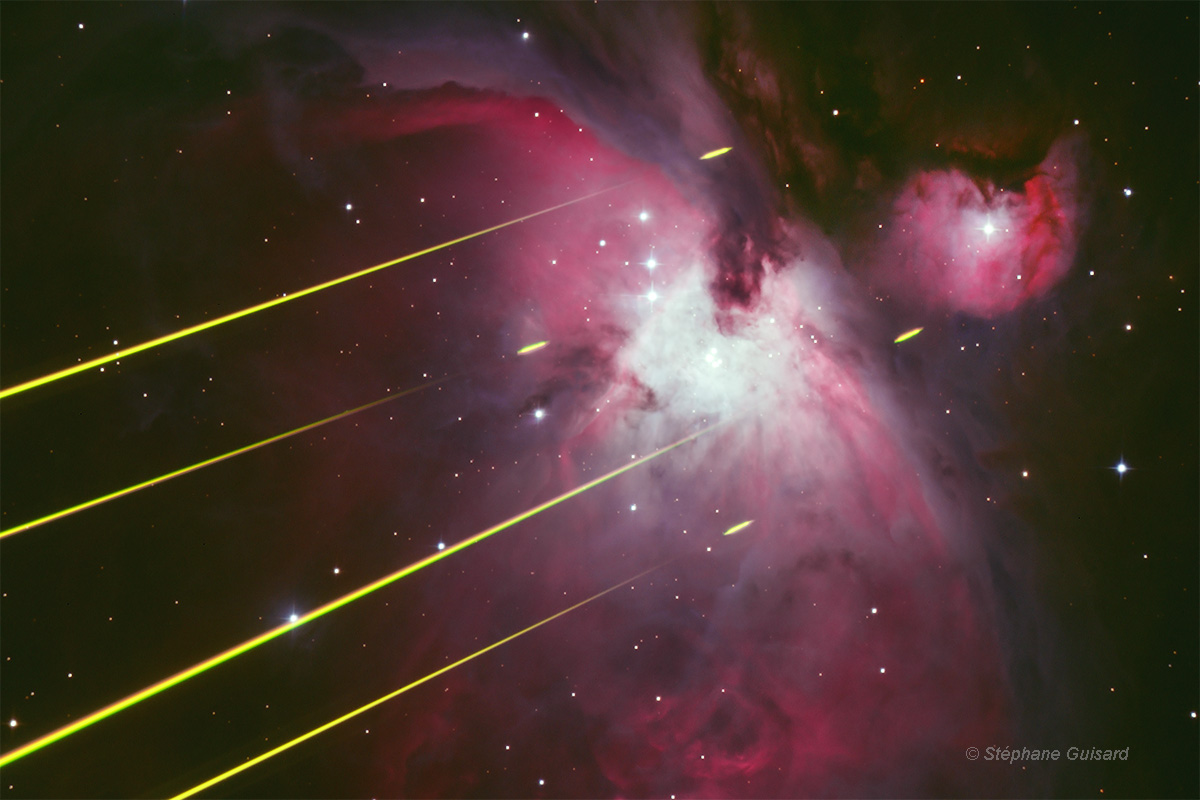
地球のアタカマ砂漠にあるESOのパラナル天文台から見たオリオン星雲のこの驚くべき画像には、4本のレーザー光線が横切っています。星間紛争とは関係なく、これらのレーザーは、天文台の超大型望遠鏡の1つであるUT4によるオリオン座の観測に使用されており、画像鮮明化補償光学システムの技術テストの一環です。レーザー光線が映ったこの星雲の画像は、UT4の囲いの外にある小型望遠鏡で撮影されました。天文台から数キロメートル上空では地球の濃密な下層大気がレーザー光を散乱させるため、この視点から光線が見えるのです。光線の向こう側に見える4つの小さなセグメントは、80~90キロメートルの高高度でレーザー光によって励起されたナトリウム原子の大気層からの放射です。UT4の視点から見ると、これらのセグメントは明るい点、つまり人工ガイド星を形成します。これらの変動は、望遠鏡の光路にある可変鏡を制御することで、視線方向の大気によるぼやけをリアルタイムで補正するために利用される。
原文(English)
Four laser beams cut across this startling image of the Orion Nebula, as seen from ESO's Paranal Observatory in the Atacama desert on planet Earth. Not part of an interstellar conflict, the lasers are being used for an observation of Orion by UT4, one of the observatory's very large telescopes, in a technical test of an image-sharpening adaptive optics system. This view of the nebula with laser beams was captured by a small telescope from outside the UT4 enclosure. The beams are visible from that perspective because in the first few kilometers above the observatory the Earth's dense lower atmosphere scatters the laser light. The four small segments appearing beyond the beams are emission from an atmospheric layer of sodium atoms excited by the laser light at higher altitudes of 80-90 kilometers. Seen from the perspective of the UT4, those segments form bright spots or artificial guide stars. Their fluctuations are used in real-time to correct for atmospheric blurring along the line-of-sight by controlling a deformable mirror in the telescope's optical path.
\ この感動を宇宙仲間にシェア /
宇宙をXでシェア
© Stéphane Guisard / APOD