
🚀 宇宙の記憶・カレンダー検索
🚀 象徴的な写真:
APOD第1回
🚀 創造の柱
🚀 スピリット火星着陸
🚀 ハッブル超深宇宙
🚀 地球へようこそ|ブルー・マーブル
🚀 エンケラドス
🚀 ベテルギウス
🚀 火星着陸
🚀 青い夕焼け
🚀 冥王星のハート
🚀 皆既日食
🚀 アースライズ再構築
🚀 ブラックホール
🚀 ウェッブ初画像
🚀 アポロ11着陸
APOD30周年(2025年6月16日)
おうし座の若い星々と塵の星雲
Young Stars and Dusty Nebulae in Taurus
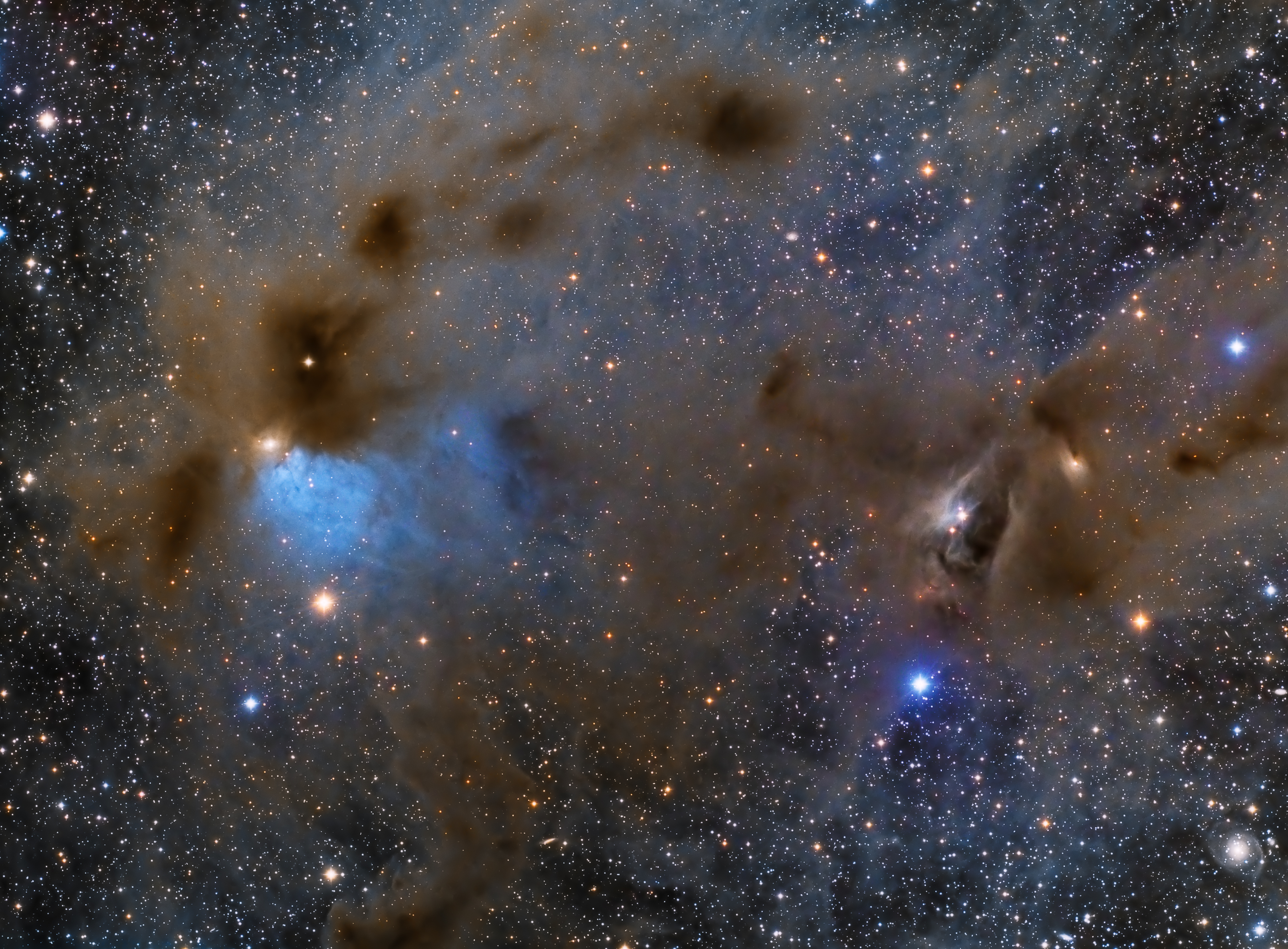
この塵の星雲の複合体は、わずか450光年離れたおうし座分子雲の端に留まっています。宇宙では星が形成されています。約40時間の画像データから構成された2度の広視野には、右側に誕生した星雲の残骸に埋め込まれた若いTタウリ型星がいくつか含まれています。数百万年前から存在し、まだ恒星の思春期にあるこれらの星は、明るさが変動し、重力崩壊の最終段階にあります。安定した低質量の主系列星へと成長するにつれて、核融合を維持するために中心温度が上昇します。これは、約45億年前に中年の太陽が達成した恒星進化の段階です。左側には、もう1つの若い変光星であるV1023タウリが見えます。その黄みがかった塵の雲の中に、鮮やかな青色の反射星雲であるセダーブラッド30(LBN 782としても知られる)が隣接している。明るい青みがかった反射星雲のすぐ上には、塵に覆われた暗黒星雲バーナード7がある。
原文(English)
This complex of dusty nebulae lingers along the edge of the Taurus molecular cloud, a mere 450 light-years distant. Stars are forming on the cosmic scene. Composed from almost 40 hours of image data, the 2 degree wide telescopic field of view includes some youthful T-Tauri class stars embedded in the remnants of their natal clouds at the right. Millions of years old and still going through stellar adolescence, the stars are variable in brightness and in the late phases of their gravitational collapse. Their core temperatures will rise to sustain nuclear fusion as they grow into stable, low mass, main sequence stars, a stage of stellar evolution achieved by our middle-aged Sun about 4.5 billion years ago. Another youthful variable star, V1023 Tauri, can be spotted on the left. Within its yellowish dust cloud, it lies next to the striking blue reflection nebula Cederblad 30, also known as LBN 782. Just above the bright bluish reflection nebula is dusty dark nebula Barnard 7.
\ この感動を宇宙仲間にシェア /
宇宙をXでシェア
© Lloyd L. Smith / APOD