
🚀 宇宙の記憶・カレンダー検索
🚀 象徴的な写真:
APOD第1回
🚀 創造の柱
🚀 スピリット火星着陸
🚀 ハッブル超深宇宙
🚀 地球へようこそ|ブルー・マーブル
🚀 エンケラドス
🚀 ベテルギウス
🚀 火星着陸
🚀 青い夕焼け
🚀 冥王星のハート
🚀 皆既日食
🚀 アースライズ再構築
🚀 ブラックホール
🚀 ウェッブ初画像
🚀 アポロ11着陸
APOD30周年(2025年6月16日)
アンテナを探る
Exploring the Antennae
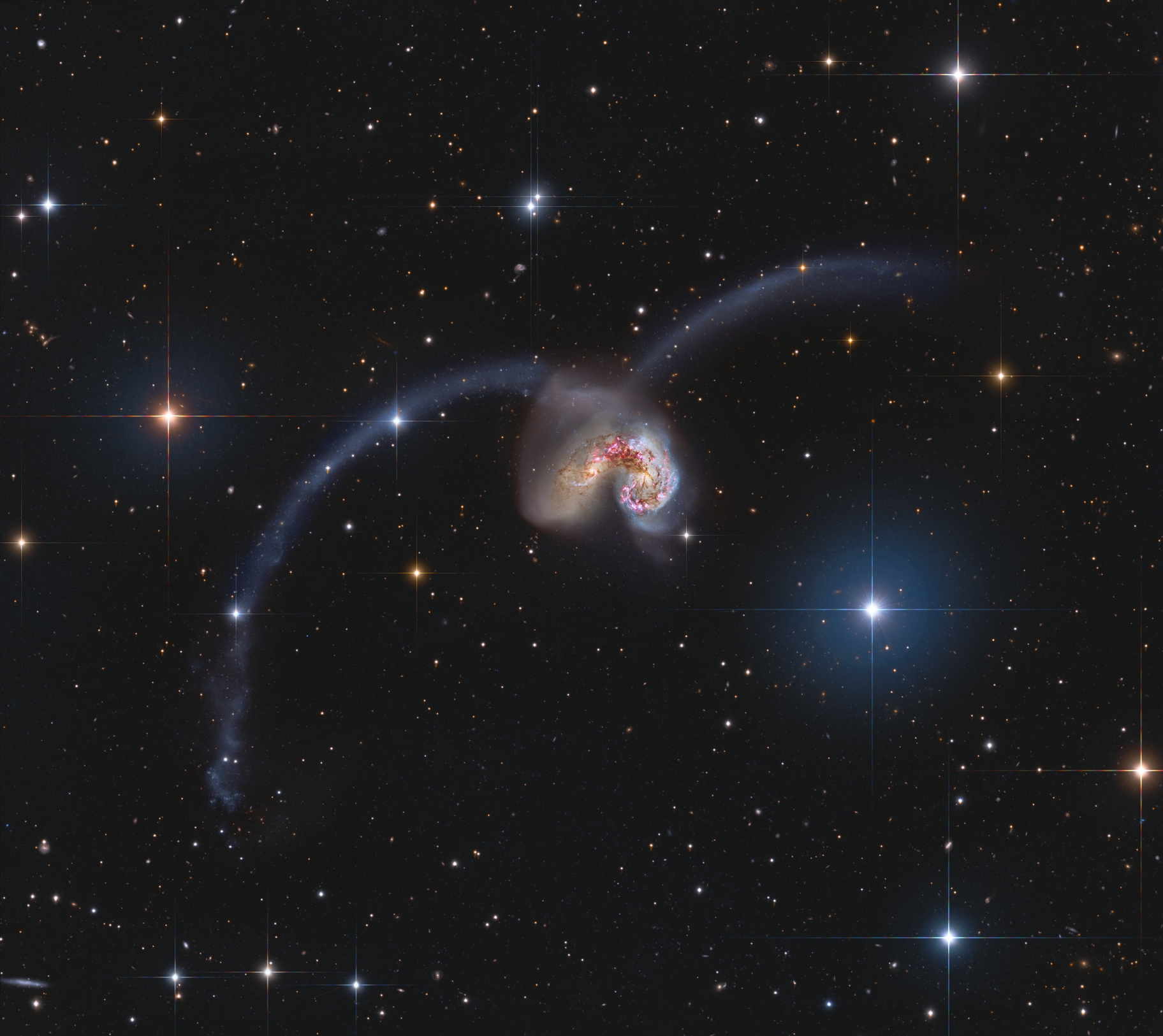
南天のからす座の約6000万光年離れた場所で、2つの巨大銀河が衝突している。NGC 4038とNGC 4039としてカタログ化されているこの2つの銀河の星々は、数億年にも及ぶこの壮大な大激変の過程で、めったに衝突しない。しかし、銀河の巨大な分子ガスと塵の雲はしばしば衝突し、宇宙の残骸の中心付近で激しい星形成を引き起こす。50万光年以上に及ぶこの驚くべき光景は、新たな星団や、重力潮汐力によって衝突現場から遠く離れた場所に吹き飛ばされた物質も明らかにしている。この注目すべきモザイク画像は、地上望遠鏡すばるのデータを用いて大規模で微かな潮汐流を捉え、ハッブル宇宙望遠鏡のデータを用いて明るい中心部の極めて詳細な情報を得て作成された。長く弧を描く構造物が持つ印象的な外観から、この銀河ペアは「アンテナ」という通称で呼ばれている。
原文(English)
Some 60 million light-years away in the southerly constellation Corvus, two large galaxies are colliding. Stars in the two galaxies, cataloged as NGC 4038 and NGC 4039, very rarely collide in the course of the ponderous cataclysm that lasts for hundreds of millions of years. But the galaxies' large clouds of molecular gas and dust often do, triggering furious episodes of star formation near the center of the cosmic wreckage. Spanning over 500 thousand light-years, this stunning view also reveals new star clusters and matter flung far from the scene of the accident by gravitational tidal forces. The remarkable mosaicked image was constructed using data from the ground-based Subaru telescope to bring out large-scale and faint tidal streams, and Hubble Space Telescope data of extreme detail in the bright cores. The suggestive visual appearance of the extended arcing structures gives the galaxy pair its popular name - The Antennae.
\ この感動を宇宙仲間にシェア /
宇宙をXでシェア
© Subaru, NAOJ / APOD