
🚀 宇宙の記憶・カレンダー検索
🚀 象徴的な写真:
APOD第1回
🚀 創造の柱
🚀 スピリット火星着陸
🚀 ハッブル超深宇宙
🚀 地球へようこそ|ブルー・マーブル
🚀 エンケラドス
🚀 ベテルギウス
🚀 火星着陸
🚀 青い夕焼け
🚀 冥王星のハート
🚀 皆既日食
🚀 アースライズ再構築
🚀 ブラックホール
🚀 ウェッブ初画像
🚀 アポロ11着陸
APOD30周年(2025年6月16日)
多波長カニ
The Multiwavelength Crab
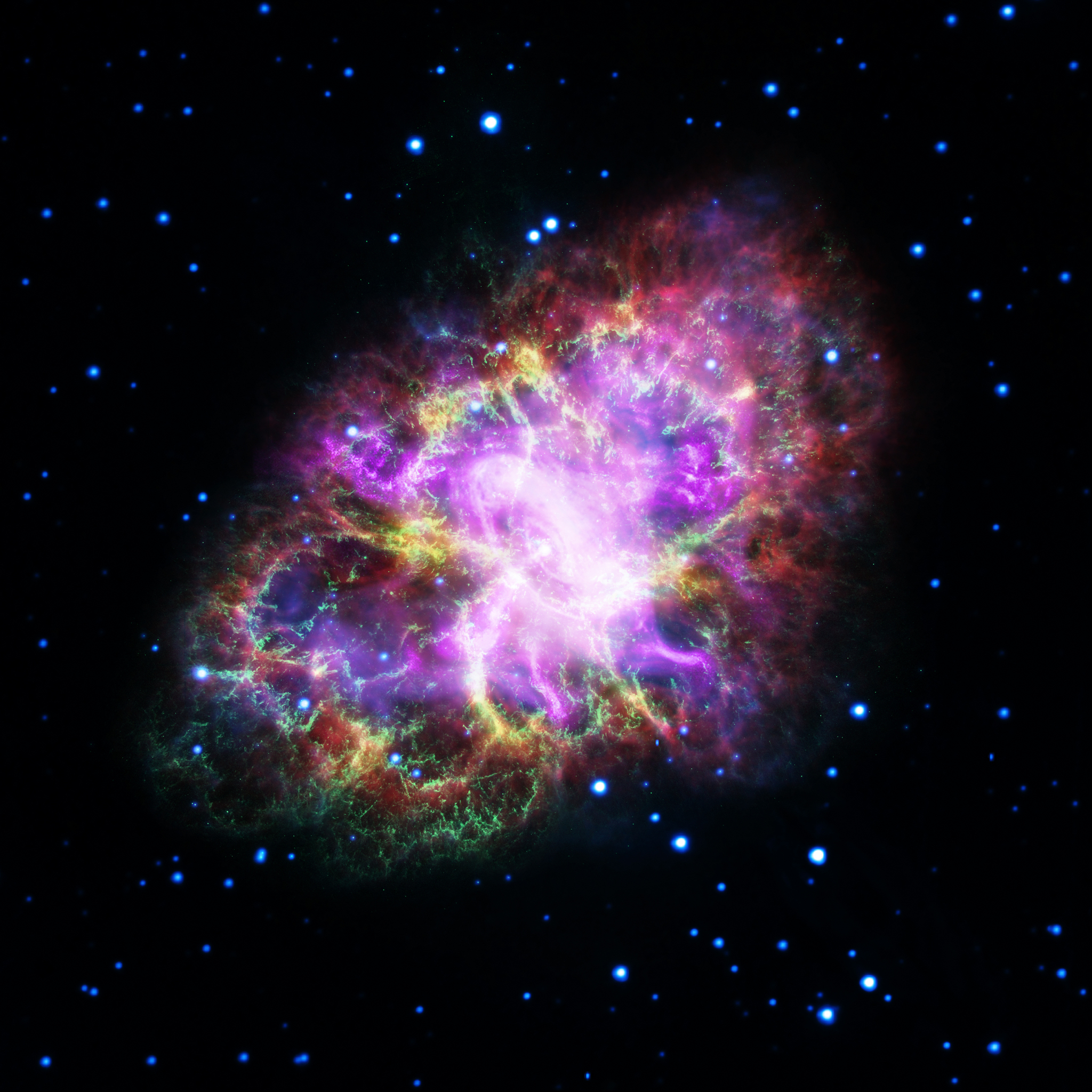
かに星雲は、シャルル・メシエの有名な「彗星ではないもの」リストの最初の天体であるM1としてカタログ化されています。実際、かに星雲は現在、西暦1054年に地球上で観測された巨大な星の死の爆発による膨張した残骸である超新星残骸であることが知られています。この勇敢な新しい画像は、電磁スペクトル全体からの画像データを可視光の波長として表示することで、かに星雲の21世紀の視点を提供します。宇宙からのチャンドラ(X線)、XMM-ニュートン(紫外線)、ハッブル(可視)、スピッツァー(赤外線)のデータは、紫、青、緑、黄色の色調で表示されます。地上からの超大型電波望遠鏡アレイの電波波長データは、赤で表示されます。現代の天文学者に知られている最もエキゾチックな天体の1つであるかにパルサーは、1秒間に30回転する中性子星で、画像の中心付近の明るい点です。宇宙のダイナモのように、この恒星核の崩壊した残骸は、かに星雲の電磁スペクトル全体にわたる放射エネルギーを供給している。かに星雲は、直径約12光年で、地球から6,500光年離れたおうし座の方向にある。
原文(English)
The Crab Nebula is cataloged as M1, the first object on Charles Messier's famous list of things which are not comets. In fact, the Crab is now known to be a supernova remnant, expanding debris from massive star's death explosion, witnessed on planet Earth in 1054 AD. This brave new image offers a 21st century view of the Crab Nebula by presenting image data from across the electromagnetic spectrum as wavelengths of visible light. From space, Chandra (X-ray) XMM-Newton (ultraviolet), Hubble (visible), and Spitzer (infrared), data are in purple, blue, green, and yellow hues. From the ground, Very Large Array radio wavelength data is in shown in red. One of the most exotic objects known to modern astronomers, the Crab Pulsar, a neutron star spinning 30 times a second, is the bright spot near picture center. Like a cosmic dynamo, this collapsed remnant of the stellar core powers the Crab's emission across the electromagnetic spectrum. Spanning about 12 light-years, the Crab Nebula is 6,500 light-years away in the constellation Taurus.
\ この感動を宇宙仲間にシェア /
宇宙をXでシェア
© NASA / APOD