
🚀 宇宙の記憶・カレンダー検索
🚀 象徴的な写真:
APOD第1回
🚀 創造の柱
🚀 スピリット火星着陸
🚀 ハッブル超深宇宙
🚀 地球へようこそ|ブルー・マーブル
🚀 エンケラドス
🚀 ベテルギウス
🚀 火星着陸
🚀 青い夕焼け
🚀 冥王星のハート
🚀 皆既日食
🚀 アースライズ再構築
🚀 ブラックホール
🚀 ウェッブ初画像
🚀 アポロ11着陸
APOD30周年(2025年6月16日)
M13:ヘルクレス座の球状星団
M13: The Great Globular Cluster in Hercules
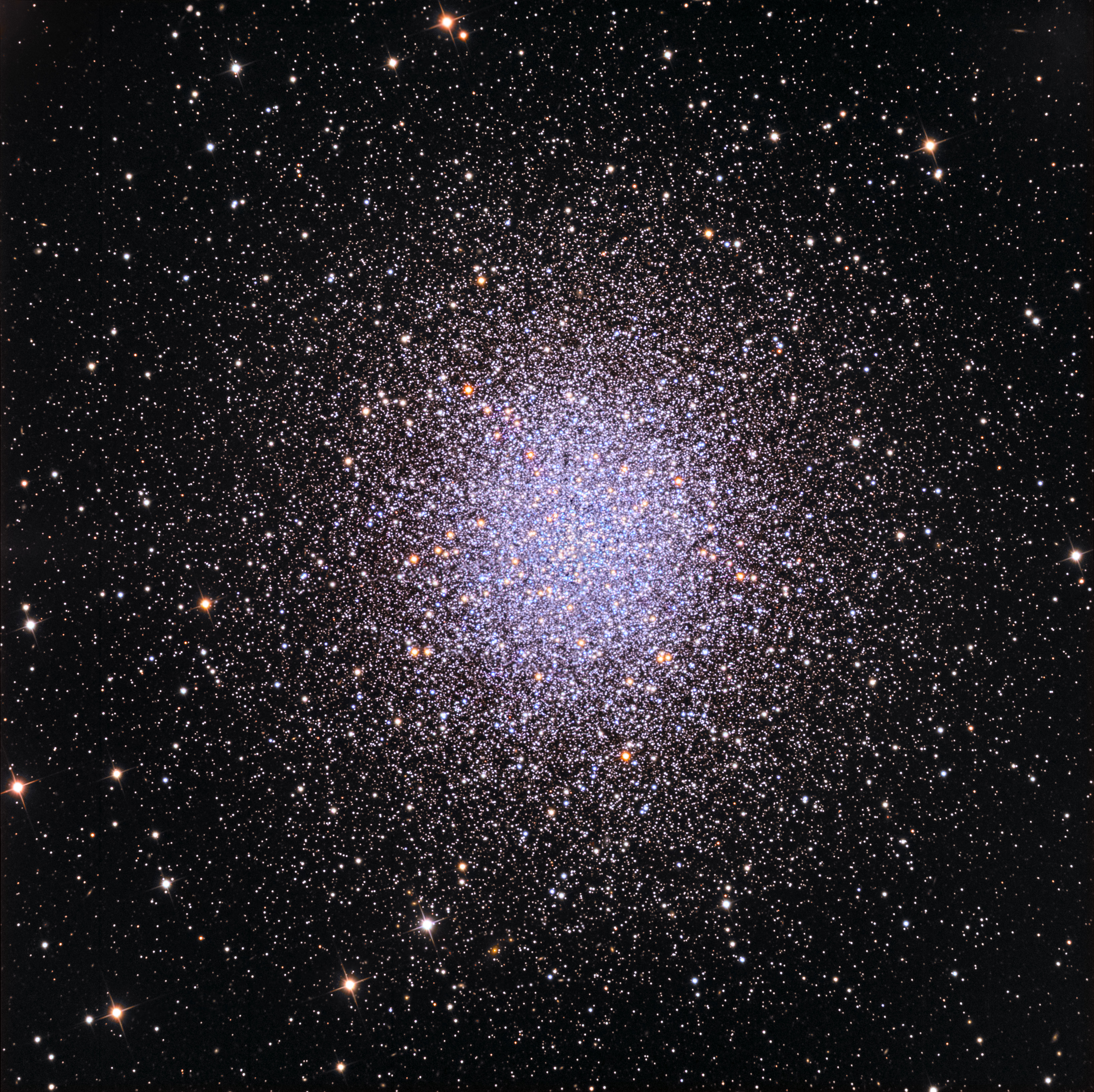
1716年、イギリスの天文学者エドモンド・ハレーは、「これは小さなパッチ星団にすぎないが、空が穏やかで月がないときには肉眼でも見える」と記した。もちろん、M13は現在、ヘルクレス座の大球状星団として、北天で最も明るい球状星団の1つとして、より広く知られている。望遠鏡で見ると、この壮大な星団には数十万個の星が集まっていることがわかる。25,000光年の距離で、星団の星は直径150光年の領域に密集している。星団の中心に近づくと、一辺がわずか3光年の立方体の中に100個以上の星が収まる。比較のために言うと、太陽に最も近い星は4光年以上離れている。この鮮明なカラー画像では、星団の密集した中心部とともに、M13の外縁部も強調されている。星団の進化した赤色と青色の巨星は、黄色と青色の色合いで示されている。
原文(English)
In 1716, English astronomer Edmond Halley noted, "This is but a little Patch, but it shews itself to the naked Eye, when the Sky is serene and the Moon absent." Of course, M13 is now less modestly recognized as the Great Globular Cluster in Hercules, one of the brightest globular star clusters in the northern sky. Telescopic views reveal the spectacular cluster's hundreds of thousands of stars. At a distance of 25,000 light-years, the cluster stars crowd into a region 150 light-years in diameter. Approaching the cluster core upwards of 100 stars could be contained in a cube just 3 light-years on a side. For comparison, the closest star to the Sun is over 4 light-years away. Along with the cluster's dense core, the outer reaches of M13 are highlighted in this sharp color image. The cluster's evolved red and blue giant stars show up in yellowish and blue tints.
\ この感動を宇宙仲間にシェア /
宇宙をXでシェア
© Adam Block / APOD