
🚀 宇宙の記憶・カレンダー検索
🚀 象徴的な写真:
APOD第1回
🚀 創造の柱
🚀 スピリット火星着陸
🚀 ハッブル超深宇宙
🚀 地球へようこそ|ブルー・マーブル
🚀 エンケラドス
🚀 ベテルギウス
🚀 火星着陸
🚀 青い夕焼け
🚀 冥王星のハート
🚀 皆既日食
🚀 アースライズ再構築
🚀 ブラックホール
🚀 ウェッブ初画像
🚀 アポロ11着陸
APOD30周年(2025年6月16日)
巨大な殻を放出する恒星 G79.29+0.46
Massive Shell-Expelling Star G79.29+0.46
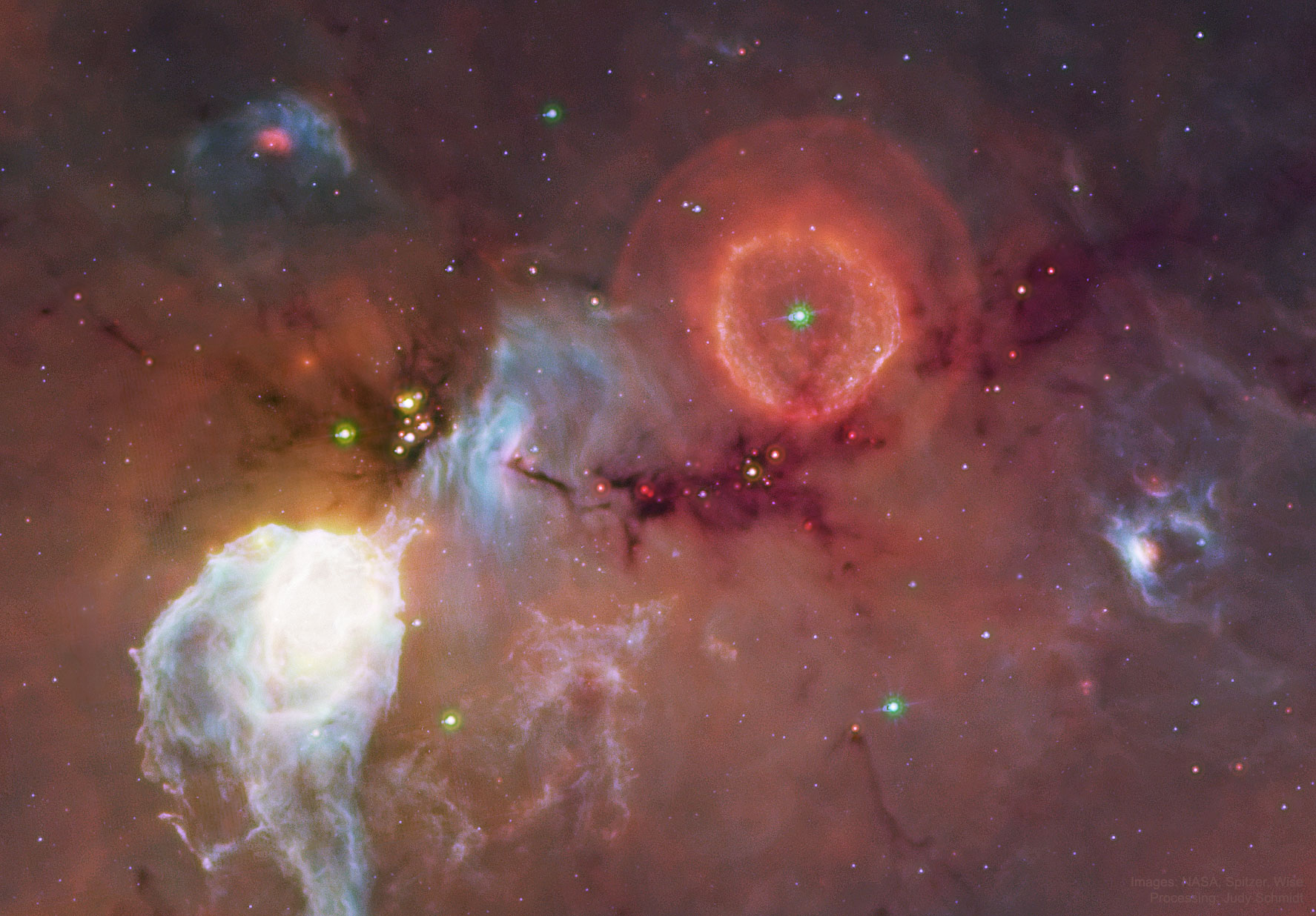
これほど不安定な星は非常に稀です。塵の雲の中に捉えられ、右上中央に見えるのは、巨大なG79.29+0.46です。これは、現在私たちの銀河系で知られている100個未満の明るい青色変光星(LBV)の1つです。LBVはガスの殻を放出し、100年かけて木星の質量さえ失うことがあります。この星自体は明るく青色ですが、塵に覆われているため可視光では見えません。しかし、NASAのスピッツァー宇宙望遠鏡とNASAの広視野赤外線探査機の画像を合成したこのカラー赤外線画像では、死にゆく星は緑色で、赤い殻に囲まれているように見えます。G79.29+0.46は、私たちの銀河系の星形成領域である白鳥座X領域に位置しています。G79.29+0.46がなぜこれほど不安定なのか、LBV段階にどれくらいの期間留まるのか、そしていつ超新星爆発を起こすのかは分かっていません。無料ダウンロード:2018年APODカレンダー
原文(English)
Stars this volatile are quite rare. Captured in the midst of dust clouds and visible to the right and above center is massive G79.29+0.46, one of less than 100 luminous blue variable stars (LBVs) currently known in our Galaxy. LBVs expel shells of gas and may lose even the mass of Jupiter over 100 years. The star, itself bright and blue, is shrouded in dust and so not seen in visible light. The dying star appears green and surrounded by red shells, though, in this mapped-color infrared picture combining images from NASA's Spitzer Space Observatory and NASA's Wide-Field Infrared Survey Explorer. G79.29+0.46 is located in the star-forming Cygnus X region of our Galaxy. Why G79.29+0.46 is so volatile, how long it will remain in the LBV phase, and when it will explode in a supernova is not known. Free Download: The 2018 APOD Calendar
\ この感動を宇宙仲間にシェア /
宇宙をXでシェア
© NASA / APOD