
🚀 宇宙の記憶・カレンダー検索
🚀 象徴的な写真:
APOD第1回
🚀 創造の柱
🚀 スピリット火星着陸
🚀 ハッブル超深宇宙
🚀 地球へようこそ|ブルー・マーブル
🚀 エンケラドス
🚀 ベテルギウス
🚀 火星着陸
🚀 青い夕焼け
🚀 冥王星のハート
🚀 皆既日食
🚀 アースライズ再構築
🚀 ブラックホール
🚀 ウェッブ初画像
🚀 アポロ11着陸
APOD30周年(2025年6月16日)
ペルセウス座銀河団から予期せぬX線が放出される
Unexpected X-Rays from Perseus Galaxy Cluster
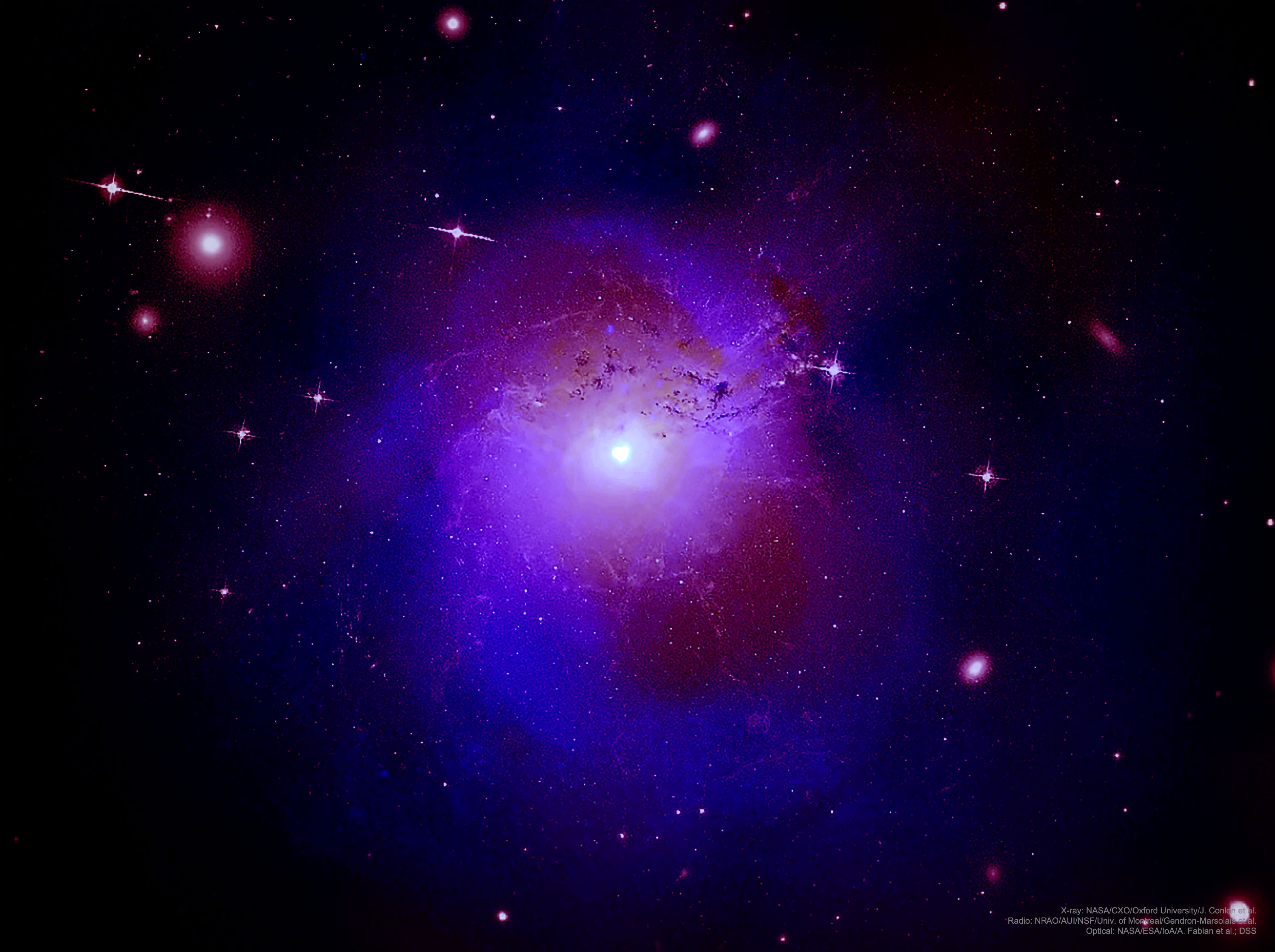
ペルセウス座銀河団がなぜ特定の色のX線で異常に輝くのか?誰も確信は持てないが、議論の的となっている仮説では、これらのX線は長年探し求められてきたダークマターの正体への手がかりであるとされている。この謎の中心にあるのは、3.5キロ電子ボルト(keV)のX線で、銀河団の中心からかなり離れた領域を観測した場合にのみ過剰に輝くように見える。一方、中心にあると思われる超大質量ブラックホールのすぐ周囲の領域では、実際には3.5keVのX線が不足している。非常に議論を呼んでいる解決策の一つは、これまで観測されたことのない何か、すなわち蛍光ダークマター(FDM)が存在する可能性があるというものだ。この形態の粒子ダークマターは、3.5keVのX線を吸収できる可能性がある。もしFDMが機能しているとすれば、吸収後、銀河団全体からこれらのX線を放出し、輝線を作り出す可能性がある。しかし、ブラックホールを取り囲む中心領域の手前に重ねて見ると、FDMの吸収はより顕著になり、吸収線が形成されます。図は、ペルセウス座銀河団の合成画像で、可視光と電波は赤色、地球周回軌道上のチャンドラX線観測衛星からのX線は青色で示されています。無料のAPOD講演会:1月5日ニューヨーク、1月9日ワシントンD.C.
原文(English)
Why does the Perseus galaxy cluster shine so strangely in one specific color of X-rays? No one is sure, but a much-debated hypothesis holds that these X-rays are a clue to the long-sought identity of dark matter. At the center of this mystery is a 3.5 Kilo-electronvolt (KeV) X-ray color that appears to glow excessively only when regions well outside the cluster center are observed, whereas the area directly surrounding a likely central supermassive black hole is actually deficient in 3.5 keV X-rays. One proposed resolution -- quite controversial -- is that something never seen before might be present: fluorescent dark matter (FDM). This form of particle dark matter might be able to absorb 3.5 keV X-radiation. If operating, FDM, after absorption, might later emit these X-rays from all over the cluster, creating an emission line. However, when seen superposed in front of the central region surrounding the black hole, FDM's absorption would be more prominent, creating an absorption line. Pictured, a composite image of the Perseus galaxy cluster shows visible and radio light in red, and X-ray light from the Earth-orbiting Chandra Observatory in blue. Free APOD Lectures: January 5 in NYC & January 9 in DC
\ この感動を宇宙仲間にシェア /
宇宙をXでシェア
© NASA / APOD