
🚀 宇宙の記憶・カレンダー検索
🚀 象徴的な写真:
APOD第1回
🚀 創造の柱
🚀 スピリット火星着陸
🚀 ハッブル超深宇宙
🚀 地球へようこそ|ブルー・マーブル
🚀 エンケラドス
🚀 ベテルギウス
🚀 火星着陸
🚀 青い夕焼け
🚀 冥王星のハート
🚀 皆既日食
🚀 アースライズ再構築
🚀 ブラックホール
🚀 ウェッブ初画像
🚀 アポロ11着陸
APOD30周年(2025年6月16日)
ガイアの天の川
Gaia's Milky Way
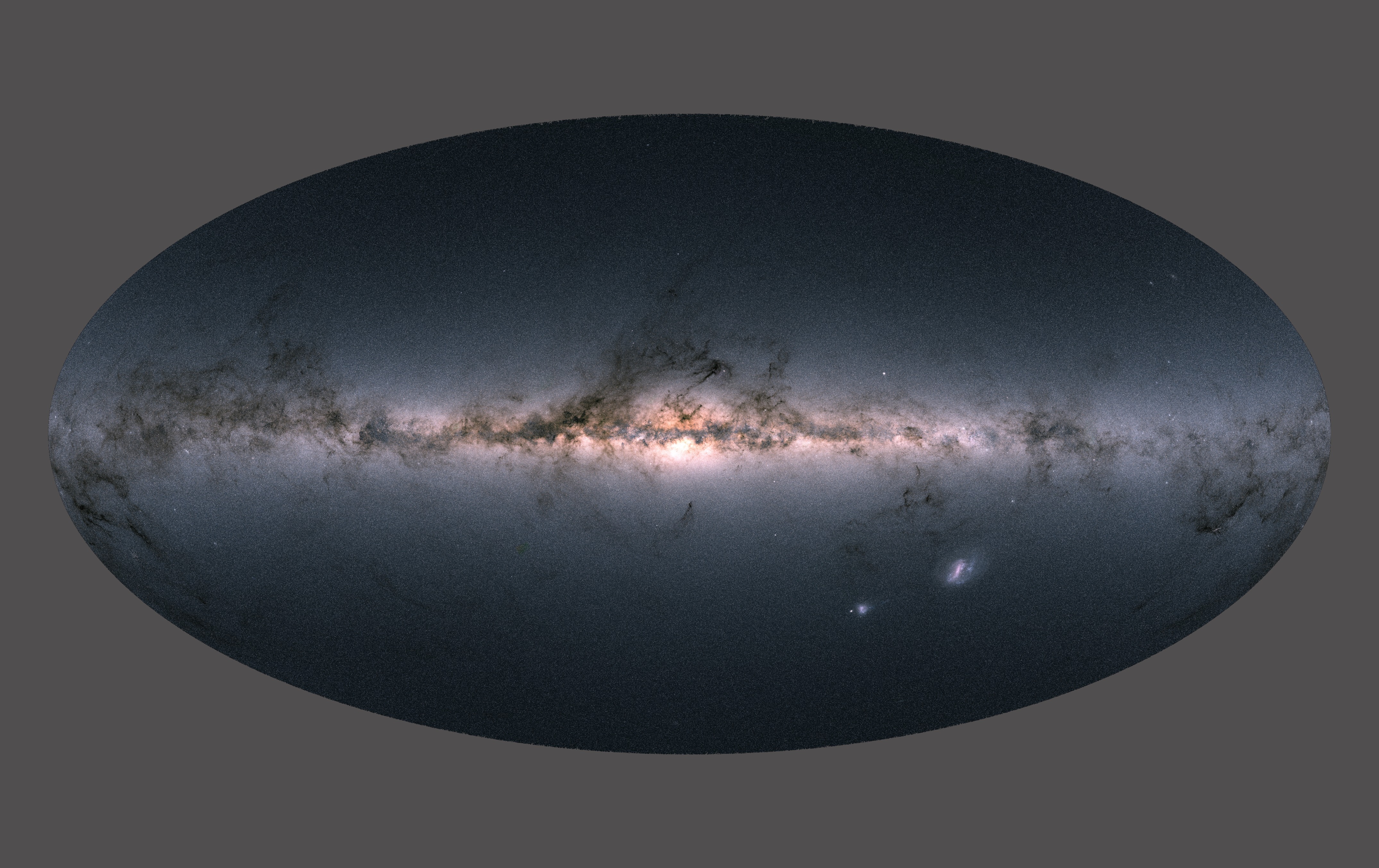
この天の川銀河とその近傍銀河の壮大な全天図は、写真ではありません。これは、約17億個の星の個々の測定値に基づいて作成された地図です。この地図を作成するために使用された天文学的に豊富なデータセットは、全天をスキャンするガイア衛星の第2次データリリースであり、13億個の星の位置、明るさ、色、視差距離の驚くほど正確な測定値が含まれています。もちろん、これは天の川銀河の全星数の約1パーセントに過ぎません。私たちの銀河の平面が依然としてこの図を支配しています。天の川銀河のほとんどの星が存在するこの平面は、ガイアの恒星データマップの中心を横切って広がっています。銀河面に沿った空隙や裂け目は、星の光を遮る星間塵の雲に対応しています。右下には、天の川銀河のすぐ外側にある隣接銀河である大マゼラン雲と小マゼラン雲の星々が見えます。
原文(English)
This grand allsky view of our Milky Way and nearby galaxies is not a photograph. It's a map based on individual measurements for nearly 1.7 billion stars. The astronomically rich data set used to create it, the sky-scanning Gaia satellite's second data release, includes remarkably precise determinations of position, brightness, colour, and parallax distance for 1.3 billion stars. Of course, that's about 1 percent of the total number of stars in the Milky Way. The flat plane of our galaxy still dominates the view. Home to most Milky Way stars it stretches across the center of Gaia's stellar data map. Voids and rifts along the galactic plane correspond to starlight-obscuring interstellar dust clouds. At lower right are stars of the Large and Small Magellanic Clouds, neighboring galaxies that lie just beyond the Milky Way.
\ この感動を宇宙仲間にシェア /
宇宙をXでシェア
© ESA,
Gaia,
DPAC / APOD