
🚀 宇宙の記憶・カレンダー検索
🚀 象徴的な写真:
APOD第1回
🚀 創造の柱
🚀 スピリット火星着陸
🚀 ハッブル超深宇宙
🚀 地球へようこそ|ブルー・マーブル
🚀 エンケラドス
🚀 ベテルギウス
🚀 火星着陸
🚀 青い夕焼け
🚀 冥王星のハート
🚀 皆既日食
🚀 アースライズ再構築
🚀 ブラックホール
🚀 ウェッブ初画像
🚀 アポロ11着陸
APOD30周年(2025年6月16日)
海と空の古代人
Ancients of Sea and Sky
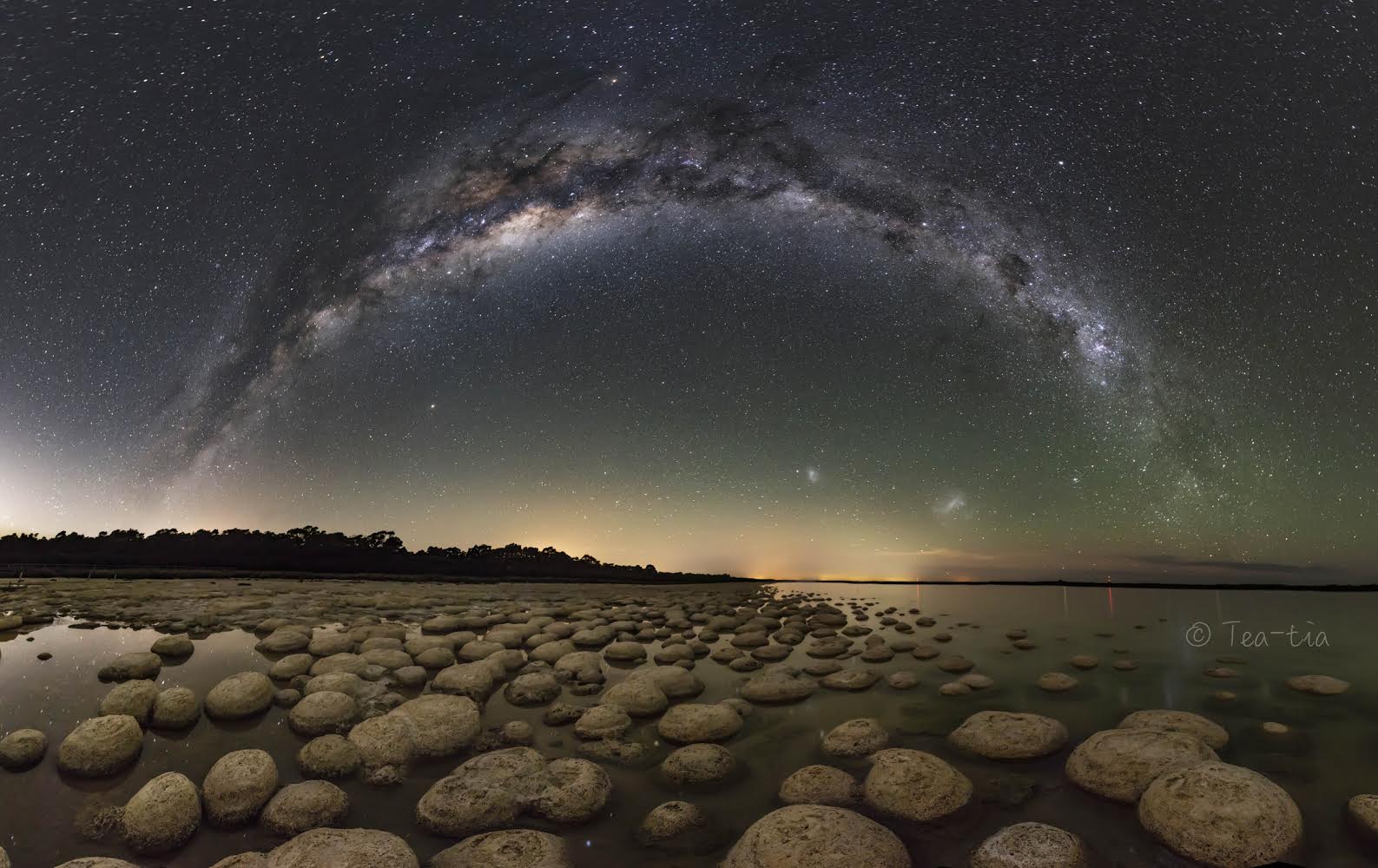
それらは丸い岩のように見えるかもしれませんが、生きているのです。しかも、それらは最も古い生命形態の一つであるストロマトライトの現代版です。化石によると、ストロマトライトは約37億年前に地球上に出現しました。これは、現代の夜空に見られる多くの星が形成されるよりも前のことです。西オーストラリアで撮影されたこの写真では、天の川銀河の古代の中心弧だけがそれよりも早く形成されました。天の川銀河の伴銀河であり、この写真で天の川銀河の中心弧の下に見えるマゼラン雲でさえ、ストロマトライトが地球上に初めて出現した当時は現在の形では存在していませんでした。ストロマトライトは、光に向かってゆっくりと移動できる数十億の微生物からなるバイオフィルムが蓄積したものです。古代のストロマトライトは、この光を利用して酸素を空気中に放出することで、地球を他の生命体、そして最終的には人間にとって住みやすい環境にするのに貢献しました。Almost Hyperspace: Random APOD Generator
原文(English)
They may look like round rocks, but they're alive. Moreover, they are modern versions of one of the oldest known forms of life: stromatolites. Fossils indicate that stromatolites appeared on Earth about 3.7 billion years ago -- even before many of the familiar stars in the modern night sky were formed. In the featured image taken in Western Australia, only the ancient central arch of our Milky Way Galaxy formed earlier. Even the Magellanic Clouds, satellite galaxies of our Milky Way and visible in the featured image below the Milky Way's arch, didn't exist in their current form when stromatolites first grew on Earth. Stromatolites are accreting biofilms of billions of microorganisms that can slowly move toward light. Using this light to liberate oxygen into the air, ancient stromatolites helped make Earth hospitable to other life forms including, eventually, humans. Almost Hyperspace: Random APOD Generator
\ この感動を宇宙仲間にシェア /
宇宙をXでシェア
© Jingyi Zhang / APOD