
🚀 宇宙の記憶・カレンダー検索
🚀 象徴的な写真:
APOD第1回
🚀 創造の柱
🚀 スピリット火星着陸
🚀 ハッブル超深宇宙
🚀 地球へようこそ|ブルー・マーブル
🚀 エンケラドス
🚀 ベテルギウス
🚀 火星着陸
🚀 青い夕焼け
🚀 冥王星のハート
🚀 皆既日食
🚀 アースライズ再構築
🚀 ブラックホール
🚀 ウェッブ初画像
🚀 アポロ11着陸
APOD30周年(2025年6月16日)
はやぶさ2号が小惑星リュウグウに接近
Hayabusa2 Approaches Asteroid Ryugu
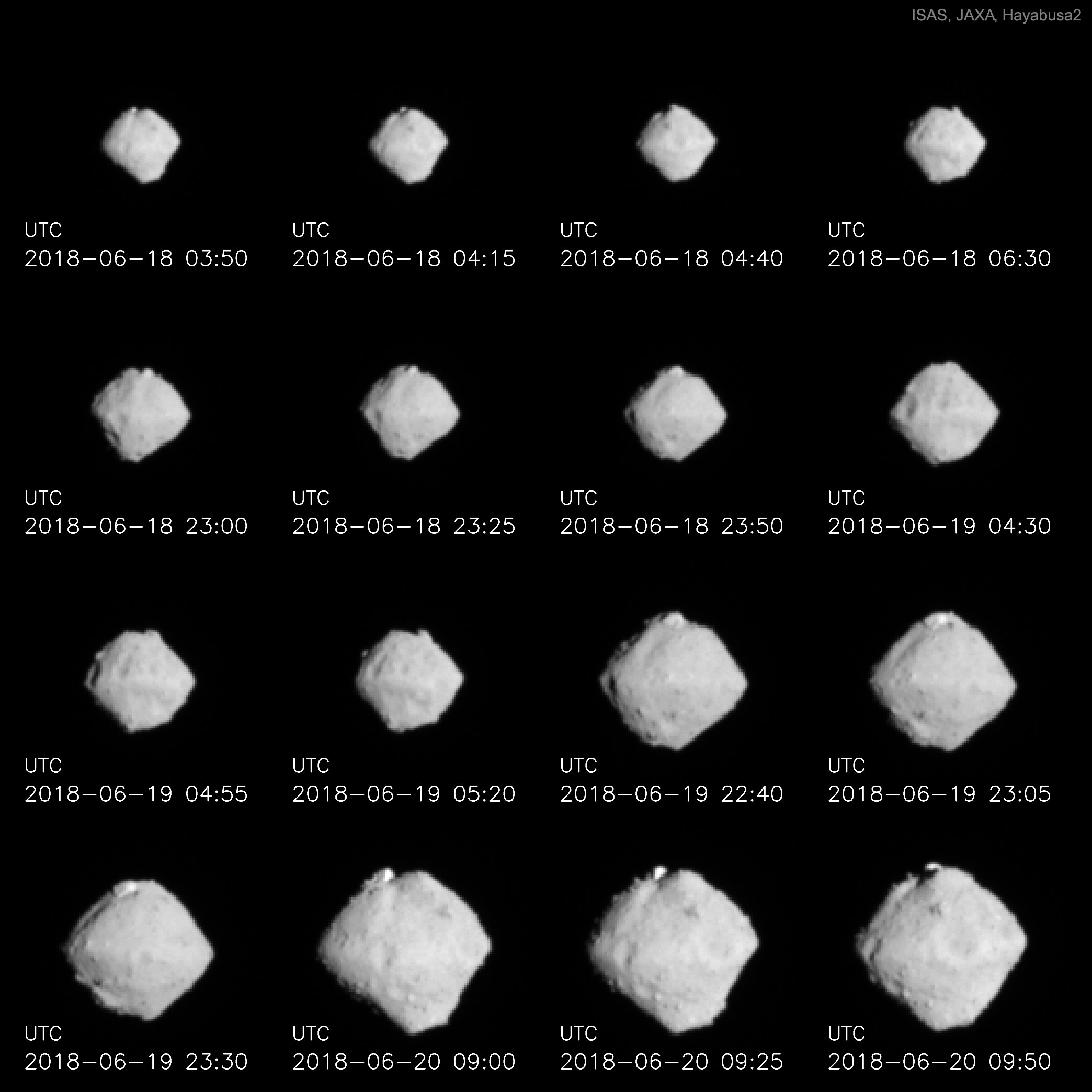
まるで巨大な宇宙のダイヤモンドのようだが、クレーターがある。これは小惑星162173 リュウグウ(龍の城)で、日本のロボット探査機「はやぶさ2」が現在この地球近傍小惑星に到着している。野心的な「はやぶさ2」には、分離可能な探査機が多数搭載されており、その中には2機の衝突機、4機の小型近接ホバリング機、3機の小型表面ホッパー、そしてリュウグウの表面に着陸して調査し移動する移動式小惑星表面探査機(MASCOT)が含まれている。これらの探査機のほとんどにはカメラが搭載されている。さらに、「はやぶさ2」自体が表面サンプルを採取し、2020年末頃に詳細な分析のために地球に持ち帰る予定だ。これまで小惑星リュウグウについて知られていたのは、その軌道、直径約1キロメートルであること、そして珍しい色を反射する暗い表面を持つことだけだった。リュウグウを研究することで、人類はリュウグウの表面や内部構造だけでなく、太陽系初期に生命の発生に必要な物質がどのようなものであったかについても知ることができるだろう。写真に写っている一連の接近画像には、大きな岩塊やクレーターを示唆する特徴が写っている。
原文(English)
It looks like a big space diamond -- but with craters. It's 162173 Ryugu (Dragon's Castle), and Japan's robotic Hayabusa2 mission is now arriving at this near-Earth asteroid. Ambitious Hayabusa2 is carrying an armada of separable probes, including two impactors, four small close-proximity hoverers, three small surface hoppers, and the Mobile Asteroid Surface Scout (MASCOT) which will land, study, and move around on Ryugu's surface. Most of these are equipped with cameras. Moreover, Hayabusa2 itself is scheduled to collect surface samples and return these samples to Earth for a detailed analysis near the end of 2020. Previously, what was known about asteroid Ryugu was its orbit, that it spans about one kilometer, and that it has a dark surface that reflects unusual colors. Studying Ryugu could tell humanity not only about Ryugu's surface and interior, but about what materials were available in the early Solar System for the development of life. Pictured, a series of approach images shows features suggestive of large boulders and craters.
\ この感動を宇宙仲間にシェア /
宇宙をXでシェア
© ISAS,
JAXA,
Hayabusa2 Team / APOD