
🚀 宇宙の記憶・カレンダー検索
🚀 象徴的な写真:
APOD第1回
🚀 創造の柱
🚀 スピリット火星着陸
🚀 ハッブル超深宇宙
🚀 地球へようこそ|ブルー・マーブル
🚀 エンケラドス
🚀 ベテルギウス
🚀 火星着陸
🚀 青い夕焼け
🚀 冥王星のハート
🚀 皆既日食
🚀 アースライズ再構築
🚀 ブラックホール
🚀 ウェッブ初画像
🚀 アポロ11着陸
APOD30周年(2025年6月16日)
西のベールに沿って
Along the Western Veil
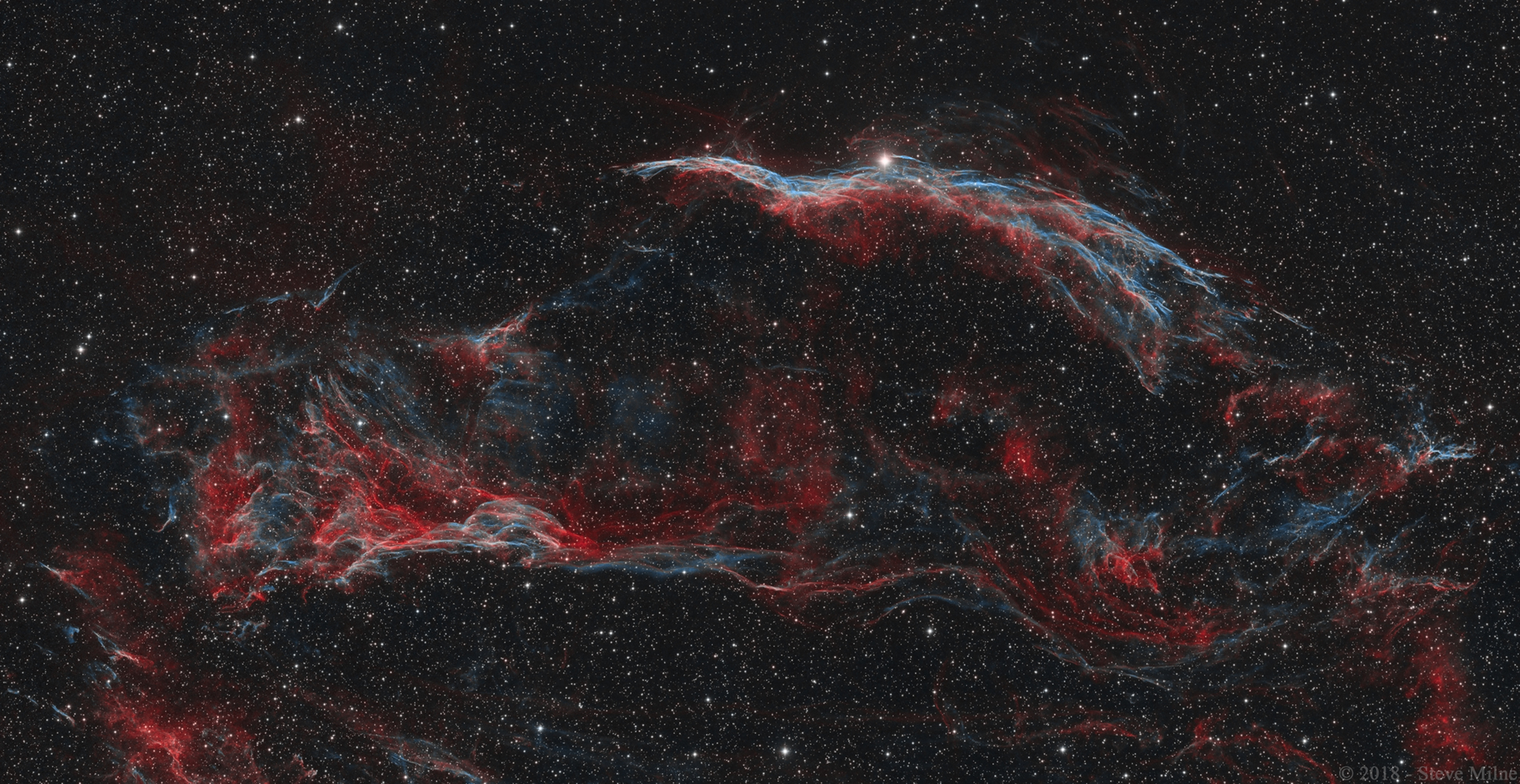
繊細な外観を持つこれらの衝撃を受けて輝くガスのフィラメントは、地球の空を横切って白鳥座の方向へと広がっています。これらはベール星雲の西側を形成しています。ベール星雲自体は巨大な超新星残骸であり、巨大な星の死の爆発によって生まれた膨張するガス雲です。最初の超新星爆発からの光は、おそらく5000年以上前に地球に到達しました。この大災害で噴出した星間衝撃波は、宇宙空間を突き進み、星間物質を掃き集めて励起します。輝くフィラメントは、ほぼ真横から見たシートの長い波紋のようで、原子状水素(赤)と酸素(青緑)のガスに驚くほどよく分離されています。白鳥座ループとしても知られるベール星雲は、現在では約3度、つまり満月の直径の約6倍の広がりを持っています。推定距離1,500光年で換算すると70光年以上になるが、この望遠鏡で撮影された西側の2枚のパネルからなるモザイク画像は、その距離の約半分を捉えている。西側のベール銀河の明るい部分は、魔女のほうき星雲(NGC 6960)や、左下にあるピッカリングの三角形星雲(NGC 6979)など、別々の星雲として認識されている。
原文(English)
Delicate in appearance, these filaments of shocked, glowing gas, are draped across planet Earth's sky toward the constellation of Cygnus. They form the western part of the Veil Nebula. The Veil Nebula itself is a large supernova remnant, an expanding cloud born of the death explosion of a massive star. Light from the original supernova explosion likely reached Earth over 5,000 years ago. Blasted out in the cataclysmic event, the interstellar shock wave plows through space sweeping up and exciting interstellar material. The glowing filaments are really more like long ripples in a sheet seen almost edge on, remarkably well separated into atomic hydrogen (red) and oxygen (blue-green) gas. Also known as the Cygnus Loop, the Veil Nebula now spans nearly 3 degrees or about 6 times the diameter of the full Moon. While that translates to over 70 light-years at its estimated distance of 1,500 light-years, this telescopic two panel mosaic image of the western portion spans about half that distance. Brighter parts of the western Veil are recognized as separate nebulae, including The Witch's Broom (NGC 6960) along the top of this view and Pickering's Triangle (NGC 6979) below and left.
\ この感動を宇宙仲間にシェア /
宇宙をXでシェア
© Steve Milne / APOD