
🚀 宇宙の記憶・カレンダー検索
🚀 象徴的な写真:
APOD第1回
🚀 創造の柱
🚀 スピリット火星着陸
🚀 ハッブル超深宇宙
🚀 地球へようこそ|ブルー・マーブル
🚀 エンケラドス
🚀 ベテルギウス
🚀 火星着陸
🚀 青い夕焼け
🚀 冥王星のハート
🚀 皆既日食
🚀 アースライズ再構築
🚀 ブラックホール
🚀 ウェッブ初画像
🚀 アポロ11着陸
APOD30周年(2025年6月16日)
葉巻銀河の中心磁場
The Central Magnetic Field of the Cigar Galaxy
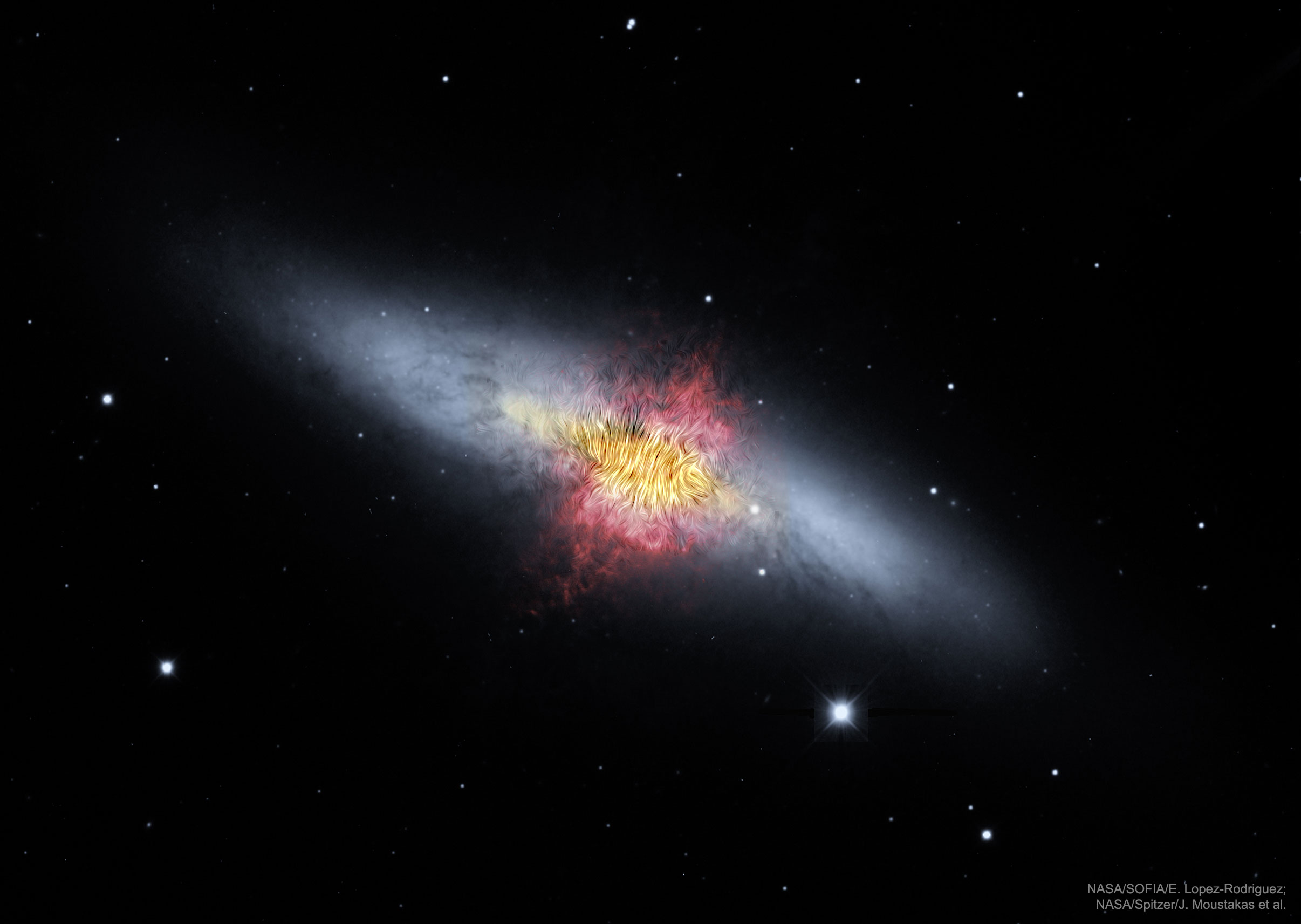
銀河は巨大な磁石なのでしょうか?はい、しかし銀河内の磁場は一般に地球表面よりもはるかに弱く、より複雑で測定が困難です。しかし最近、航空機搭載型(747)SOFIA天文台に搭載されたHAWC+機器は、局所的な磁場に合わせて回転する細長い塵の粒子から放射される偏光赤外線を観測することで、遠方の磁場の詳細を明らかにすることに成功しました。葉巻銀河M82のHAWC+観測では、中心磁場がディスクに垂直で、強い超銀河風に平行であることが示されました。この観測は、M82の中心磁場が、その風が中心のスターバースト領域から何百万もの星の質量を運び出すのを助けているという仮説を補強するものです。注目の画像は、キットピーク国立天文台の可視光(灰色)と水素ガス(赤)の画像に磁力線を重ね合わせ、さらにSOFIAとスピッツァー宇宙望遠鏡の赤外線画像(黄色)を組み合わせて表示しています。葉巻銀河は約 1,200 万光年離れており、双眼鏡を使えばおおぐま座の方向に見ることができます。
原文(English)
Are galaxies giant magnets? Yes, but the magnetic fields in galaxies are typically much weaker than on Earth's surface, as well as more complex and harder to measure. Recently, though, the HAWC+ instrument onboard the airborne (747) SOFIA observatory has been successful in detailing distant magnetic fields by observing the polarized infrared light emitted by elongated dust grains rotating in alignment with the local magnetic field. HAWC+ observations of M82, the Cigar galaxy, show that the central magnetic field is perpendicular to the disk and parallel to the strong supergalactic wind. This observation bolsters the hypothesis that M82's central magnetic field helps its wind transport the mass of millions of stars out from the central star-burst region. The featured image shows magnetic field lines superposed on top of an optical light (gray) and hydrogen gas (red) image from Kitt Peak National Observatory, further combined with infrared images (yellow) from SOFIA and the Spitzer Space Telescope. The Cigar Galaxy is about 12 million light years distant and visible with binoculars towards the constellation of the Great Bear.
\ この感動を宇宙仲間にシェア /
宇宙をXでシェア
© NASA / APOD