
🚀 宇宙の記憶・カレンダー検索
🚀 象徴的な写真:
APOD第1回
🚀 創造の柱
🚀 スピリット火星着陸
🚀 ハッブル超深宇宙
🚀 地球へようこそ|ブルー・マーブル
🚀 エンケラドス
🚀 ベテルギウス
🚀 火星着陸
🚀 青い夕焼け
🚀 冥王星のハート
🚀 皆既日食
🚀 アースライズ再構築
🚀 ブラックホール
🚀 ウェッブ初画像
🚀 アポロ11着陸
APOD30周年(2025年6月16日)
MeerKATによる電波で見る銀河中心
The Galactic Center in Radio from MeerKAT
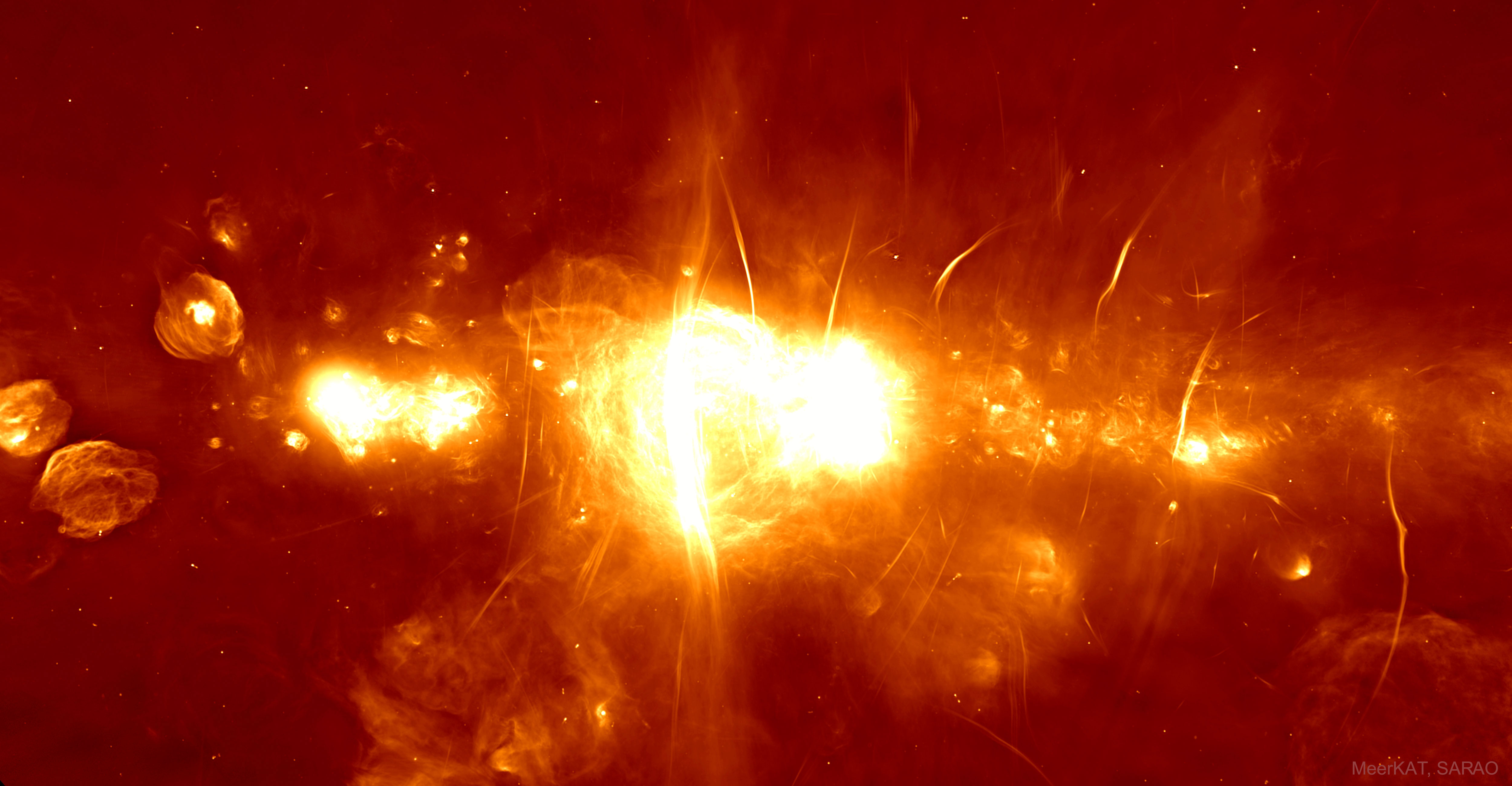
私たちの銀河の中心では何が起こっているのでしょうか?可視光は星間塵によって遮られるため、光学望遠鏡ではそれを知ることは困難です。しかし、電波などの他の波長帯では、銀河の中心を画像化することができ、非常に興味深く活発な場所であることが分かります。掲載されている画像は、南アフリカで完成したばかりの64基の電波望遠鏡からなるMeerKATアレイの最初の画像です。月の視角(2度)の4倍に及ぶこの画像は、驚くほど広大で、深く、詳細です。銀河の中心はいて座の方向にあるため、Sgrという接頭辞を持つ多くの既知の天体を含め、多くの天体が鮮明に詳細に示されています。私たちの銀河の中心には、天の川銀河の中心にある超大質量ブラックホールを擁するSgr Aがあり、この画像では中心のすぐ右側に位置しています。Sgr Aのすぐ左側にあるアークや、多数のフィラメント状の構造など、画像内の他の天体については、まだ十分に解明されていません。 MeerKATの目標には、はるかに若い宇宙で放出された中性水素からの電波放射や、短時間ながら遠方で発生する電波バーストの探索が含まれる。
原文(English)
What's happening at the center of our galaxy? It's hard to tell with optical telescopes since visible light is blocked by intervening interstellar dust. In other bands of light, though, such as radio, the galactic center can be imaged and shows itself to be quite an interesting and active place. The featured picture shows the inaugural image of the MeerKAT array of 64 radio dishes just completed in South Africa. Spanning four times the angular size of the Moon (2 degrees), the image is impressively vast, deep, and detailed. Many known sources are shown in clear detail, including many with a prefix of Sgr, since the Galactic Center is in the direction of the constellation Sagittarius. In our Galaxy's Center lies Sgr A, found here just to the right of the image center, which houses the Milky Way's central supermassive black hole. Other sources in the image are not as well understood, including the Arc, just to the left of Sgr A, and numerous filamentary threads. Goals for MeerKAT include searching for radio emission from neutral hydrogen emitted in a much younger universe and brief but distant radio flashes.
\ この感動を宇宙仲間にシェア /
宇宙をXでシェア
© NASA / APOD