
🚀 宇宙の記憶・カレンダー検索
🚀 象徴的な写真:
APOD第1回
🚀 創造の柱
🚀 スピリット火星着陸
🚀 ハッブル超深宇宙
🚀 地球へようこそ|ブルー・マーブル
🚀 エンケラドス
🚀 ベテルギウス
🚀 火星着陸
🚀 青い夕焼け
🚀 冥王星のハート
🚀 皆既日食
🚀 アースライズ再構築
🚀 ブラックホール
🚀 ウェッブ初画像
🚀 アポロ11着陸
APOD30周年(2025年6月16日)
ほぼ見えるオリオン座
The Orion You Can Almost See
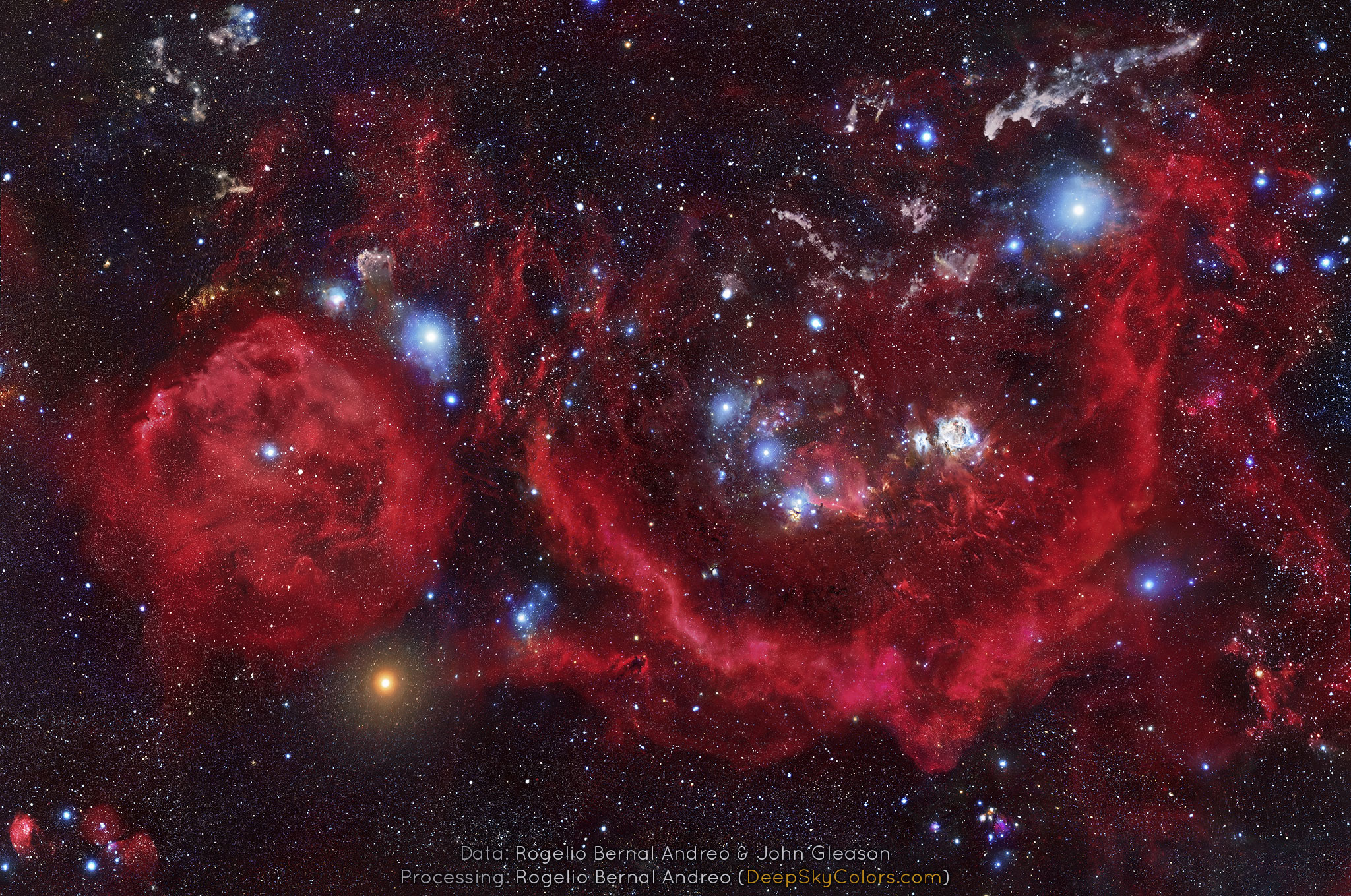
この星座をご存知ですか? 空で最もよく知られた星の集まりの一つですが、これはあなたが見るよりもずっと完全なオリオン座です。長時間露光のデジタルカメラ撮影と後処理によって初めて明らかになるオリオン座です。ここでは、左下で最も明るい星である低温の赤色巨星ベテルギウスが強いオレンジ色を帯びています。オリオン座には高温の青色星が数多くあり、右上には超巨星リゲルがベテルギウスと釣り合い、左上にはベラトリックスがいます。オリオン座の三つ星には、約1500光年離れた3つの星が並んでおり、これらは星座のよく研究されている星間雲から生まれたものです。オリオン座の三つ星の右側には、明るくぼやけた領域があり、これも見覚えがあるかもしれません。それはオリオン星雲として知られる星形成領域です。最後に、肉眼でかろうじて見える程度ですが、非常に印象的なのがバーナード・ループです。これはオリオン座の三つ星と星雲を取り囲む巨大なガス状輝線星雲で、100年以上前にオリオン座の先駆的な写真家E・E・バーナードによって発見されました。APODポッドキャスト:iTunesとYouTubeで視聴可能です。
原文(English)
Do you recognize this constellation? Although it is one of the most recognizable star groupings on the sky, this is a more full Orion than you can see -- an Orion only revealed with long exposure digital camera imaging and post-processing. Here the cool red giant Betelgeuse takes on a strong orange tint as the brightest star at the lower left. Orion's hot blue stars are numerous, with supergiant Rigel balancing Betelgeuse on the upper right, and Bellatrix at the upper left. Lined up in Orion's belt are three stars all about 1,500 light-years away, born from the constellation's well-studied interstellar clouds. To the right of Orion's belt is a bright but fuzzy patch that might also look familiar -- the stellar nursery known as Orion's Nebula. Finally, just barely visible to the unaided eye but quite striking here is Barnard's Loop -- a huge gaseous emission nebula surrounding Orion's Belt and Nebula discovered over 100 years ago by the pioneering Orion photographer E. E. Barnard. APOD Podcasts: Available on iTunes and YouTube.
\ この感動を宇宙仲間にシェア /
宇宙をXでシェア
© John Gleason
&
Rogelio
Bernal Andreo / APOD