
🚀 宇宙の記憶・カレンダー検索
🚀 象徴的な写真:
APOD第1回
🚀 創造の柱
🚀 スピリット火星着陸
🚀 ハッブル超深宇宙
🚀 地球へようこそ|ブルー・マーブル
🚀 エンケラドス
🚀 ベテルギウス
🚀 火星着陸
🚀 青い夕焼け
🚀 冥王星のハート
🚀 皆既日食
🚀 アースライズ再構築
🚀 ブラックホール
🚀 ウェッブ初画像
🚀 アポロ11着陸
APOD30周年(2025年6月16日)
遠くの光を破る
Breaking Distant Light
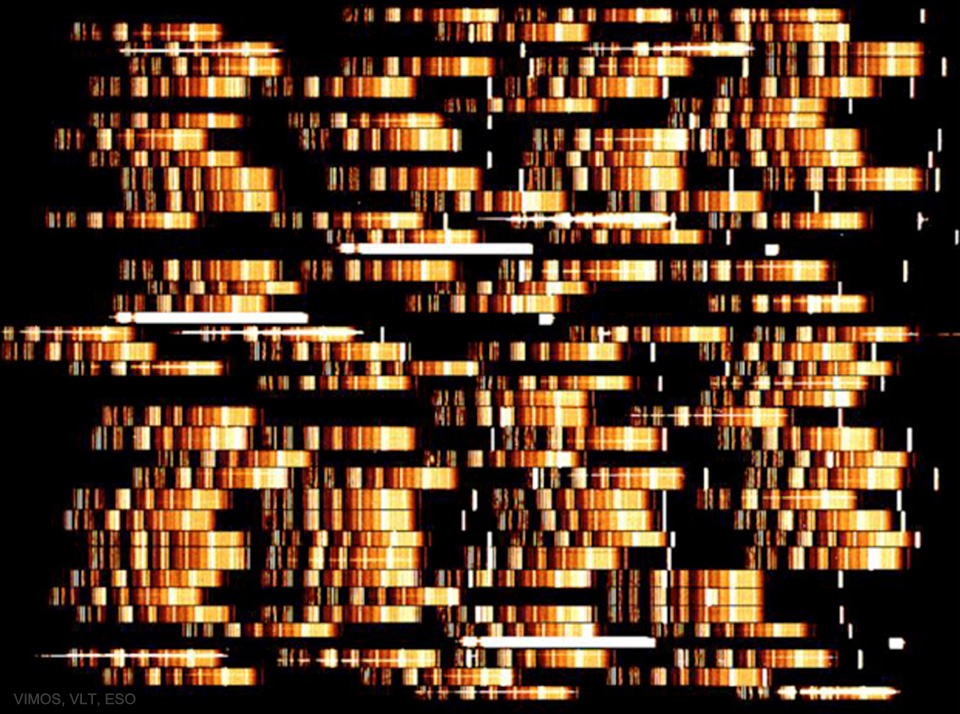
遠い宇宙では、時間がゆっくりと流れているように見えます。時間の遅れによって光はスペクトルの赤い端にシフト(赤方偏移)するため、天文学者は宇宙論的な時間の遅れを利用して、宇宙の広大な距離を測定することができます。この画像では、遠方の銀河からの光が構成色(スペクトル)に分解されており、天文学者は既知のスペクトル線の宇宙論的赤方偏移を測定できます。この画像の斬新さは、数百の銀河までの距離を1枚のフレームから測定できることです。このフレームは、チリの超大型望遠鏡(VLT)アレイで稼働している可視多天体分光器(VIMOS)によって撮影されたものです。遠方の天体の空間分布を分析することで、初期宇宙で星や銀河がいつ、どのように形成され、集まり、進化してきたのかについての洞察が得られます。
原文(English)
In the distant universe, time appears to run slowly. Since time-dilated light appears shifted toward the red end of the spectrum (redshifted), astronomers are able to use cosmological time-slowing to help measure vast distances in the universe. Featured, the light from distant galaxies has been broken up into its constituent colors (spectra), allowing astronomers to measure the cosmological redshift of known spectral lines. The novelty of the featured image is that the distance to hundreds of galaxies can be measured from a single frame, in this case one taken by the Visible MultiObject Spectrograph (VIMOS) operating at the Very Large Telescope (VLT) array in Chile. Analyzing the space distribution of distant objects will allow insight into when and how stars and galaxies formed, clustered, and evolved in the early universe.
\ この感動を宇宙仲間にシェア /
宇宙をXでシェア
© NASA / APOD