
🚀 宇宙の記憶・カレンダー検索
🚀 象徴的な写真:
APOD第1回
🚀 創造の柱
🚀 スピリット火星着陸
🚀 ハッブル超深宇宙
🚀 地球へようこそ|ブルー・マーブル
🚀 エンケラドス
🚀 ベテルギウス
🚀 火星着陸
🚀 青い夕焼け
🚀 冥王星のハート
🚀 皆既日食
🚀 アースライズ再構築
🚀 ブラックホール
🚀 ウェッブ初画像
🚀 アポロ11着陸
APOD30周年(2025年6月16日)
国際宇宙ステーションが火星を通過
ISS Transits Mars
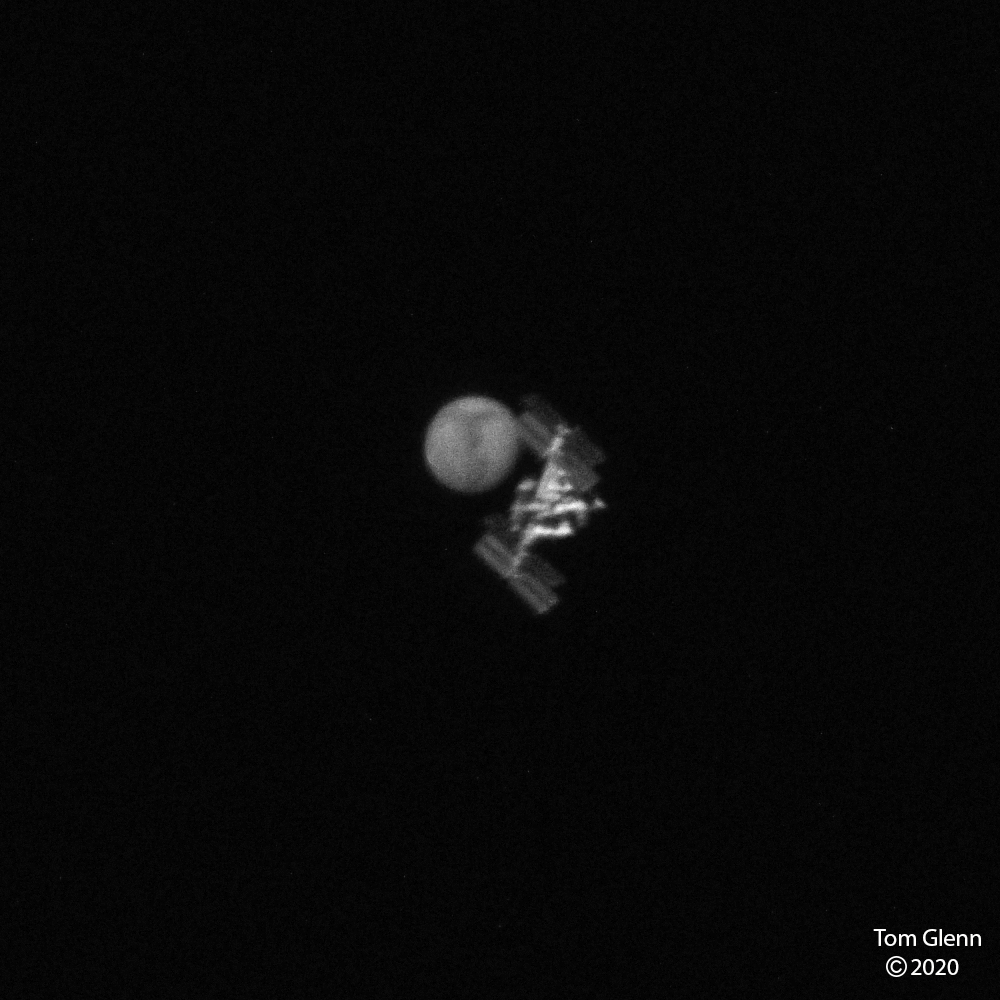
はい、でも宇宙ステーションがこんな風に動くのを見たことがありますか?いつ、どこを見ればよいかがわかっていれば、明るい国際宇宙ステーション(ISS)が夜空を漂うのを見るのは魅力的な光景ですが、それほど珍しいことではありません。半度の月や太陽の前をISSが横切る画像は確かに存在しますが、撮影には計画、タイミング、そして忍耐が必要なので、なかなか珍しいものです。しかし、小さな火星の前をISSが横切る様子を捉えるのは、また別の次元です。オンラインソフトウェアを使用して、この写真家は、この珍しい通過が、わずか90メートルにわたる近くの非常に狭い陸地に沿って一瞬だけ見えることを知りました。この範囲内で、通過するISSの画像の地上換算速度は、秒速7.4キロメートルと速いでしょう。しかし、標準的なカメラ、小型望遠鏡、機材を設置する正確な場所、望遠鏡を向ける正確な方向、そしてミリ秒未満のタイミングで、彼はビデオを作成し、そこから0.00035秒の露出部分を抽出しました。撮影された画像では、火星と国際宇宙ステーション(ISS)の両方の詳細が同時に確認できます。注目の画像は、先週月曜日の現地時間5時15分47秒に、米国カリフォルニア州サンディエゴの北東付近から撮影されました。通常、ISSよりも角度的にはるかに小さい火星ですが、今後数週間で最大角度に近づきます。青い惑星(地球)が赤い惑星(火星)に最も接近し、太陽の周りを回る軌道を進むためです。Portal Universe: ランダムAPODジェネレータ
原文(English)
Yes, but have you ever seen the space station do this? If you know when and where to look, watching the bright International Space Station (ISS) drift across your night sky is a fascinating sight -- but not very unusual. Images of the ISS crossing in front of the half-degree Moon or Sun do exist, but are somewhat rare as they take planning, timing, and patience to acquire. Catching the ISS crossing in front of minuscule Mars, though, is on another level. Using online software, the featured photographer learned that the unusual transit would be visible only momentarily along a very narrow stretch of nearby land spanning just 90 meters. Within this stretch, the equivalent ground velocity of the passing ISS image would be a quick 7.4 kilometers per second. However, with a standard camera, a small telescope, an exact location to set up his equipment, an exact direction to point the telescope, and sub-millisecond timing -- he created a video from which the featured 0.00035 second exposure was extracted. In the resulting image capture, details on both Mars and the ISS are visible simultaneously. The featured image was acquired last Monday at 05:15:47 local time from just northeast of San Diego, California, USA. Although typically much smaller, angularly, than the ISS, Mars is approaching its maximum angular size in the next few weeks, because the blue planet (Earth) is set to pass its closest to the red planet (Mars) in their respective orbits around the Sun. Portal Universe: Random APOD Generator
\ この感動を宇宙仲間にシェア /
宇宙をXでシェア
© Tom Glenn / APOD