
🚀 宇宙の記憶・カレンダー検索
🚀 象徴的な写真:
APOD第1回
🚀 創造の柱
🚀 スピリット火星着陸
🚀 ハッブル超深宇宙
🚀 地球へようこそ|ブルー・マーブル
🚀 エンケラドス
🚀 ベテルギウス
🚀 火星着陸
🚀 青い夕焼け
🚀 冥王星のハート
🚀 皆既日食
🚀 アースライズ再構築
🚀 ブラックホール
🚀 ウェッブ初画像
🚀 アポロ11着陸
APOD30周年(2025年6月16日)
ウェブからWR 140付近に飛散するダストシェル
Dust Shells around WR 140 from Webb
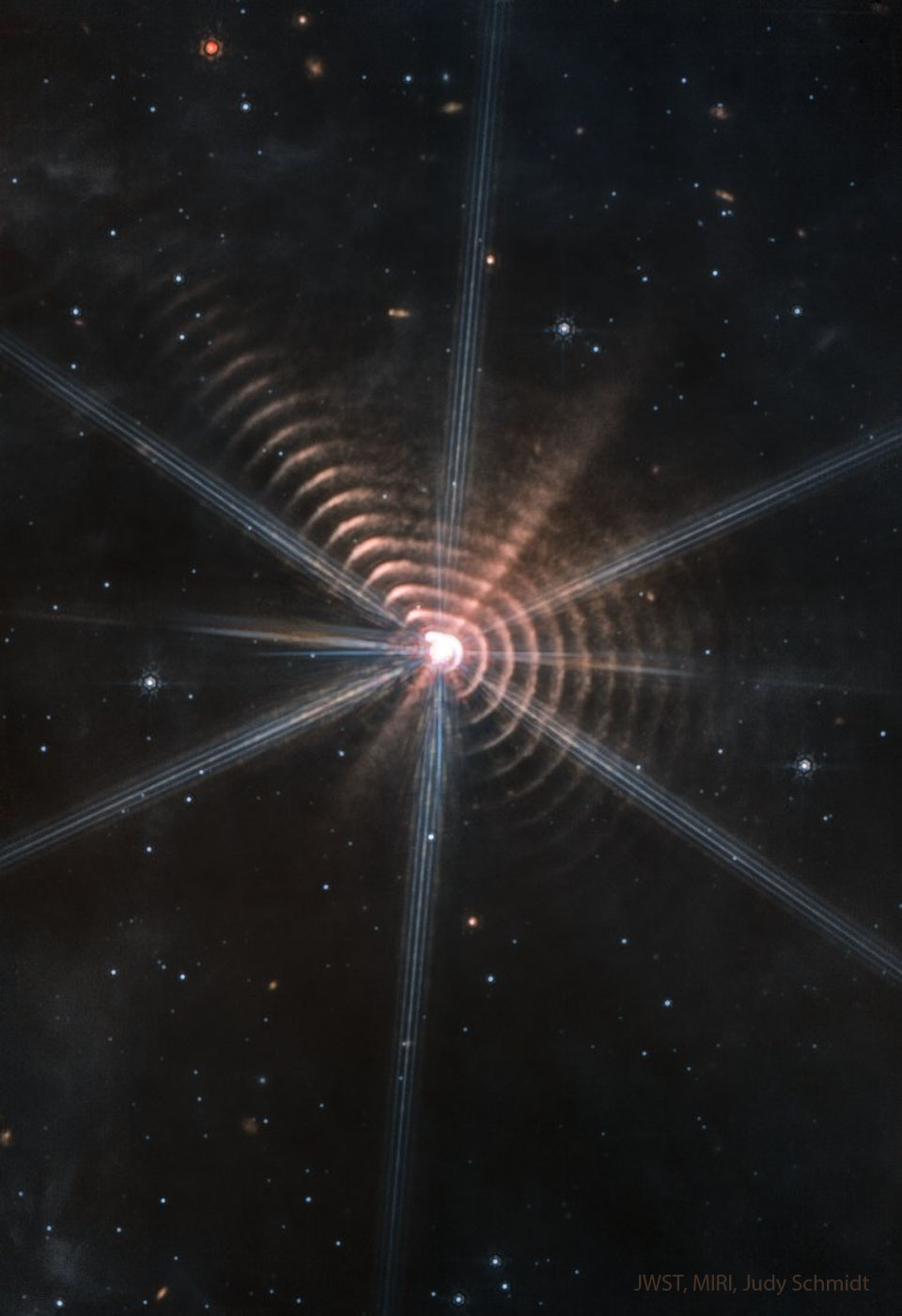
あの奇妙な環は何だろう?塵を豊富に含むこれらの環は、おそらく3Dシェル構造だが、どのように形成されたのかは未だ研究のテーマとなっている。しかし、それらがどこで形成されたかはよく分かっている。白鳥座(はくちょう座)の方向に約6000光年離れた連星系で、ウォルフ・ライエ星WR 140が支配星系である。ウォルフ・ライエ星は質量が大きく、明るく、激しい恒星風で知られている。また、星間塵の構成要素である炭素などの重元素を生成・拡散することでも知られている。連星系のもう一方の星も明るく質量が大きいが、それほど活発ではない。この2つの巨大な星は、約8年ごとに互いに接近しながら、楕円軌道を描いて競い合っている。最も接近すると、この系からのX線放射が増加し、宇宙空間に放出される塵も増加するようで、新たなシェルが形成される。今回紹介するウェッブ宇宙望遠鏡による赤外線画像は、これまで以上に詳細な構造と多くの塵のシェルを捉えている。
原文(English)
What are those strange rings? Rich in dust, the rings are likely 3D shells -- but how they were created remains a topic of research. Where they were created is well known: in a binary star system that lies about 6,000 light years away toward the constellation of the Swan (Cygnus) -- a system dominated by the Wolf-Rayet star WR 140. Wolf-Rayet stars are massive, bright, and known for their tumultuous winds. They are also known for creating and dispersing heavy elements such as carbon which is a building block of interstellar dust. The other star in the binary is also bright and massive -- but not as active. The two great stars joust in an oblong orbit as they approach each other about every eight years. When at closest approach, the X-ray emission from the system increases, as, apparently, does the dust expelled into space -- creating another shell. The featured infrared image by the new Webb Space Telescope resolves greater details and more dust shells than ever before.
\ この感動を宇宙仲間にシェア /
宇宙をXでシェア
© NASA / APOD