
🚀 宇宙の記憶・カレンダー検索
🚀 象徴的な写真:
APOD第1回
🚀 創造の柱
🚀 スピリット火星着陸
🚀 ハッブル超深宇宙
🚀 地球へようこそ|ブルー・マーブル
🚀 エンケラドス
🚀 ベテルギウス
🚀 火星着陸
🚀 青い夕焼け
🚀 冥王星のハート
🚀 皆既日食
🚀 アースライズ再構築
🚀 ブラックホール
🚀 ウェッブ初画像
🚀 アポロ11着陸
APOD30周年(2025年6月16日)
南極での月食
Lunar Eclipse at the South Pole
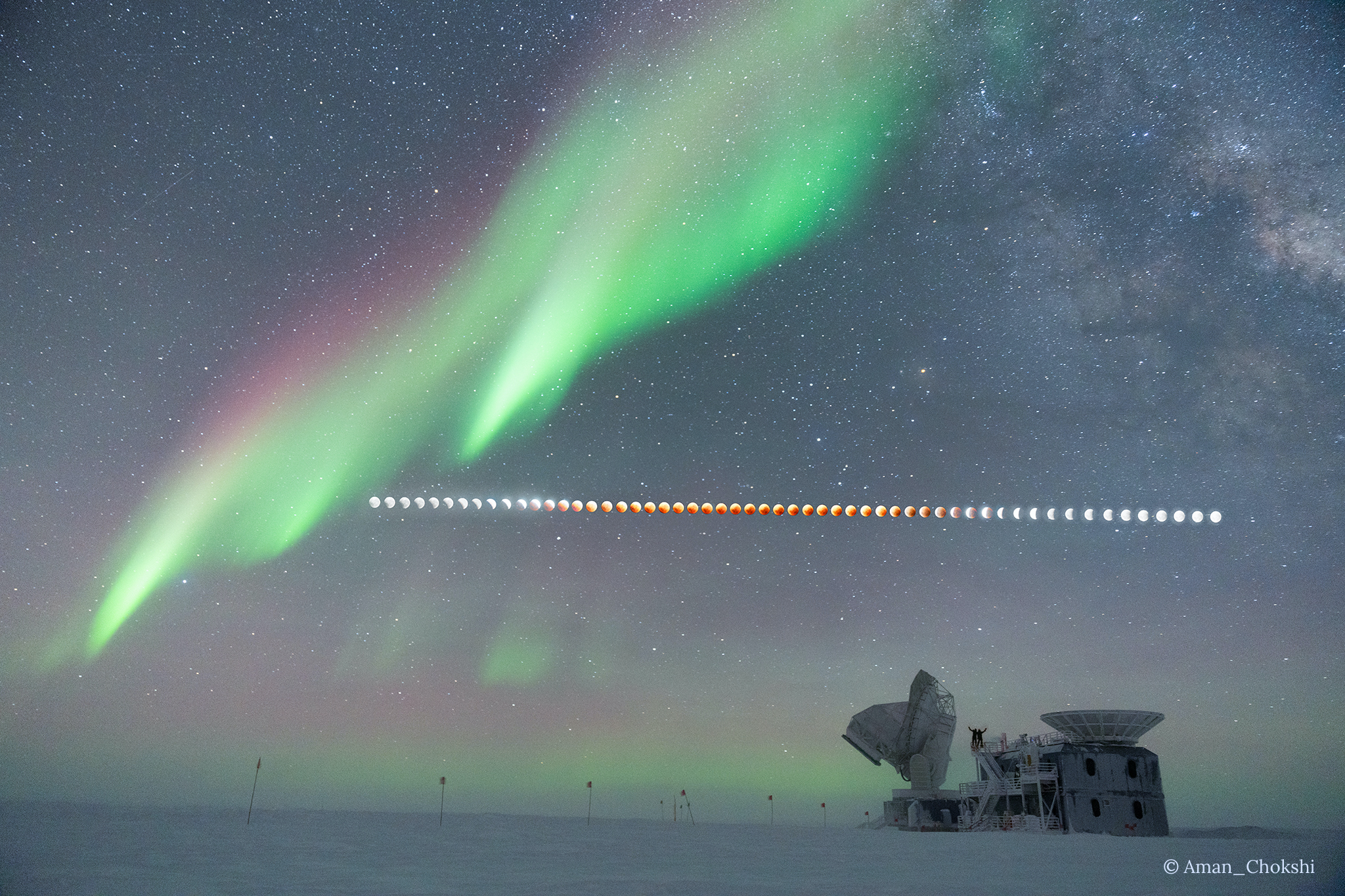
昨年5月16日、月は地球の影を通り抜け、皆既月食の間、約1時間25分間、地球の暗い影に完全に覆われました。この合成タイムラプス映像では、月がアムンゼン・スコット南極基地から地平線上に移動するにつれて、月食の部分食と皆既食の段階が捉えられています。そこでは、月は南極の寒く星空の夜を、オーロラ・オーストラリスと天の川の中心の力強い光景とともに共有しました。前景には、最南端の基地のダークセクター研究所にあるBICEP(右)と南極望遠鏡があります。しかし、極地の空は壮観ですが、11月8日に起こる皆既月食を見るために南極に行く必要はありません。代わりに、その月食はアジア、オーストラリア、アメリカ大陸、太平洋の各地で見ることができます。2025年まで皆既月食を見る最後のチャンスです。
原文(English)
Last May 16 the Moon slid through Earth's shadow, completely immersed in the planet's dark umbra for about 1 hour and 25 minutes during a total lunar eclipse. In this composited timelapse view, the partial and total phases of the eclipse were captured as the Moon tracked above the horizon from Amundsen-Scott South Pole Station. There it shared a cold and starry south polar night with a surging display of the aurora australis and central Milky Way. In the foreground are the BICEP (right) and South Pole telescopes at the southernmost station's Dark Sector Laboratory. But while polar skies can be spectacular, you won't want to go to the South Pole to view the total lunar eclipse coming up on November 8. Instead, that eclipse can be seen from locations in Asia, Australia, the Americas and the Pacific. It will be your last chance to watch a total lunar eclipse until 2025.
\ この感動を宇宙仲間にシェア /
宇宙をXでシェア
© Aman Chokshi / APOD