
🚀 宇宙の記憶・カレンダー検索
🚀 象徴的な写真:
APOD第1回
🚀 創造の柱
🚀 スピリット火星着陸
🚀 ハッブル超深宇宙
🚀 地球へようこそ|ブルー・マーブル
🚀 エンケラドス
🚀 ベテルギウス
🚀 火星着陸
🚀 青い夕焼け
🚀 冥王星のハート
🚀 皆既日食
🚀 アースライズ再構築
🚀 ブラックホール
🚀 ウェッブ初画像
🚀 アポロ11着陸
APOD30周年(2025年6月16日)
アンドロメダ銀河に向かう予期せぬ雲
Unexpected Clouds Toward the Andromeda Galaxy
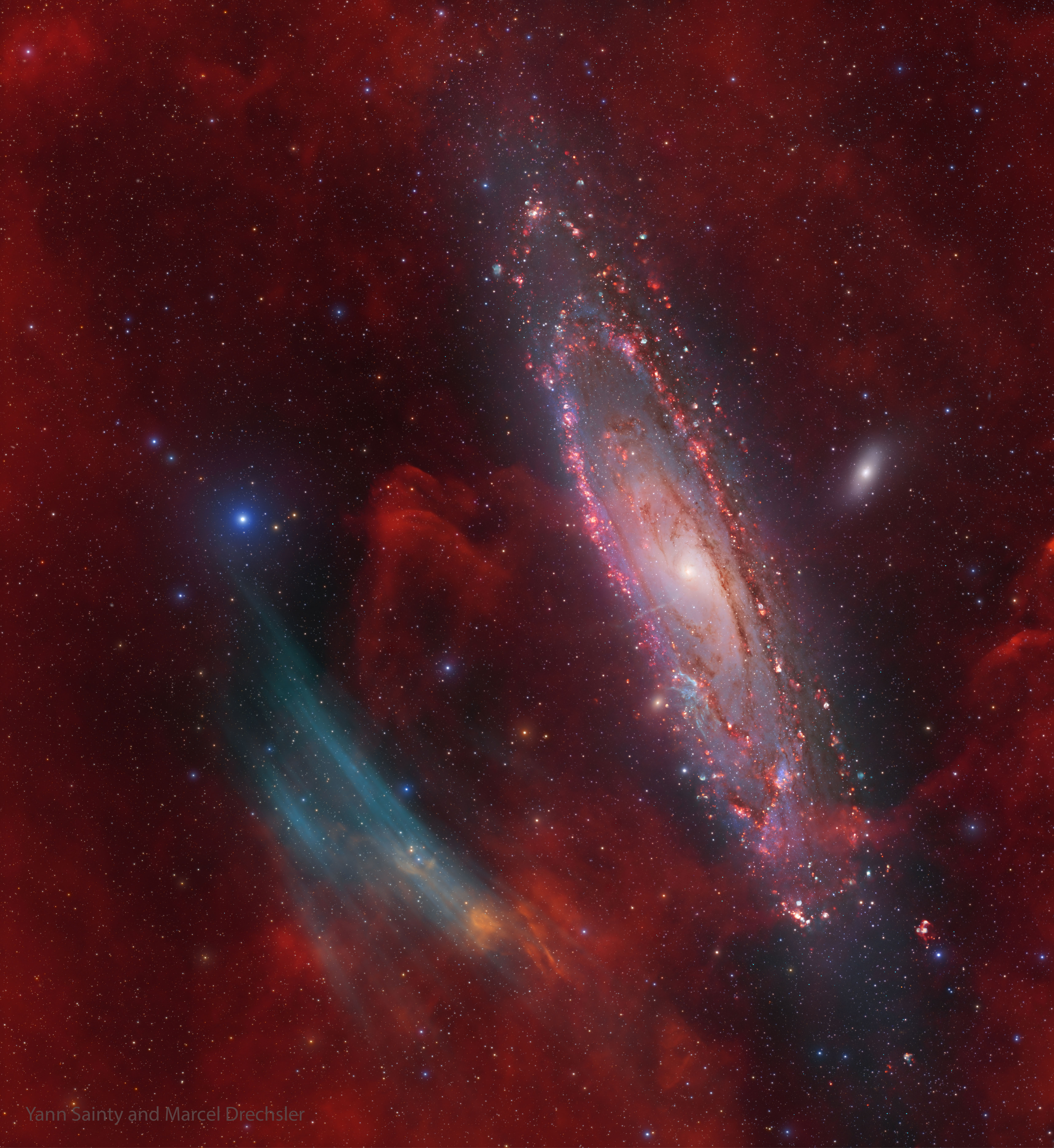
なぜアンドロメダ銀河の方向付近に酸素を放出する弧状構造が存在するのか?誰も確信を持てずにいる。青色で示されたこれらのガス弧は、昨年アマチュア天文家によって発見され、初めて確認された。これらの弧の起源に関する主な仮説は2つあり、1つは実際にアンドロメダ銀河(M31)の近くにあるというもの、もう1つは天の川銀河に偶然存在するガスフィラメントであるというものだ。さらに謎を深めているのは、これまで水素から放出される光で撮影されたM31の深宇宙画像にはこれらの弧が見られなかったこと、そして他のより遠方の銀河では同様の酸素放出構造が一般的に報告されていないことである。この発見は、市販の望遠鏡を使用する熱心なアマチュア天文家によってなされた。その理由の一つは、プロ仕様の望遠鏡は通常、夜空のごく小さな領域しか観測しないのに対し、これらの弧は満月の角径の数倍にも及ぶからである。今後、酸素やその他の元素から放出される光を用いた観測が必ず行われるだろう。
原文(English)
Why are there oxygen-emitting arcs near the direction of the Andromeda galaxy? No one is sure. The gas arcs, shown in blue, were discovered and first confirmed by amateur astronomers just last year. The two main origin hypotheses for the arcs are that they really are close to Andromeda (M31), or that they are just coincidentally placed gas filaments in our Milky Way galaxy. Adding to the mystery is that arcs were not seen in previous deep images of M31 taken primarily in light emitted by hydrogen, and that other, more distant galaxies have not been generally noted as showing similar oxygen-emitting structures. Dedicated amateurs using commercial telescopes made this discovery because, in part, professional telescopes usually investigate angularly small patches of the night sky, whereas these arcs span several times the angular size of the full moon. Future observations -- both in light emitted by oxygen and by other elements -- are sure to follow.
\ この感動を宇宙仲間にシェア /
宇宙をXでシェア
© Yann Sainty &
Marcel Drechsler / APOD