
🚀 宇宙の記憶・カレンダー検索
🚀 象徴的な写真:
APOD第1回
🚀 創造の柱
🚀 スピリット火星着陸
🚀 ハッブル超深宇宙
🚀 地球へようこそ|ブルー・マーブル
🚀 エンケラドス
🚀 ベテルギウス
🚀 火星着陸
🚀 青い夕焼け
🚀 冥王星のハート
🚀 皆既日食
🚀 アースライズ再構築
🚀 ブラックホール
🚀 ウェッブ初画像
🚀 アポロ11着陸
APOD30周年(2025年6月16日)
ZTFとATLASの出会い
ZTF meets ATLAS
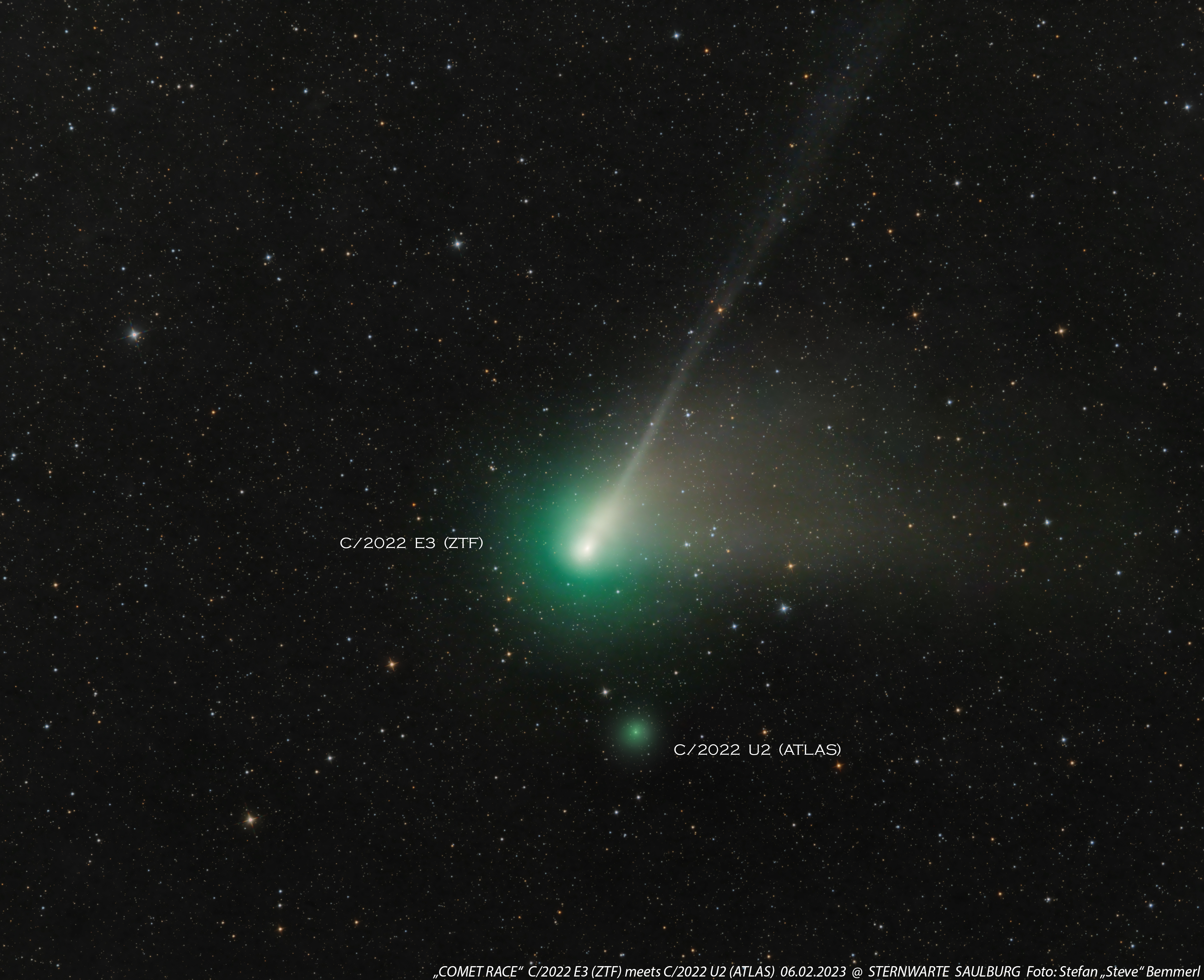
地球の北の空を駆け抜けるにつれて暗くなっていく彗星 C/2022 E3 (ZTF) は、彗星 C/2022 U2 (ATLAS) と共にこの望遠鏡のフレームを共有しています。ドイツのバイエルンの森にある庭園の天文台から 2 月 6 日の夜に撮影されたこの星空は、ぎょしゃ座の方向を約 2.5 度にわたっています。2022 年にスカイサーベイプロジェクト (ツビッキートランジェントファシリティと小惑星地球衝突最終警報システム) によって発見されたこれらの長周期彗星は、遠ざかっており、つい先月近日点に到達しました。はるかに暗い彗星 ATLAS は、1 月 29 日に地球に最も接近し、その距離は約 4.6 光分でしたが、2 月 2 日に彗星 ZTF が接近したときのわずか 2.4 光分でした。この彗星 ATLAS には、かつて肉眼で見えた彗星 ZTF のような発達した尾がありません。しかし、どちらの彗星も緑がかったコマを伴っており、これは二原子炭素分子が太陽光で蛍光を発しているものです。地球の空を駆け抜け続ける双眼鏡でよく見える彗星ZTFは、今夜、明るい火星の近くに現れるでしょう。
原文(English)
Fading as it races across planet Earth's northern skies comet C/2022 E3 (ZTF) shares this telescopic frame with comet C/2022 U2 (ATLAS). Captured on the night of February 6 from a garden observatory in Germany's Bavarian Forest, the starry field of view toward the constellation Auriga spans about 2.5 degrees. Discovered by sky survey projects in 2022 (the Zwicky Transient Facility and the Asteroid Terrestrial-impact Last Alert System) these long-period comets are outbound, reaching perihelion just last month. The much fainter comet ATLAS made its closest approach to our fair planet on January 29 at a distance of about 4.6 light-minutes, compared to a mere 2.4 light-minutes for comet ZTF on February 2. This comet ATLAS lacks the well-developed tails of the formerly naked-eye comet ZTF. But both comets sport greenish tinted comas, emission from diatomic carbon molecules fluorescing in sunlight. Continuing its dash across planet Earth's sky, the good-binocular comet ZTF will appear close to bright planet Mars tonight.
\ この感動を宇宙仲間にシェア /
宇宙をXでシェア
© Stefan Bemmerl / APOD