
🚀 宇宙の記憶・カレンダー検索
🚀 象徴的な写真:
APOD第1回
🚀 創造の柱
🚀 スピリット火星着陸
🚀 ハッブル超深宇宙
🚀 地球へようこそ|ブルー・マーブル
🚀 エンケラドス
🚀 ベテルギウス
🚀 火星着陸
🚀 青い夕焼け
🚀 冥王星のハート
🚀 皆既日食
🚀 アースライズ再構築
🚀 ブラックホール
🚀 ウェッブ初画像
🚀 アポロ11着陸
APOD30周年(2025年6月16日)
Zが火星を表すとき
When Z is for Mars
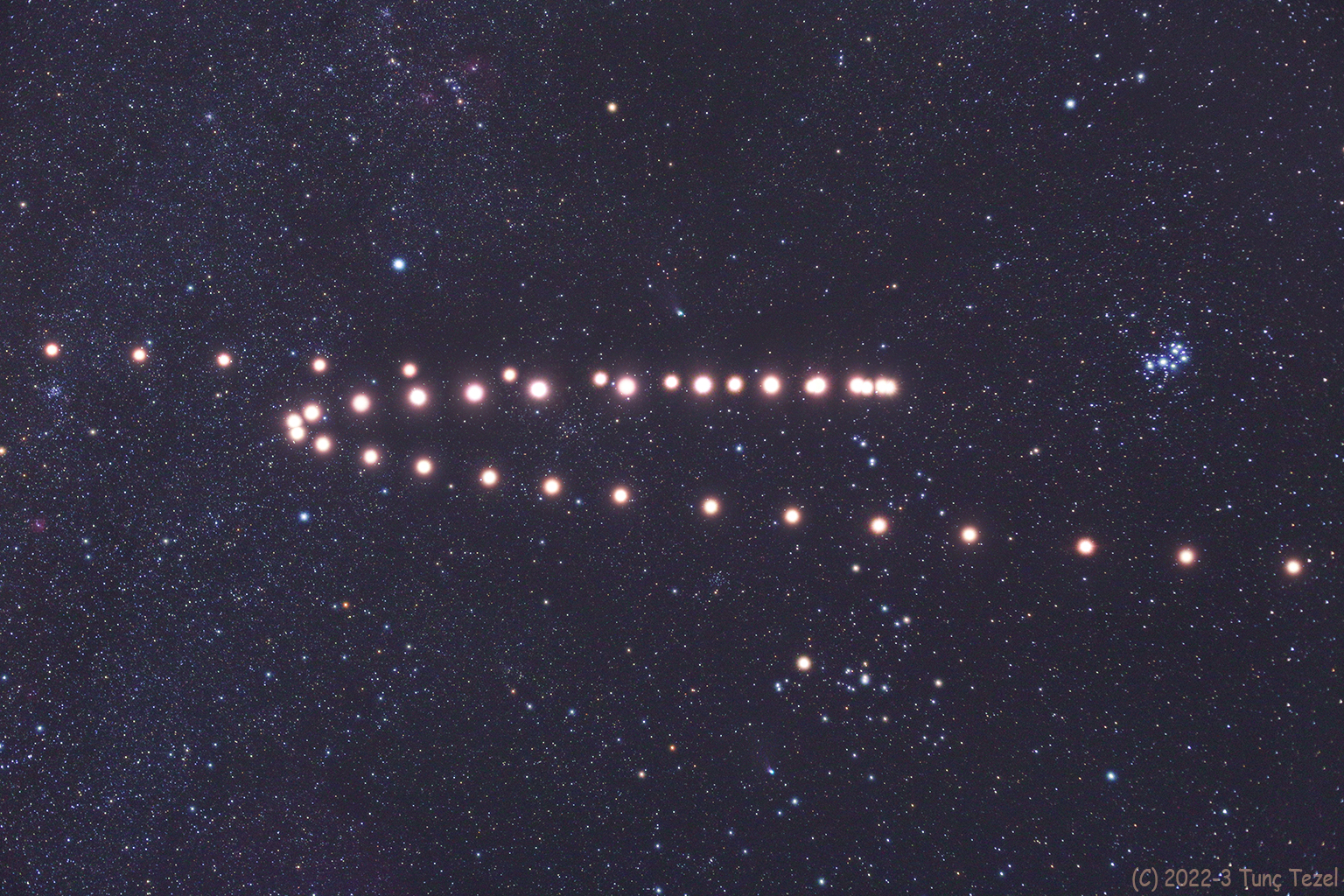
2022年8月中旬から2023年3月下旬にかけて約1週間間隔で撮影された画像を合成したこのシリーズは、赤みがかった火星の逆行運動を捉えています。右下から左上へと進む火星は、地球の夜空でプレアデス星団とヒアデス星団を通り過ぎ、おうし座を通過する際にZ字型の軌跡を描きます。約2年ごとに見られるこの現象ですが、火星が実際に軌道の方向を反転させてZ字型を描くわけではありません。背景の星々に対する見かけ上の逆行運動は、地球自身の軌道運動を反映したものです。逆行運動は、地球が太陽から遠く離れた惑星を追い越すたびに見られ、地球は比較的太陽に近い軌道をより速く移動します。北半球の空高く、赤い惑星は12月8日に太陽の反対側に位置し、フレームの中央付近で最も近く明るく輝いていました。火星の近くで観測された、太陽系内側によく訪れる彗星ZTF(C/2022 E3)も、2月10日と2月16日の2回にわたって観測された。
原文(English)
A composite of images captured about a week apart from mid August 2022 through late March 2023, this series traces the retrograde motion of ruddy-colored Mars. Progressing from lower right to upper left Mars makes a Z-shaped path as it wanders past the Pleiades and Hyades star clusters, through the constellation Taurus in planet Earth's night sky. Seen about every two years, Mars doesn't actually reverse the direction of its orbit to trace out the Z-shape though. Instead, the apparent backwards or retrograde motion with respect to the background stars is a reflection of the orbital motion of Earth itself. Retrograde motion can be seen each time Earth overtakes and laps planets orbiting farther from the Sun, the Earth moving more rapidly through its own relatively close-in orbit. High in northern hemisphere skies the Red Planet was opposite the Sun and at its closest and brightest on December 8, near the center of the frame. Seen close to Mars, a popular visitor to the inner Solar System, comet ZTF (C/2022 E3), was also captured on two dates, February 10 and February 16.
\ この感動を宇宙仲間にシェア /
宇宙をXでシェア
© Tunc Tezel / APOD