
🚀 宇宙の記憶・カレンダー検索
🚀 象徴的な写真:
APOD第1回
🚀 創造の柱
🚀 スピリット火星着陸
🚀 ハッブル超深宇宙
🚀 地球へようこそ|ブルー・マーブル
🚀 エンケラドス
🚀 ベテルギウス
🚀 火星着陸
🚀 青い夕焼け
🚀 冥王星のハート
🚀 皆既日食
🚀 アースライズ再構築
🚀 ブラックホール
🚀 ウェッブ初画像
🚀 アポロ11着陸
APOD30周年(2025年6月16日)
ターコイズブルーのワンダーランドに広がる天の川
Milky Way over a Turquoise Wonderland
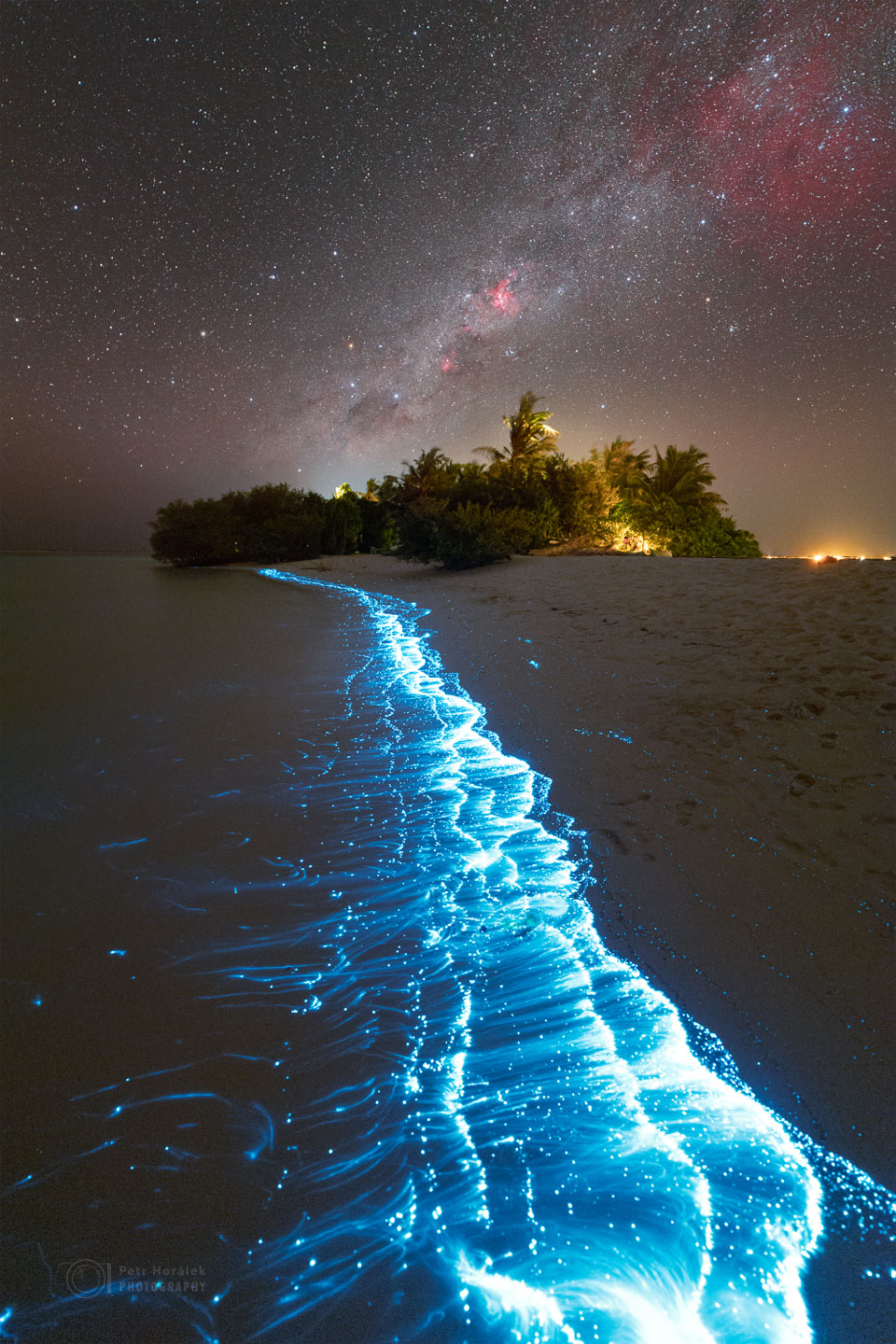
何が光っているのでしょうか?答えは、海か空かによって異なります。海では、珍しい青い光は生物発光です。具体的には、このきらめきは、打ち寄せる波に刺激された単細胞プランクトンであるノクチルカ・シンティランスから生じます。プランクトンは、この光を使って捕食者を驚かせ、照らします。2月中旬にモルディブの島で見られたこの光景は非常に強烈で、天体写真家はそれをターコイズブルーのワンダーランドと表現しました。一方、空には、より馴染みのある星や星雲の光があります。人工的に照らされた緑の植物から立ち昇る白い帯は、天の川銀河の中心円盤にある数十億個の星によって作られています。空には、左側に星団オメガ・ケンタウリ、中央に有名な南十字星群も見えます。赤く輝く星雲には、中央のすぐ右にある明るいカリーナ星雲や、右上にある広大なガム星雲などがあります。
原文(English)
What glows there? The answer depends: sea or sky? In the sea, the unusual blue glow is bioluminescence. Specifically, the glimmer arises from Noctiluca scintillans, single-celled plankton stimulated by the lapping waves. The plankton use their glow to startle and illuminate predators. This mid-February display on an island in the Maldives was so intense that the astrophotographer described it as a turquoise wonderland. In the sky, by contrast, are the more familiar glows of stars and nebulas. The white band rising from the artificially-illuminated green plants is created by billions of stars in the central disk of our Milky Way Galaxy. Also visible in the sky is the star cluster Omega Centauri, toward the left, and the famous Southern Cross asterism in the center. Red-glowing nebulas include the bright Carina Nebula, just right of center, and the expansive Gum Nebula on the upper right.
\ この感動を宇宙仲間にシェア /
宇宙をXでシェア
© Petr Horálek /
Institute of Physics in Opava,
Sovena Jani / APOD