
🚀 宇宙の記憶・カレンダー検索
🚀 象徴的な写真:
APOD第1回
🚀 創造の柱
🚀 スピリット火星着陸
🚀 ハッブル超深宇宙
🚀 地球へようこそ|ブルー・マーブル
🚀 エンケラドス
🚀 ベテルギウス
🚀 火星着陸
🚀 青い夕焼け
🚀 冥王星のハート
🚀 皆既日食
🚀 アースライズ再構築
🚀 ブラックホール
🚀 ウェッブ初画像
🚀 アポロ11着陸
APOD30周年(2025年6月16日)
暁の紫外線に照らされた金星
Venus in Ultraviolet from Akatsuki
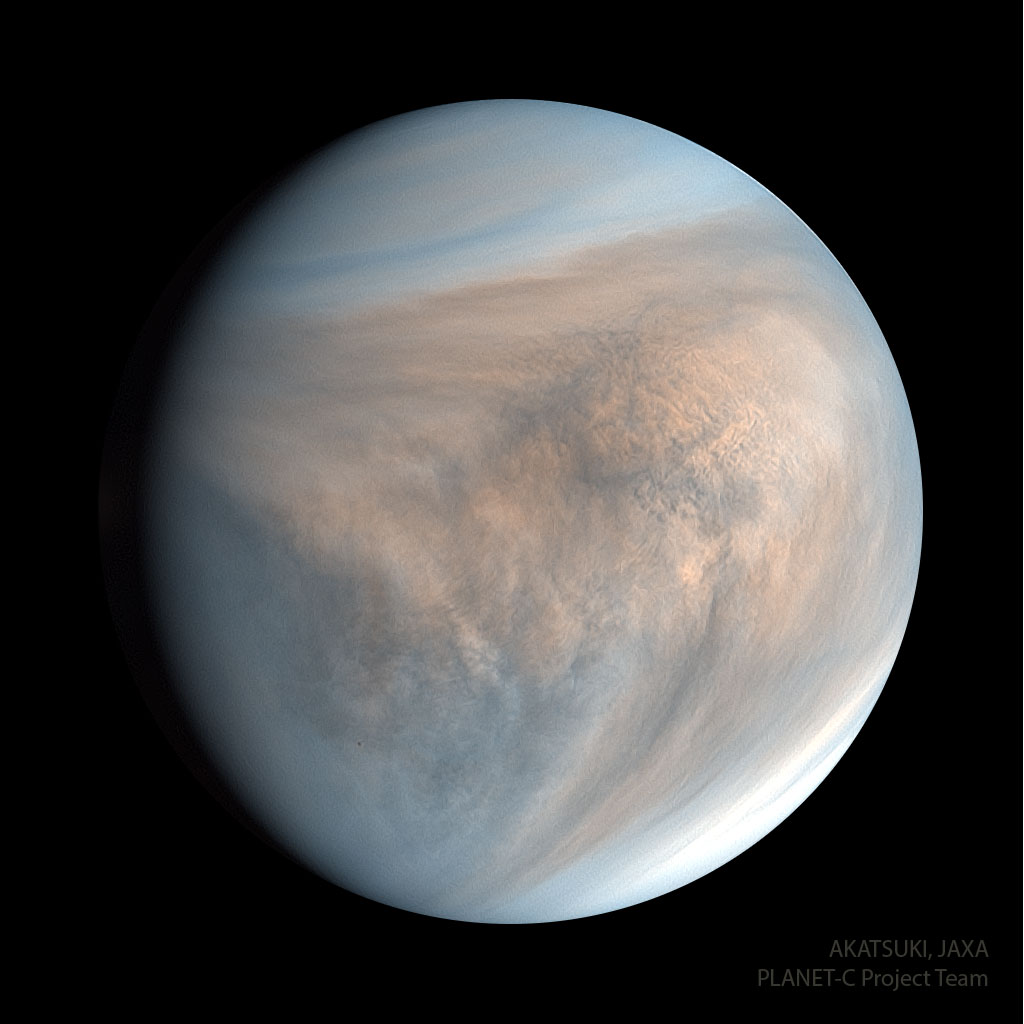
金星はなぜ地球とこんなに違うのか?その解明のため、日本は無人探査機「あかつき」を打ち上げました。あかつきは、予定外の5年間の太陽系内周回航行を経て、2015年末に金星周回軌道に入りました。あかつきは当初の計画寿命を過ぎていましたが、探査機と搭載機器の性能が非常に良好だったため、当初のミッションの多くが再開されました。金星気候探査機としても知られるあかつきの機器は、火山活動の有無、濃密な大気中での雷の発生、風速が自転速度を大きく上回る理由など、地球の姉妹惑星である金星に関する未知の事柄を調査しました。あかつきのUVIカメラで撮影された特集画像では、金星の昼側が惑星規模のV字型の雲パターンで示されています。この画像は3色の紫外線で表示され、淡い青色で二酸化硫黄の相対存在量の減少を示しています。あかつきの画像とデータの分析により、金星には地球のジェット気流に似た赤道ジェット気流が存在するなど、多くの発見がありました。
原文(English)
Why is Venus so different from Earth? To help find out, Japan launched the robotic Akatsuki spacecraft which entered orbit around Venus late in 2015 after an unplanned five-year adventure around the inner Solar System. Even though Akatsuki was past its original planned lifetime, the spacecraft and instruments were operating so well that much of its original mission was reinstated. Also known as the Venus Climate Orbiter, Akatsuki's instruments investigated unknowns about Earth's sister planet, including whether volcanoes are still active, whether lightning occurs in the dense atmosphere, and why wind speeds greatly exceed the planet's rotation speed. In the featured image taken by Akatsuki's UVI camera, the day-side of Venus is seen shown with planet-scale V-shaped cloud pattern. The image displays three ultraviolet colors and indicates a dip in the relative abundance of sulfur dioxide shown in faint blue. Analyses of Akatsuki images and data has shown, among other discoveries, that Venus has equatorial jet similar to Earth's jet stream.
\ この感動を宇宙仲間にシェア /
宇宙をXでシェア
© JAXA / APOD