
🚀 宇宙の記憶・カレンダー検索
🚀 象徴的な写真:
APOD第1回
🚀 創造の柱
🚀 スピリット火星着陸
🚀 ハッブル超深宇宙
🚀 地球へようこそ|ブルー・マーブル
🚀 エンケラドス
🚀 ベテルギウス
🚀 火星着陸
🚀 青い夕焼け
🚀 冥王星のハート
🚀 皆既日食
🚀 アースライズ再構築
🚀 ブラックホール
🚀 ウェッブ初画像
🚀 アポロ11着陸
APOD30周年(2025年6月16日)
X線で高温の星々が輝くわし星雲
The Eagle Nebula with X-ray Hot Stars
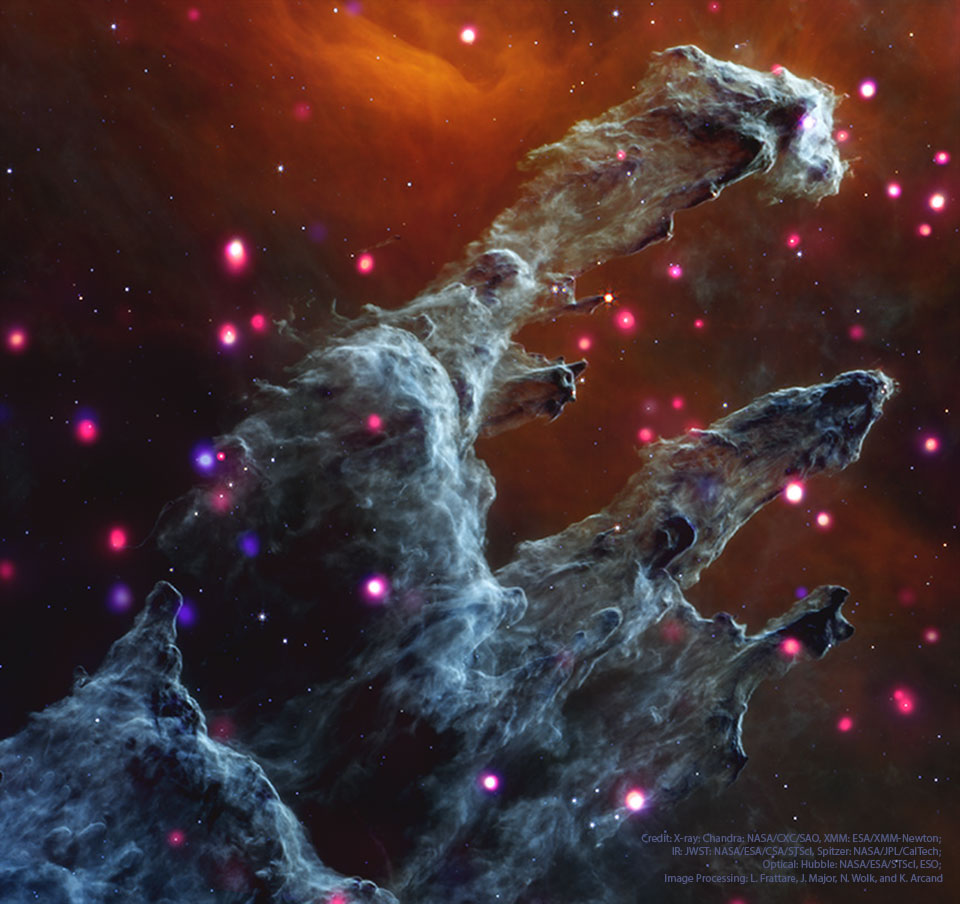
有名なわし星雲の星柱は、X線で見るとどのように見えるのでしょうか?それを調べるため、NASAの軌道上にあるチャンドラX線観測衛星は、星形成が盛んなこれらの星間山脈を観測しました。M16では、塵の柱自体からはあまりX線が放出されていないものの、小さくても明るいX線源が多数存在することが明らかになりました。これらの源は、チャンドラ(X線)、XMM(X線)、JWST(赤外線)、スピッツァー(赤外線)、ハッブル(可視光)、VLT(可視光)の画像を合成した画像に明るい点として示されています。これらのX線を放出する星が何であるかは依然として研究対象ですが、高温で最近形成された低質量星であると推測されるものもあれば、高温で古い高質量星であると考えられているものもあります。これらのX線を発する高温の星はフレーム全体に散らばっている。可視光で観測された以前に特定された蒸発性ガス状球状星団(EGGS)は、現在X線を放出するほど高温ではない。
原文(English)
What do the famous Eagle Nebula star pillars look like in X-ray light? To find out, NASA's orbiting Chandra X-ray Observatory peered in and through these interstellar mountains of star formation. It was found that in M16 the dust pillars themselves do not emit many X-rays, but a lot of small-but-bright X-ray sources became evident. These sources are shown as bright dots on the featured image which is a composite of exposures from Chandra (X-rays), XMM (X-rays), JWST (infrared), Spitzer (infrared), Hubble (visible), and the VLT (visible). What stars produce these X-rays remains a topic of research, but some are hypothesized to be hot, recently-formed, low-mass stars, while others are thought to be hot, older, high-mass stars. These X-ray hot stars are scattered around the frame -- the previously identified Evaporating Gaseous Globules (EGGS) seen in visible light are not currently hot enough to emit X-rays.
\ この感動を宇宙仲間にシェア /
宇宙をXでシェア
© NASA / APOD