
🚀 宇宙の記憶・カレンダー検索
🚀 象徴的な写真:
APOD第1回
🚀 創造の柱
🚀 スピリット火星着陸
🚀 ハッブル超深宇宙
🚀 地球へようこそ|ブルー・マーブル
🚀 エンケラドス
🚀 ベテルギウス
🚀 火星着陸
🚀 青い夕焼け
🚀 冥王星のハート
🚀 皆既日食
🚀 アースライズ再構築
🚀 ブラックホール
🚀 ウェッブ初画像
🚀 アポロ11着陸
APOD30周年(2025年6月16日)
はくちょう座:泡と三日月
Cygnus: Bubble and Crescent
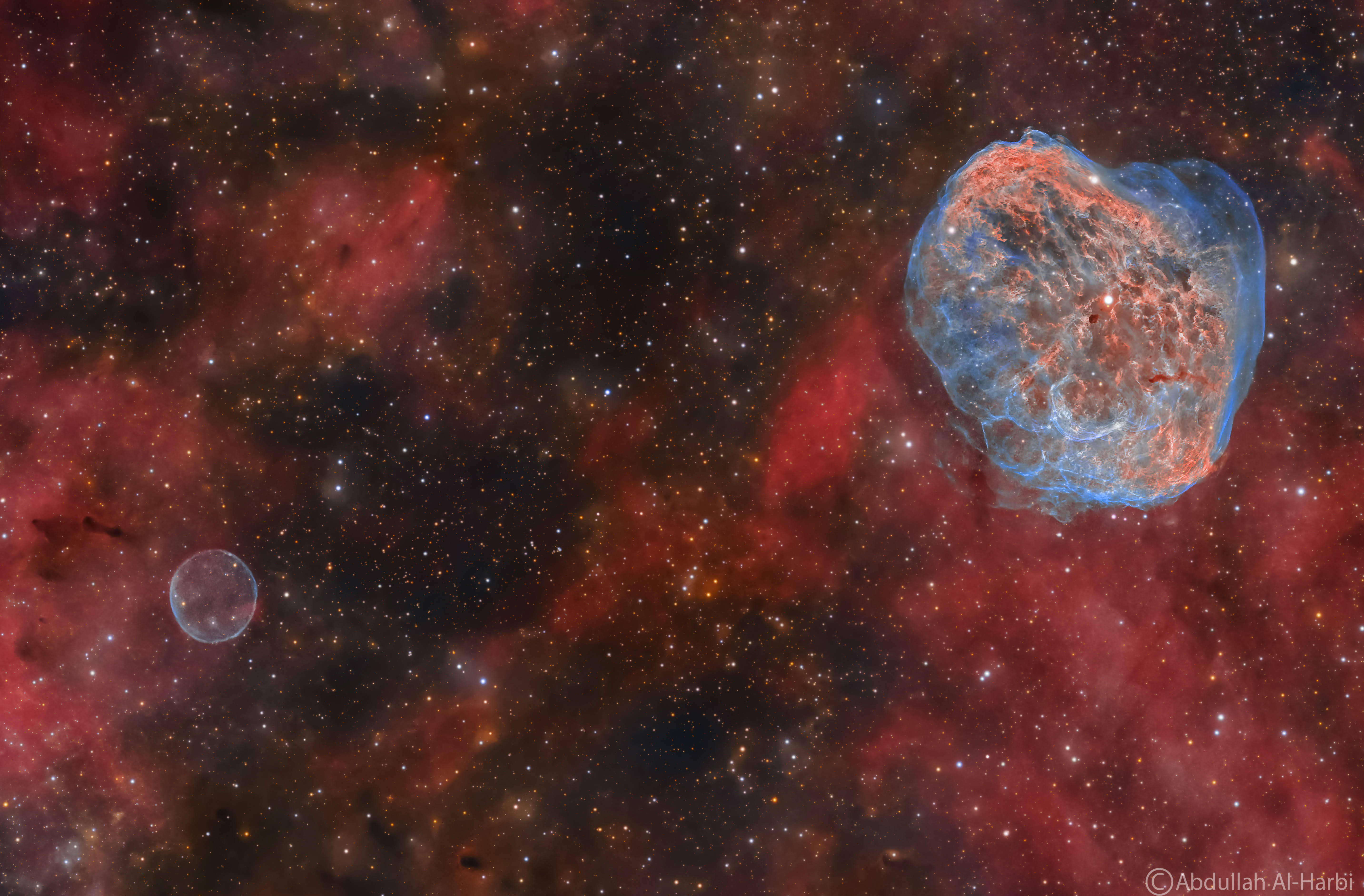
星が死を迎えると、ガスと塵の雲が生まれます。天の川銀河の平面にある星が豊富な領域を漂う白鳥座(はくちょう座)の高空には、ガスと塵からなる2つの恒星の死の雲が見られます。望遠鏡の視野内に捉えられているのは、ソープバブル星雲(左下)と三日月星雲(右上)です。どちらも、星の生涯の最終段階で形成されました。NGC 6888としても知られる三日月星雲は、中心にある明るく巨大なウォルフ・ライエ星WR 136が強い恒星風で外層を放出した際に形成されました。WR 136は驚異的な速度で燃料を消費しており、壮大な超新星爆発で終わるはずの短い寿命の終わりに近づいています。 2013年に発見されたソープバブル星雲は、おそらく惑星状星雲であり、ゆっくりと冷えていく白色矮星になる運命にある、質量が小さく寿命の長い太陽のような恒星の最後の残骸であると考えられています。どちらの星雲も約5,000光年離れており、より大きな三日月星雲は直径約25光年です。数百万年以内に、どちらも散逸してしまう可能性が高いです。あなたの空のサプライズ:あなたの誕生日にAPODで紹介された写真はどれですか?(1995年以降)
原文(English)
As stars die, they create clouds. Two stellar death clouds of gas and dust can be found toward the high-flying constellation of the Swan (Cygnus) as they drift through rich star fields in the plane of our Milky Way Galaxy. Caught here within the telescopic field of view are the Soap Bubble (lower left) and the Crescent Nebula (upper right). Both were formed at the final phase in the life of a star. Also known as NGC 6888, the Crescent Nebula was shaped as its bright, central massive Wolf-Rayet star, WR 136, shed its outer envelope in a strong stellar wind. Burning through fuel at a prodigious rate, WR 136 is near the end of a short life that should finish in a spectacular supernova explosion. Discovered in 2013, the Soap Bubble Nebula is likely a planetary nebula, the final shroud of a lower mass, long-lived, Sun-like star destined to become a slowly cooling white dwarf. Both stellar nebulas are about 5,000 light-years distant, with the larger Crescent Nebula spanning about 25 light-years across. Within a few million years, both will likely have dispersed. Your Sky Surprise: What picture did APOD feature on your birthday? (post 1995)
\ この感動を宇宙仲間にシェア /
宇宙をXでシェア
© Abdullah Al-Harbi / APOD