
🚀 宇宙の記憶・カレンダー検索
🚀 象徴的な写真:
APOD第1回
🚀 創造の柱
🚀 スピリット火星着陸
🚀 ハッブル超深宇宙
🚀 地球へようこそ|ブルー・マーブル
🚀 エンケラドス
🚀 ベテルギウス
🚀 火星着陸
🚀 青い夕焼け
🚀 冥王星のハート
🚀 皆既日食
🚀 アースライズ再構築
🚀 ブラックホール
🚀 ウェッブ初画像
🚀 アポロ11着陸
APOD30周年(2025年6月16日)
NGC 6302:蝶星雲
NGC 6302: The Butterfly Nebula
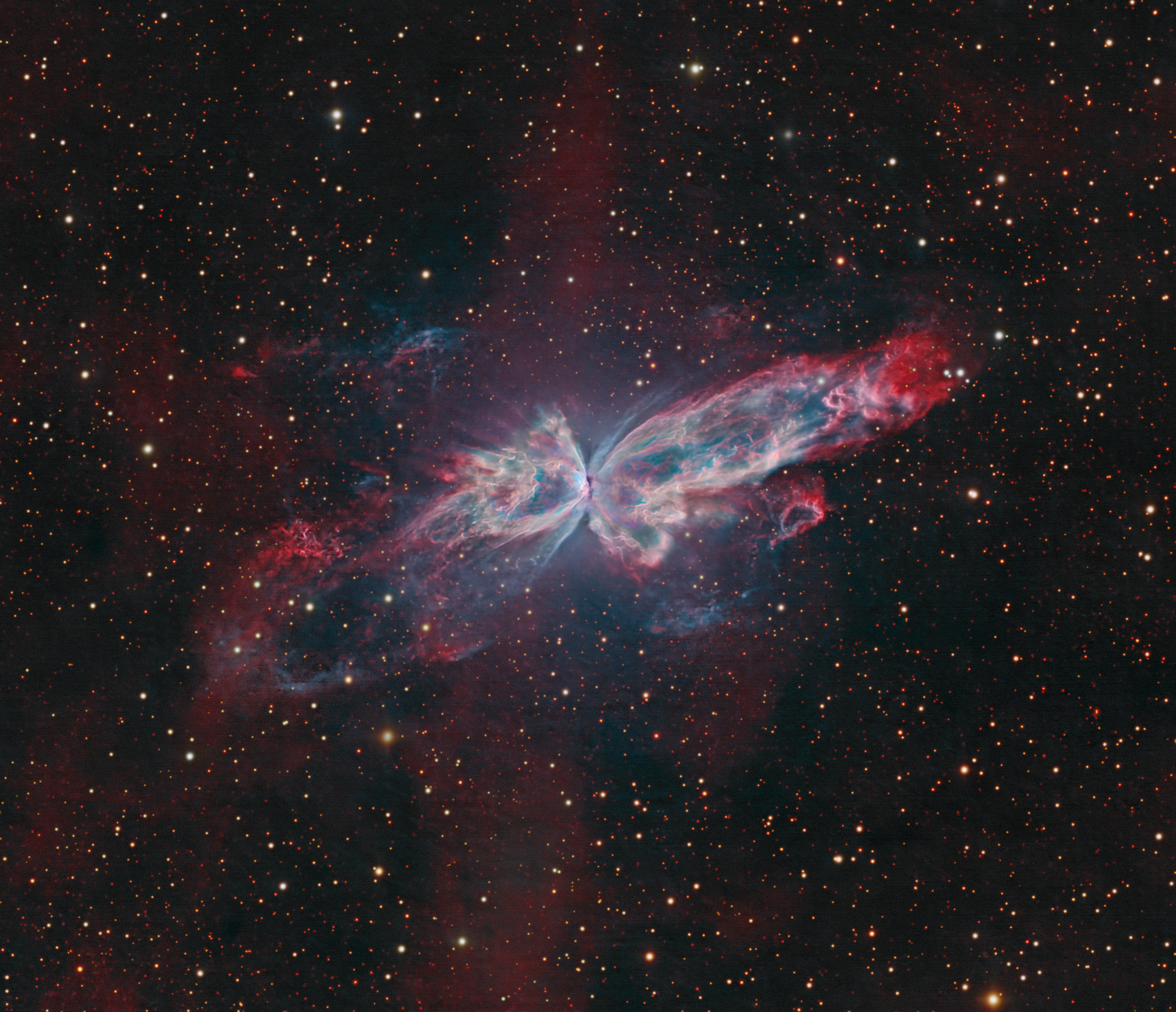
地球の夜空に輝く星団や星雲には、しばしば花や昆虫の名前が付けられますが、翼幅がなんと3光年もあるNGC 6302も例外ではありません。推定表面温度が約25万℃のこの惑星状星雲の中心星は、白色矮星へと変化しつつあり、非常に高温になり、紫外線で明るく輝いています。中心星は塵のトーラスによって直接見ることはできませんが、その強力な紫外線は星雲内の原子を電離させます。狭帯域画像データを用いて撮影されたこの鮮明な望遠鏡画像では、電離した水素原子と二重に電離した酸素原子が、それぞれ特徴的な赤と青緑の色で示され、星雲の翼のような双極性流出の中に、見事な結び目とフィラメントの複合体が浮かび上がっています。 NGC 6302は、さそり座(Scorpius)という、クモの形態的に正しい星座の方向に、約4000光年離れた場所に位置しています。
原文(English)
The bright clusters and nebulae of planet Earth's night sky are often given the names of flowers or insects, and its whopping 3 light-year wingspan, NGC 6302 is no exception. With an estimated surface temperature of about 250,000 degrees C, the central star of the planetary nebula is transforming into a white dwarf star, becoming exceptionally hot, and shining brightly in ultraviolet light. The central star is hidden from direct view by a torus of dust, but its energetic ultraviolet light ionizes atoms in the nebula. In this sharp, telescopic view composed with narrowband image data, the ionized hydrogen and doubly ionized oxygen atoms are shown in their characteristic red and blue-green hues to reveal a stunning complex of knots and filaments within the nebula's wing-like bipolar outflows. NGC 6302 lies about 4,000 light-years away in the arachnologically correct constellation of the Scorpion (Scorpius).
\ この感動を宇宙仲間にシェア /
宇宙をXでシェア
© Mike Selby / APOD