
🚀 宇宙の記憶・カレンダー検索
🚀 象徴的な写真:
APOD第1回
🚀 創造の柱
🚀 スピリット火星着陸
🚀 ハッブル超深宇宙
🚀 地球へようこそ|ブルー・マーブル
🚀 エンケラドス
🚀 ベテルギウス
🚀 火星着陸
🚀 青い夕焼け
🚀 冥王星のハート
🚀 皆既日食
🚀 アースライズ再構築
🚀 ブラックホール
🚀 ウェッブ初画像
🚀 アポロ11着陸
APOD30周年(2025年6月16日)
ペガスス座51星系まで50光年
50 Light-years to 51 Pegasi
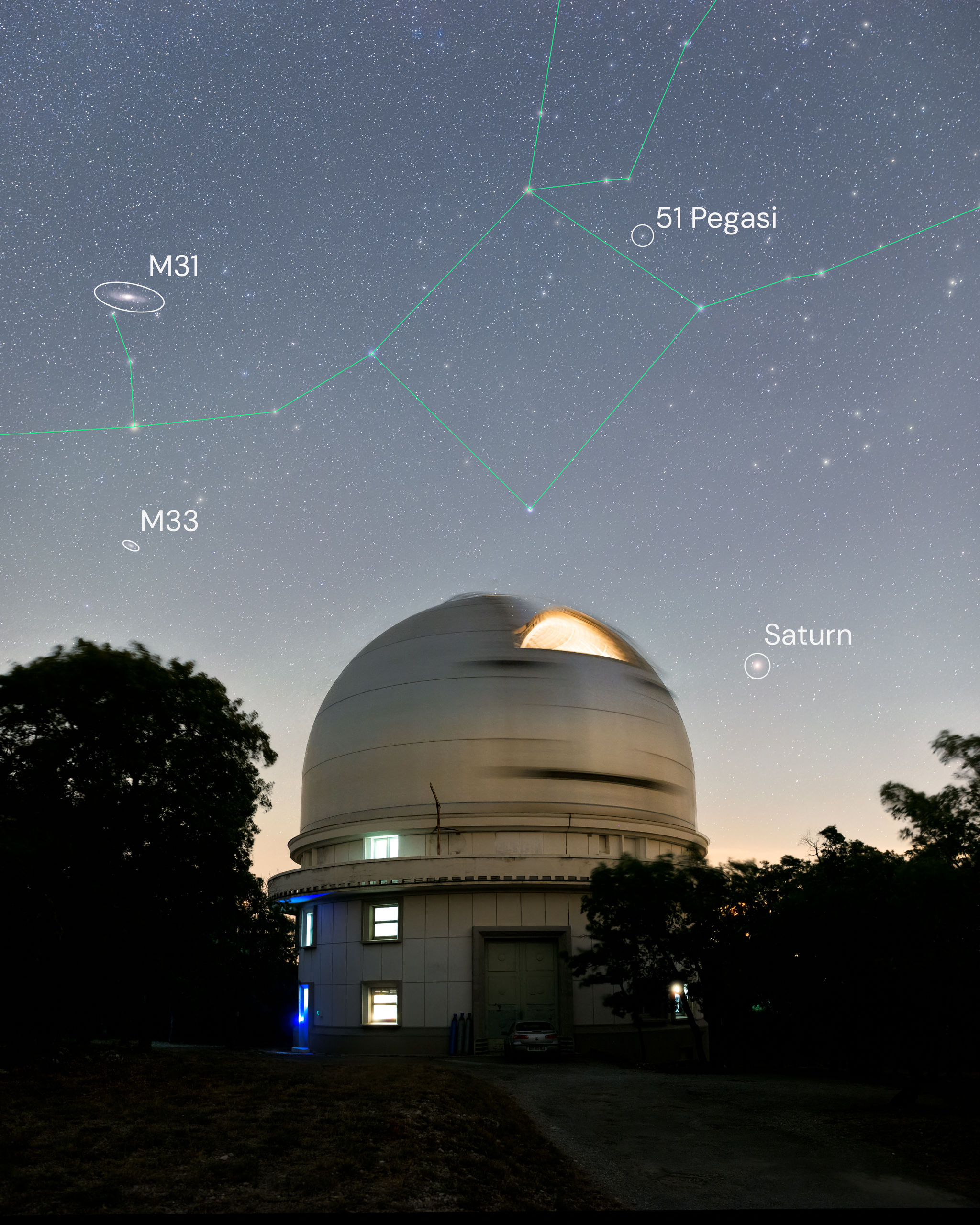
ペガシ星51番まではわずか50光年です。この星の位置は、2025年8月にフランスのオート=プロヴァンス天文台のドーム上空に明るい星がほとんど見える夜に撮影されたこの写真に示されています。30年前の1995年10月、天文学者のミシェル・マイヨールとディディエ・ケロは、この天文台で発見された画期的な発見を発表しました。彼らは精密な分光器を用いて、ペガシ星51番を周回する惑星を検出しました。これは、太陽に似た恒星を周回する既知の最初の系外惑星です。マイヨールとケロは分光器を用いて、周回する惑星の重力による揺れによって引き起こされる恒星の視線速度の変化を測定しました。ペガシ星51番bと名付けられたこの惑星は、少なくとも木星の半分の質量を持ち、公転周期は4.2日であると判明しました。これにより、この系外惑星は水星が太陽から離れている距離よりもずっと親星に近い位置にあることが判明しました。彼らの発見はすぐに確認され、マヨールとケロズは最終的に2019年にノーベル物理学賞を受賞しました。現在では、ホットジュピターとして知られる系外惑星の原型として認識されている51ペガシbは、2015年にラテン語で半分を意味するディミディウムと正式に命名されました。30年前に発見されて以来、6,000個以上の系外惑星が発見されています。
原文(English)
It's only 50 light-years to 51 Pegasi. That star's position is indicated in this snapshot from August 2025, taken on a night with mostly brighter stars visible above the dome at Observatoire de Haute-Provence in France. Thirty years ago, in October of 1995, astronomers Michel Mayor and Didier Queloz announced a profound discovery made at the observatory. Using a precise spectrograph, they had detected a planet orbiting 51 Peg, the first known exoplanet orbiting a sun-like star. Mayor and Queloz had used the spectrograph to measure changes in the star's radial velocity, a regular wobble caused by the gravitational tug of the orbiting planet. Designated 51 Pegasi b, the planet was determined to have a mass at least half of Jupiter's mass and an orbital period of 4.2 days. That made the exoplanet much closer to its parent star than Mercury is to the Sun. Their discovery was quickly confirmed and Mayor and Queloz were ultimately awarded the Nobel Prize in physics in 2019. Now recognized as the prototype for the class of exoplanets fondly known as hot Jupiters, 51 Pegasi b was formally named Dimidium, Latin for half, in 2015. Since its discovery 30 years ago, over 6,000 exoplanets have been found.
\ この感動を宇宙仲間にシェア /
宇宙をXでシェア
© José Rodrigues / APOD