
🚀 宇宙の記憶・カレンダー検索
🚀 象徴的な写真:
APOD第1回
🚀 創造の柱
🚀 スピリット火星着陸
🚀 ハッブル超深宇宙
🚀 地球へようこそ|ブルー・マーブル
🚀 エンケラドス
🚀 ベテルギウス
🚀 火星着陸
🚀 青い夕焼け
🚀 冥王星のハート
🚀 皆既日食
🚀 アースライズ再構築
🚀 ブラックホール
🚀 ウェッブ初画像
🚀 アポロ11着陸
APOD30周年(2025年6月16日)
可視化:ブラックホールと円盤付近
Visualization: Near a Black Hole and Disk
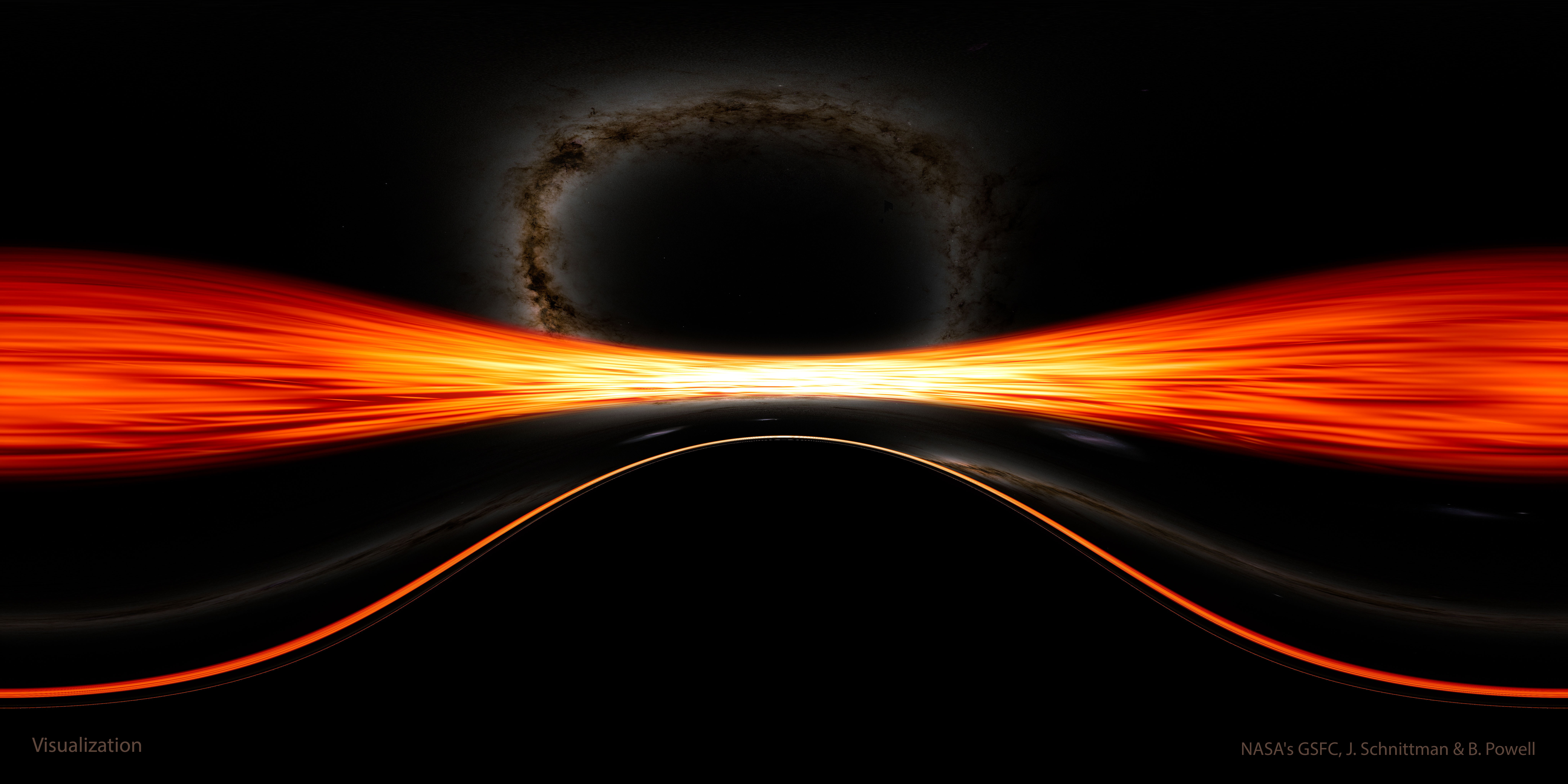
巨大なブラックホールに突入するとは、一体どんな光景が広がるのでしょうか?この画像は、スーパーコンピューターによる可視化で、私たちの銀河系の中心にあるブラックホールに似た、太陽質量の400万倍のブラックホールに向かって突入するシミュレーションカメラから見た全天の様子を示しています。カメラはブラックホールの事象の地平線から約1600万キロメートル離れた場所にあり、光速の62%の速度で内側に向かって移動しています。重力の歪んだ効果により、天の川の星々は、この画像の上部にコンパクトなループとして、下部に横切る二次的な像として現れています。画像の上にカーソルを移動すると、さらに詳しい説明が表示されます。このような可視化によって、天文学者は従来不可能だった方法でブラックホールを研究することができます。
原文(English)
What would it look like to plunge into a monster black hole? This image from a supercomputer visualization shows the entire sky as seen from a simulated camera plunging toward a 4-million-solar-mass black hole, similar to the one at the center of our galaxy. The camera lies about 16 million kilometers from the black hole’s event horizon and is moving inward at 62% the speed of light. Thanks to gravity’s funhouse effects, the starry band of the Milky Way appears both as a compact loop at the top of this view and as a secondary image stretching across the bottom. Move the cursor over the image for additional explanations. Visualizations like this allow astronomers to explore black holes in ways not otherwise possible.
\ この感動を宇宙仲間にシェア /
宇宙をXでシェア
© NASA / APOD