
🚀 宇宙の記憶・カレンダー検索
🚀 象徴的な写真:
APOD第1回
🚀 創造の柱
🚀 スピリット火星着陸
🚀 ハッブル超深宇宙
🚀 地球へようこそ|ブルー・マーブル
🚀 エンケラドス
🚀 ベテルギウス
🚀 火星着陸
🚀 青い夕焼け
🚀 冥王星のハート
🚀 皆既日食
🚀 アースライズ再構築
🚀 ブラックホール
🚀 ウェッブ初画像
🚀 アポロ11着陸
APOD30周年(2025年6月16日)
シャプレー1:環状惑星状星雲
Shapley 1: An Annular Planetary Nebula
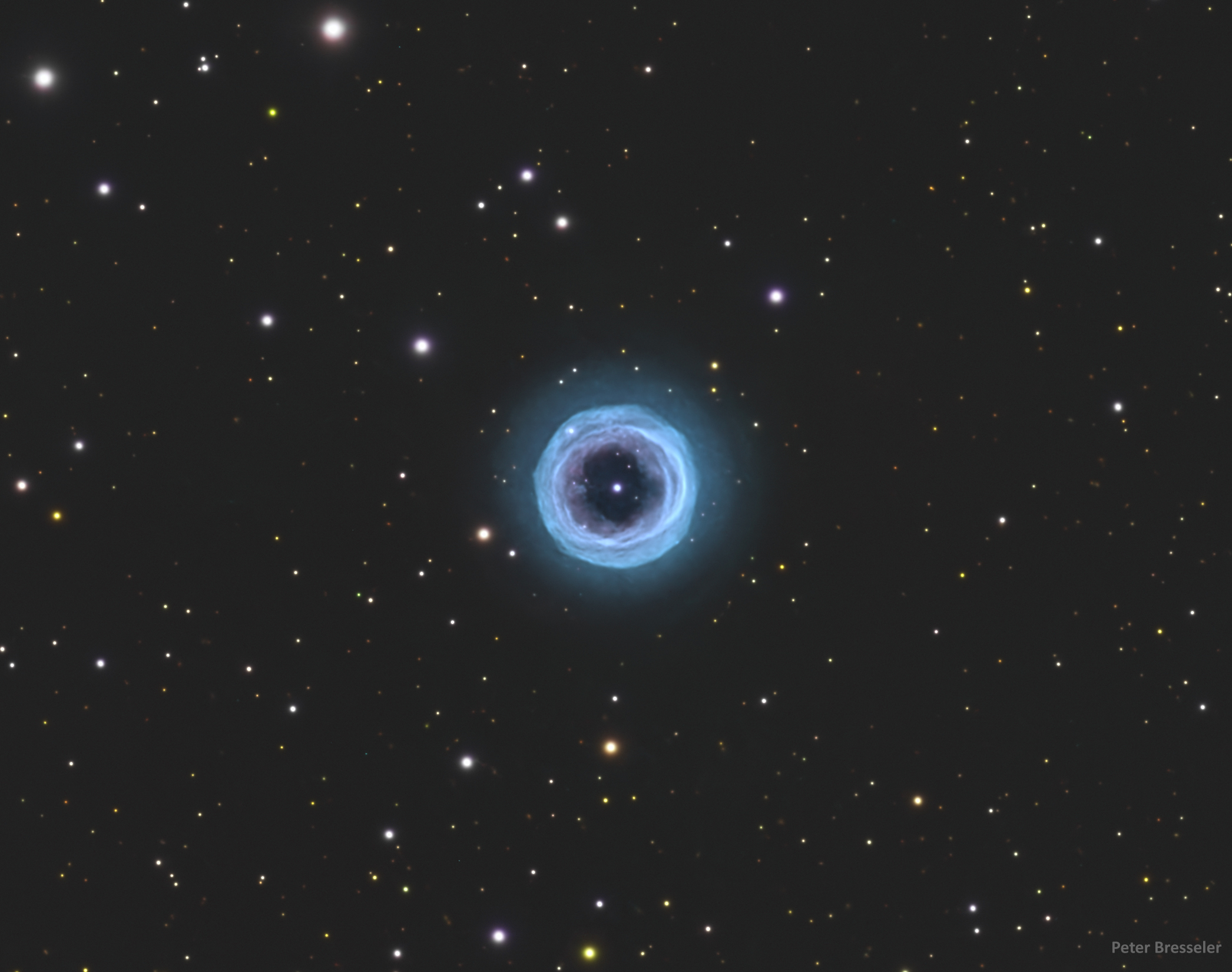
あなたを見つめ返しているのは宇宙の目ではなく、美しい対称性を持つ惑星状星雲、シャプレー1です。シャプレー1は、ファインリング星雲またはPLN 329+2.1としても知られ、南天の星座である大工の四角(ノルマ)を彩っています。この星雲は、太陽に近い質量の恒星が燃料を使い果たし、外層を放出した結果生じたものです。放出された外層から放出された酸素が輝くことで、円形のハローが形成されます。明るい中心点は実は連星系で、外層が宇宙空間に放出された後に残った恒星核である白色矮星と、もう1つの恒星が2.9日周期で互いの周りを公転しています。シャプレー1の環状の形状は、私たちがこの系を上から見下ろしているためであり、中心星が惑星状星雲の構造に与える影響についての洞察を与えてくれます。
原文(English)
What’s looking back at you isn’t a cosmic eye, but Shapley 1, a beautifully symmetric planetary nebula. Shapley 1, also known as the Fine Ring Nebula or PLN 329+2.1, bejewels the southern sky constellation of the Carpenter's Square (Norma). The nebula is the result of a star near the mass of our Sun running out of fuel and shedding its outer layers. Glowing oxygen from those expelled layers makes up the circular halo. The bright central point is actually a binary: a white dwarf, the remaining stellar core after the outer layers are expelled into space, and another star, orbiting each other every 2.9 days. Shapley 1’s annular shape is due to our top-down view of the system and provides insight into the influence of central stars on planetary nebula structures.
\ この感動を宇宙仲間にシェア /
宇宙をXでシェア
© Peter Bresseler;
Text:
Keighley Rockcliffe
(NASA
GSFC,
UMBC
CSST,
CRESST II) / APOD