
🚀 宇宙の記憶・カレンダー検索
🚀 象徴的な写真:
APOD第1回
🚀 創造の柱
🚀 スピリット火星着陸
🚀 ハッブル超深宇宙
🚀 地球へようこそ|ブルー・マーブル
🚀 エンケラドス
🚀 ベテルギウス
🚀 火星着陸
🚀 青い夕焼け
🚀 冥王星のハート
🚀 皆既日食
🚀 アースライズ再構築
🚀 ブラックホール
🚀 ウェッブ初画像
🚀 アポロ11着陸
APOD30周年(2025年6月16日)
網に捕らえられて:タランチュラ星雲におけるブラックホール合体の可視化
Caught in the Web: Visualization of a Black Hole Merger in the Tarantula Nebula
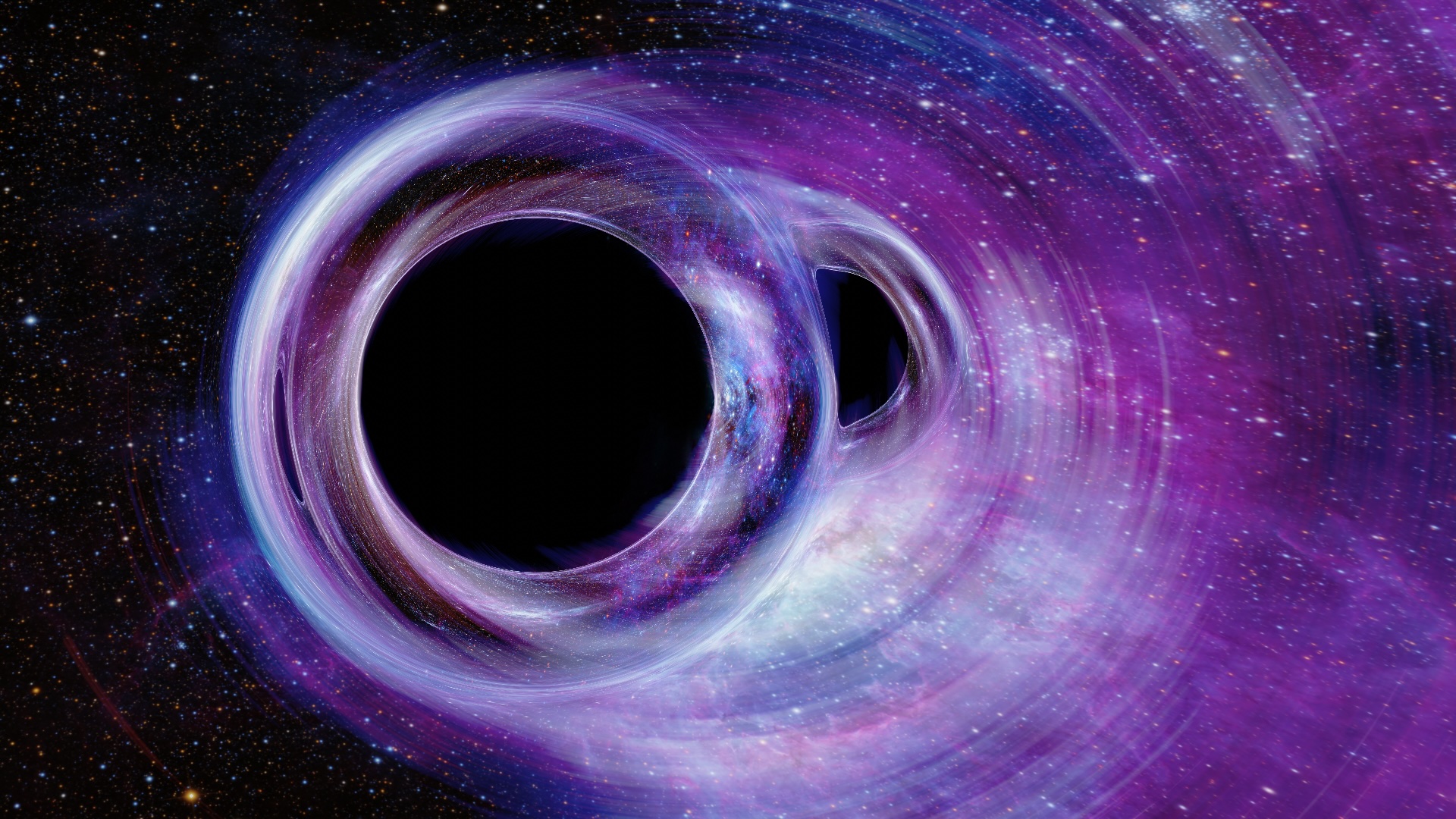
目に見えないものをどうやって見ることができるのでしょうか?ブラックホールは暗い宇宙の夜には簡単には見えませんが、天文学者は物質、光、時空に対する重力の影響を分析することでブラックホールを見つけることができます。掲載されている画像は、ブラックホール連星系が最後の「死の舞踏」を繰り広げるシミュレーションと、背景に写っているタランチュラ星雲の天体写真を組み合わせたイラストです。ブラックホールは光を発しませんが、重力レンズのように光線の経路を歪めます。その結果、星雲は極度に歪み、アインシュタインリングや多重像を形成します。タランチュラ星雲は、天の川銀河の伴銀河の一つである矮小銀河、大マゼラン雲に位置し、地球から16万光年離れています。これは、これまで検出されたどの連星ブラックホール合体よりも1000倍以上も近い距離です。おそらく、これほど近い場所で合体現象を検出することはないでしょう。
原文(English)
How can we see what is invisible? Black holes are not easy to see in the dark cosmic night, but astronomers can find them by analyzing their gravitational effects on matter, light and spacetime. The featured image shows an illustration that combines a simulation of a black hole binary system in its final "death-dance" with an astrophotography image of the Tarantula Nebula in the background. Even though black holes don't emit light, they distort the path of light rays, acting like a gravitational lens. As a result, the nebula appears extremely distorted, forming Einstein rings and multiple images. Tarantula Nebula lies in the Large Magellanic Cloud, a dwarf galaxy that is one of the satellite galaxies of the Milky Way, 160,000 light-years away. That is more than 1,000 times closer than any of the binary black hole mergers detected so far. We'll probably never detect a merger so close to home!
\ この感動を宇宙仲間にシェア /
宇宙をXでシェア
© Carl Knox / APOD