
🚀 宇宙の記憶・カレンダー検索
🚀 象徴的な写真:
APOD第1回
🚀 創造の柱
🚀 スピリット火星着陸
🚀 ハッブル超深宇宙
🚀 地球へようこそ|ブルー・マーブル
🚀 エンケラドス
🚀 ベテルギウス
🚀 火星着陸
🚀 青い夕焼け
🚀 冥王星のハート
🚀 皆既日食
🚀 アースライズ再構築
🚀 ブラックホール
🚀 ウェッブ初画像
🚀 アポロ11着陸
APOD30周年(2025年6月16日)
CG 30:彗星状球状体
CG 30: Cometary Globules
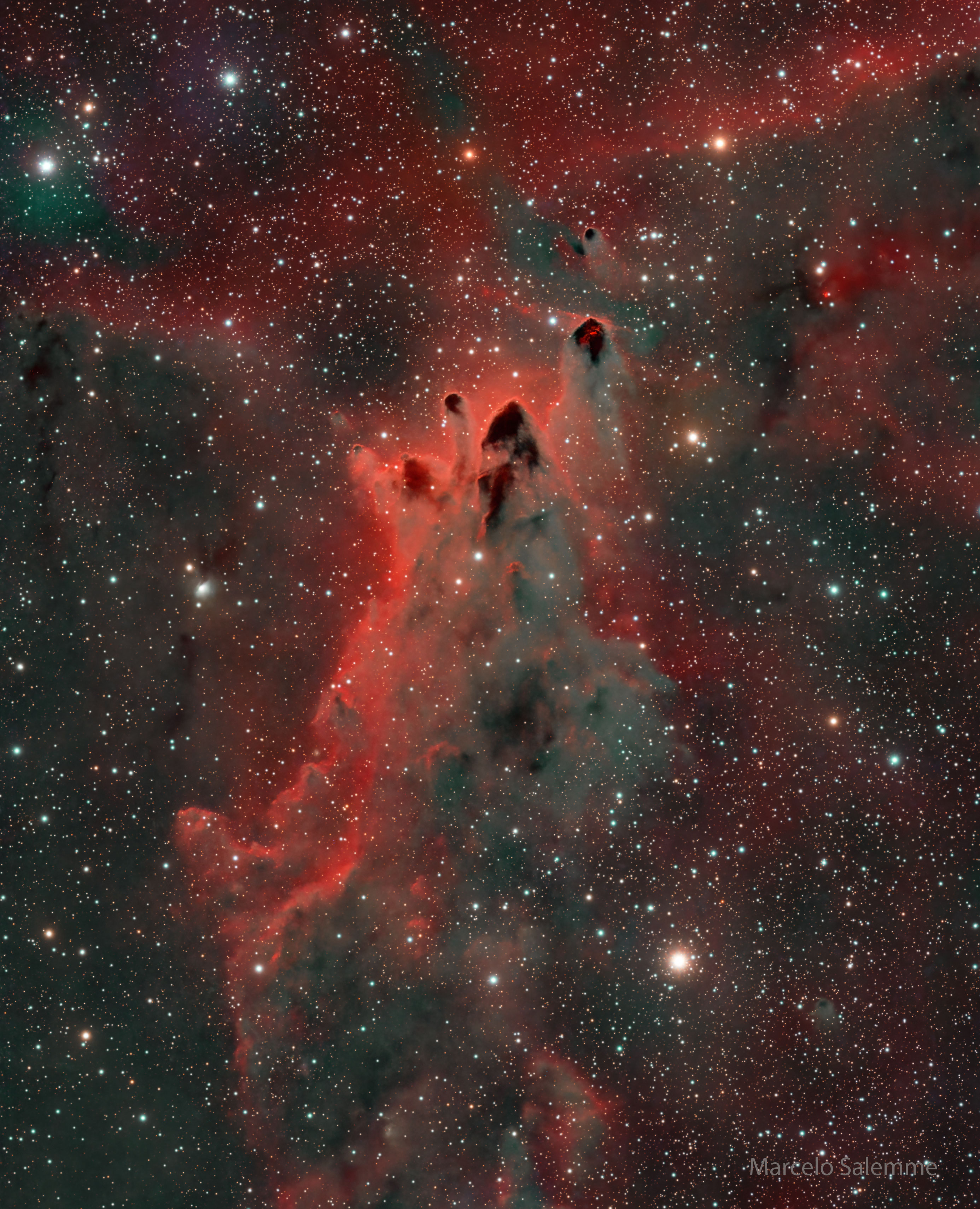
それらは山頂のようですが、星を形成している最中です。明るい縁を持つ流れるような形状が、南天の航海星座であるとも座とほ座の境界付近にあるこの豊かな星野の中心付近に集まっています。星間ガスと塵で構成された、光年サイズの彗星状球状体の集まりは、約1300光年離れています。近くの高温の星からの高エネルギー紫外線が球状体を形作り、明るい縁を電離しました。球状体はほ座超新星残骸からも流れ出ており、それが球状体の後退した形状に影響を与えた可能性があります。球状体内部では、冷たいガスと塵の核が収縮して低質量星を形成していると考えられ、その形成によって最終的に球状体は散逸します。実際、彗星状球状体CG 30(グループの右上)は、頭部に小さな赤みがかった輝きを放っており、これは形成初期段階の星からの高エネルギージェットの明らかな兆候です。
原文(English)
They're like mountain peaks, but they are forming stars. Bright-rimmed, flowing shapes gather near the center of this rich starfield toward the borders of the nautical southern constellations Puppis and Vela. Composed of interstellar gas and dust, the grouping of light-year sized cometary globules is about 1300 light-years distant. Energetic ultraviolet light from nearby hot stars has molded the globules and ionized their bright rims. The globules also stream away from the Vela supernova remnant which may have influenced their swept-back shapes. Within them, cores of cold gas and dust are likely collapsing to form low mass stars whose formation will ultimately cause the globules to disperse. In fact, cometary globule CG 30 (upper right in the group) sports a small reddish glow inside its head, a telltale sign of energetic jets from a star in the early stages of formation.
\ この感動を宇宙仲間にシェア /
宇宙をXでシェア
© Marcelo Salemme / APOD