
🚀 宇宙の記憶・カレンダー検索
🚀 象徴的な写真:
APOD第1回
🚀 創造の柱
🚀 スピリット火星着陸
🚀 ハッブル超深宇宙
🚀 地球へようこそ|ブルー・マーブル
🚀 エンケラドス
🚀 ベテルギウス
🚀 火星着陸
🚀 青い夕焼け
🚀 冥王星のハート
🚀 皆既日食
🚀 アースライズ再構築
🚀 ブラックホール
🚀 ウェッブ初画像
🚀 アポロ11着陸
APOD30周年(2025年6月16日)
ルービンのCOSMOSフィールド
Rubin's COSMOS field
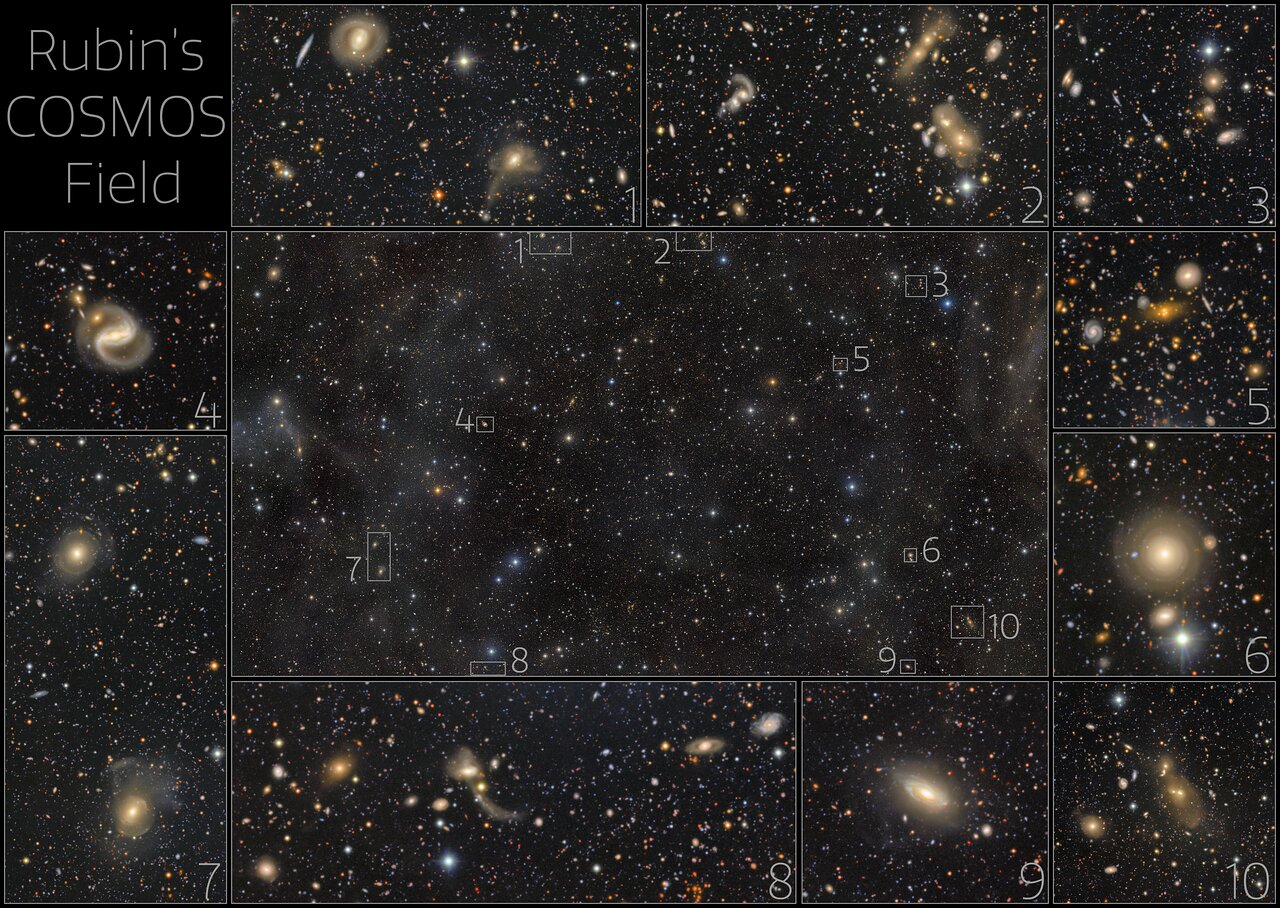
チリにあるNSF-DOEベラ・C・ルービン天文台が撮影したこの画像の中央パネルには、50万個以上の銀河が写っています。ここはCOSMOS領域と呼ばれる、満月の数倍の大きさの空の領域で、ハッブル宇宙望遠鏡によって初めて観測されました。この領域は、私たちの銀河系からの明るい星が比較的少ないため、天の川銀河以外の銀河を比較的遮るものなく観測できることから、ウェッブ宇宙望遠鏡をはじめとする他の望遠鏡でも観測されています。外側のパネル(番号1~10)は、中央パネルで強調表示されている対応する小さな領域を拡大したものです。銀河の形や大きさの多様性は驚くべきものです。中には、光が地球に届くまでに数十億年もかかるほど遠くにあるものもあります。ルービン天文台は、10年間にわたる「宇宙と時間のレガシーサーベイ」の一環として、数日おきにCOSMOS領域を観測します。これにより、COSMOS領域の動的な様子や、空が時間とともにどのように変化していくかを把握することができます。
原文(English)
There are more than half a million galaxies in the central panel of this image from the NSF-DOE Vera C. Rubin Observatory in Chile. This is the COSMOS field, a patch of sky several times larger than the full moon, first observed by Hubble. It has also been observed by Webb and other telescopes because it contains comparatively few bright stars from our own galaxy, offering a relatively unimpeded view of other galaxies outside the Milky Way. The outer panels, numbered 1-10, show zoomed-in views of the corresponding small regions highlighted in the central panel. The variety of galaxy shapes and sizes is astonishing. Some of them are so far away that their light has traveled for billions of years before reaching Earth. Rubin will come back every couple of days to the COSMOS field as part of its ten-year Legacy Survey of Space and Time. It will allow a dynamic view of the COSMOS field and how the sky changes over time.
\ この感動を宇宙仲間にシェア /
宇宙をXでシェア
© NSF–DOE Vera C. Rubin Observatory/NOIRLab/SLAC/AURA
Text:
Cecilia Chirenti
(NASA
GSFC,
UMCP,
CRESST II) / APOD