
🚀 宇宙の記憶・カレンダー検索
🚀 象徴的な写真:
APOD第1回
🚀 創造の柱
🚀 スピリット火星着陸
🚀 ハッブル超深宇宙
🚀 地球へようこそ|ブルー・マーブル
🚀 エンケラドス
🚀 ベテルギウス
🚀 火星着陸
🚀 青い夕焼け
🚀 冥王星のハート
🚀 皆既日食
🚀 アースライズ再構築
🚀 ブラックホール
🚀 ウェッブ初画像
🚀 アポロ11着陸
APOD30周年(2025年6月16日)
銀河団アベル1689が空間を歪める
Galaxy Cluster Abell 1689 Warps Space
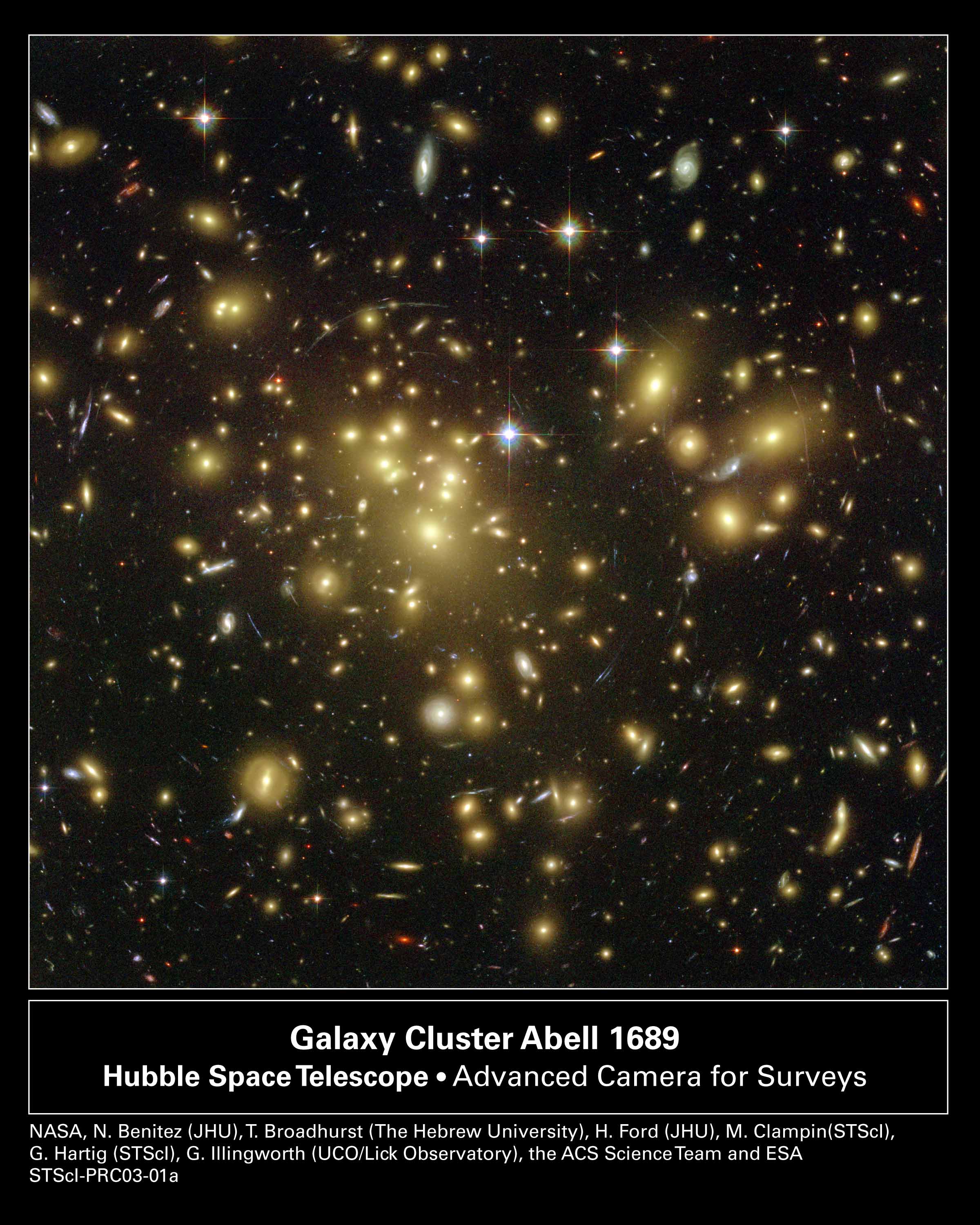
20億光年離れた銀河団アベル1689は、宇宙で最も質量の大きい天体の1つです。ハッブル宇宙望遠鏡の先進観測カメラ(ACS)で撮影されたこの画像では、アベル1689がアインシュタインの重力理論の予測どおり空間を歪めている様子が捉えられています。銀河団の背後にある個々の銀河からの光が曲げられ、複数の湾曲した像が生み出されています。この巨大な重力レンズの威力は質量に依存しますが、銀河団の黄色っぽい銀河という形で見える物質は、背景の銀河の青みがかった弧状の像を作り出すのに必要な質量のわずか1パーセント程度に過ぎません。実際、この宇宙規模の重力レンズ効果を説明するのに十分なほど空間を歪めるのに必要な重力質量の大部分は、いまだ謎に包まれたダークマターの形で存在しています。銀河団の重力の主要因であるダークマターの目に見えない存在は、レンズ効果によって生じた弧状の像や歪んだ背景の銀河像によって明らかにされます。
原文(English)
Two billion light-years away, galaxy cluster Abell 1689 is one of the most massive objects in the Universe. In this view from the Hubble Space Telescope's Advanced Camera for Surveys, Abell 1689 is seen to warp space as predicted by Einstein's theory of gravity -- bending light from individual galaxies which lie behind the cluster to produce multiple, curved images. The power of this enormous gravitational lens depends on its mass, but the visible matter, in the form of the cluster's yellowish galaxies, only accounts for about one percent of the mass needed to make the observed bluish arcing images of background galaxies. In fact, most of the gravitational mass required to warp space enough to explain this cosmic scale lensing is in the form of still mysterious dark matter. As the dominant source of the cluster's gravity, the dark matter's unseen presence is mapped out by the lensed arcs and distorted background galaxy images.
\ この感動を宇宙仲間にシェア /
宇宙をXでシェア
© NASA / APOD