
🚀 宇宙の記憶・カレンダー検索
🚀 象徴的な写真:
APOD第1回
🚀 創造の柱
🚀 スピリット火星着陸
🚀 ハッブル超深宇宙
🚀 地球へようこそ|ブルー・マーブル
🚀 エンケラドス
🚀 ベテルギウス
🚀 火星着陸
🚀 青い夕焼け
🚀 冥王星のハート
🚀 皆既日食
🚀 アースライズ再構築
🚀 ブラックホール
🚀 ウェッブ初画像
🚀 アポロ11着陸
APOD30周年(2025年6月16日)
流星のスペクトル
The Spectrum of a Meteor
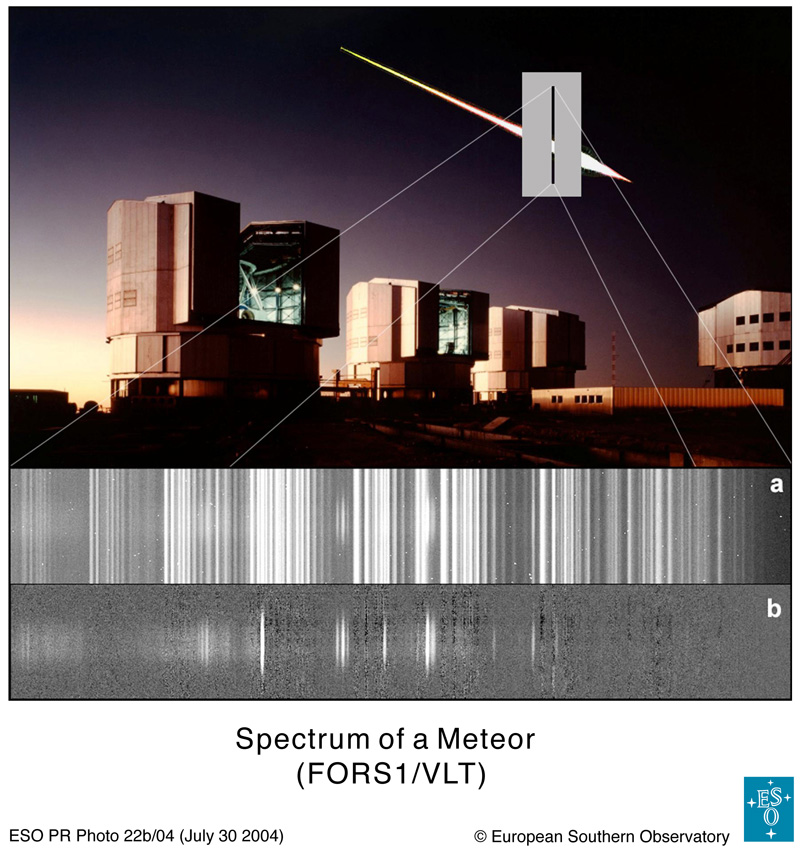
非常に大きな望遠鏡で空を横切る流星の軌跡の短い閃光を追いかけるのは、ほぼ不可能な作業です。しかし、2002年5月12日、天文学者たちは幸運にも、明るい流星がパラナル天文台の分光器の狭いスリットを横切ったのです。当時、この分光器は超新星からの光を研究するために使用されており、遠く離れた恒星爆発で発生した原子によって生成された多くの近赤外線輝線を分離して記録していました。パラナルにある流星の軌跡と超大型望遠鏡ユニットのこの芸術的なモンタージュの下にあるパネルaは、近赤外線の空の背景スペクトルと5月12日の流星を組み合わせたものです。パネルbは、背景成分を差し引いた後の流星単独の放射スペクトルを示しています。流星の放射は、高度約100キロメートルで輝く軌跡に沿って超高温の空気中の酸素原子と窒素原子および分子の衝突によるものです。
原文(English)
Chasing the brief flash of a meteor trail across the sky with a very large telescope is a nearly impossible task. But on May 12, 2002, astronomers got lucky, as a bright meteor chanced across the narrow slit of their spectrograph at the Paranal Observatory. At the time, the spectrograph was being used to study the light from a supernova, separating and recording the many near-infrared emission lines produced by atoms in the distant stellar explosion. Below this artistic montage of a meteor streak and Very Large Telescope units at Paranal, panel a shows the near-infrared sky background spectrum and the May 12 meteor combined. Panel b shows the emission spectrum of the meteor alone, after subtracting away the background contributions. The meteor emission is due to colliding oxygen and nitrogen atoms and molecules in the superheated air along the glowing trail at an altitude of about 100 kilometers.
\ この感動を宇宙仲間にシェア /
宇宙をXでシェア
© P. Jenniskens
(SETI Inst.),
E. Jehin (ESO)
et al.,
FORS1/VLT,
ESO / APOD