
🚀 宇宙の記憶・カレンダー検索
🚀 象徴的な写真:
APOD第1回
🚀 創造の柱
🚀 スピリット火星着陸
🚀 ハッブル超深宇宙
🚀 地球へようこそ|ブルー・マーブル
🚀 エンケラドス
🚀 ベテルギウス
🚀 火星着陸
🚀 青い夕焼け
🚀 冥王星のハート
🚀 皆既日食
🚀 アースライズ再構築
🚀 ブラックホール
🚀 ウェッブ初画像
🚀 アポロ11着陸
APOD30周年(2025年6月16日)
ニュートロン・マーズ
Neutron Mars
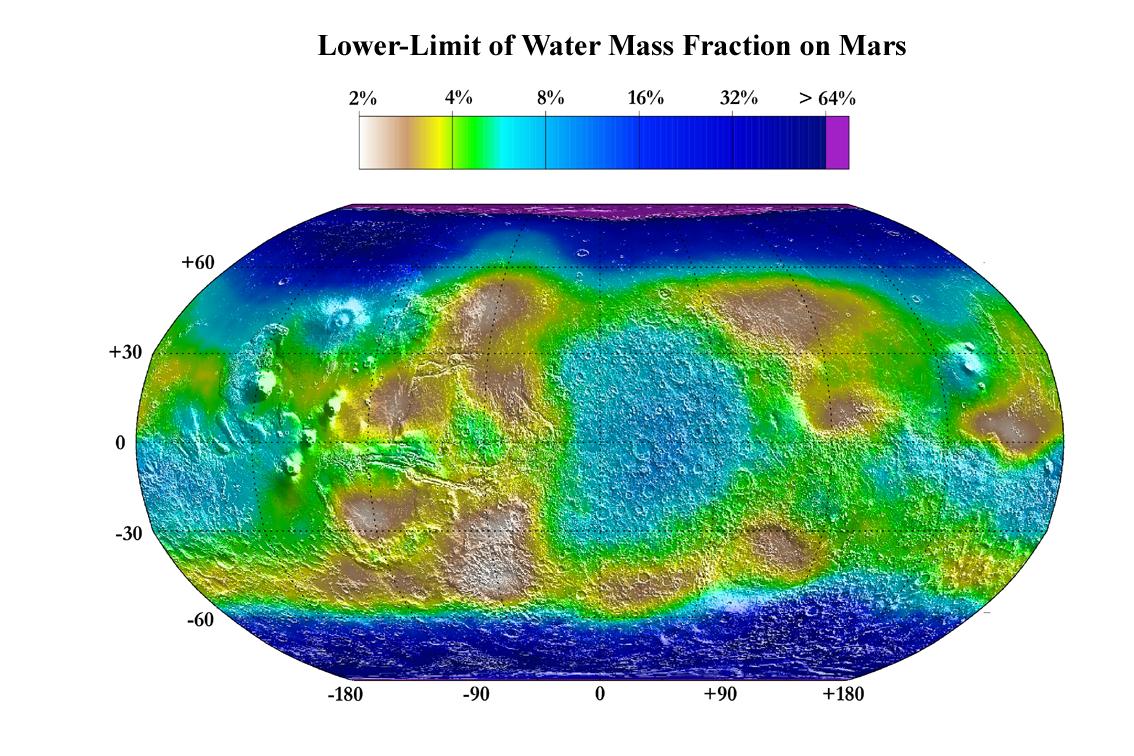
火星に水を探すため、火星探査機マーズ・オデッセイに搭載された検出器を使用する研究者たちは、赤い惑星である火星から放出される高エネルギー中性子の擬似カラー全球マップを作成しました。中性子と水にはどのような関係があるのでしょうか?惑星間空間からの宇宙線が薄い火星の大気を貫通して地表に到達すると、土壌の上層にある元素と相互作用し、中性子を宇宙空間に散乱させます。しかし、火星の土壌に水素が含まれている場合、散乱された高エネルギー中性子を強く吸収します。中性子検出器は吸収の変化を追跡することで、軌道上から地表の水素含有量の変化をマッピングできます。水素含有量は、火星の地表付近で最も可能性の高い水素の形態である凍結水(H2O)の代替指標として用いられます。したがって、上記のマップで青色が濃いほど、地表付近の水氷の濃度が高いと推定されます。火星の極に水氷が存在することは驚くべきことではありませんでしたが、低緯度にもかなりの濃度が存在するようです。こうした地表付近の氷の融解が、火星の谷の形成原因となっている可能性がある。
原文(English)
Looking for water on Mars, researchers using detectors on board the orbiting Mars Odyssey spacecraft have created this false-color global map of energetic neutrons from the otherwise Red Planet. What do neutrons have to do with water? As cosmic rays from interplanetary space penetrate the thin martian atmosphere and reach the surface they interact with elements in the upper layer of soil, scattering neutrons back into space. But if the martian soil contains hydrogen, it seriously absorbs energetic scattered neutrons. Tracking variations in absorption, neutron detectors can map changes in surface hydrogen content from orbit. Hydrogen content is taken as a surrogate measure of frozen water (H20), the most likely form of hydrogen close to the martian surface. Thus, bluer shades in the above map correspond to larger presumed concentrations of near-surface water ice. Water ice at the martian poles came as no surprise, but significant concentrations also seem to be present at lower latitudes. The melting of such near-surface ice could be responsible for the formation of martian gullies.
\ この感動を宇宙仲間にシェア /
宇宙をXでシェア
© NASA / APOD