
🚀 宇宙の記憶・カレンダー検索
🚀 象徴的な写真:
APOD第1回
🚀 創造の柱
🚀 スピリット火星着陸
🚀 ハッブル超深宇宙
🚀 地球へようこそ|ブルー・マーブル
🚀 エンケラドス
🚀 ベテルギウス
🚀 火星着陸
🚀 青い夕焼け
🚀 冥王星のハート
🚀 皆既日食
🚀 アースライズ再構築
🚀 ブラックホール
🚀 ウェッブ初画像
🚀 アポロ11着陸
APOD30周年(2025年6月16日)
N11:巨大な発光星雲の環
N11: A Giant Ring of Emission Nebulas
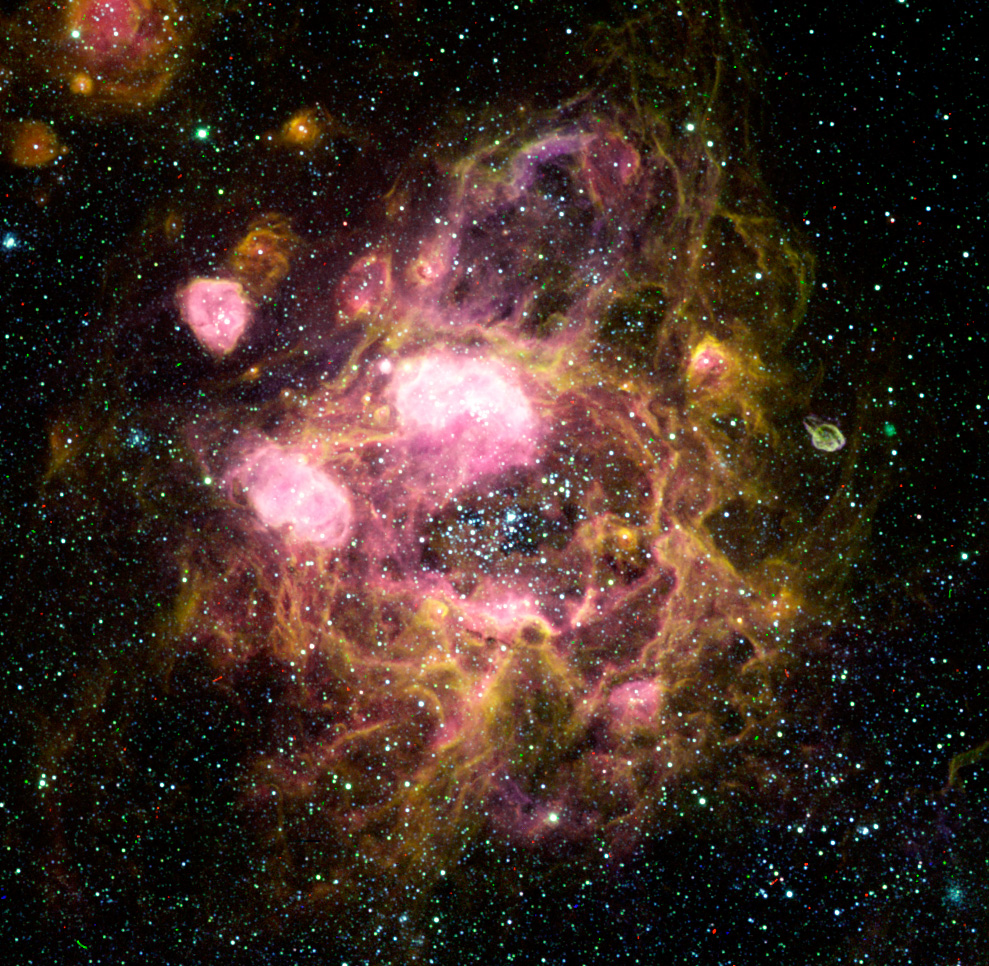
この異常に大きな星雲はどのようにして形成されたのでしょうか?これまでに検出された最大の星雲の1つは、実際には輝くフィラメントでつながった複雑な環状の輝線星雲です。N11として知られるこの特異なネットワークは、1000光年以上に渡り、天の川銀河最大の伴銀河である大マゼラン雲の目立つ構造です。上の画像の中央には、NGC 1760としても知られる散開星団LH9があり、周囲に穴を開けるほどの放射線を放出する約50個の明るい青い星で構成されています。N11の形成に関する有力な仮説は、中心からさらに外側で連続する世代の星の殻が形成されるというものです。中心のすぐ上の明るい領域はN11Bで、今日でも星が形成されている爆発領域です。
原文(English)
How did this unusually large nebula form? One of the largest nebulas yet detected is actually a complex ring of emission nebulas connected by glowing filaments. The unusual network, known as N11, spans over 1000 light years and is a prominent structure of the Large Magellanic Cloud, the largest satellite galaxy of our Milky Way Galaxy. In the center of the above image is open star cluster LH9, also known as NGC 1760, composed of about 50 bright blue stars that emit radiation that has eroded a hole in their surroundings. A leading hypothesis for the formation of N11 is shells of successive generations of stars being formed further out from the center. The bright region just above center is N11B, an explosive domain where stars are being formed even today.
\ この感動を宇宙仲間にシェア /
宇宙をXでシェア
© C. Smith / APOD