
🚀 宇宙の記憶・カレンダー検索
🚀 象徴的な写真:
APOD第1回
🚀 創造の柱
🚀 スピリット火星着陸
🚀 ハッブル超深宇宙
🚀 地球へようこそ|ブルー・マーブル
🚀 エンケラドス
🚀 ベテルギウス
🚀 火星着陸
🚀 青い夕焼け
🚀 冥王星のハート
🚀 皆既日食
🚀 アースライズ再構築
🚀 ブラックホール
🚀 ウェッブ初画像
🚀 アポロ11着陸
APOD30周年(2025年6月16日)
チャンドラ、ハッブル、スピッツァーによるケプラー超新星残骸の画像
Kepler's SNR from Chandra, Hubble, and Spitzer
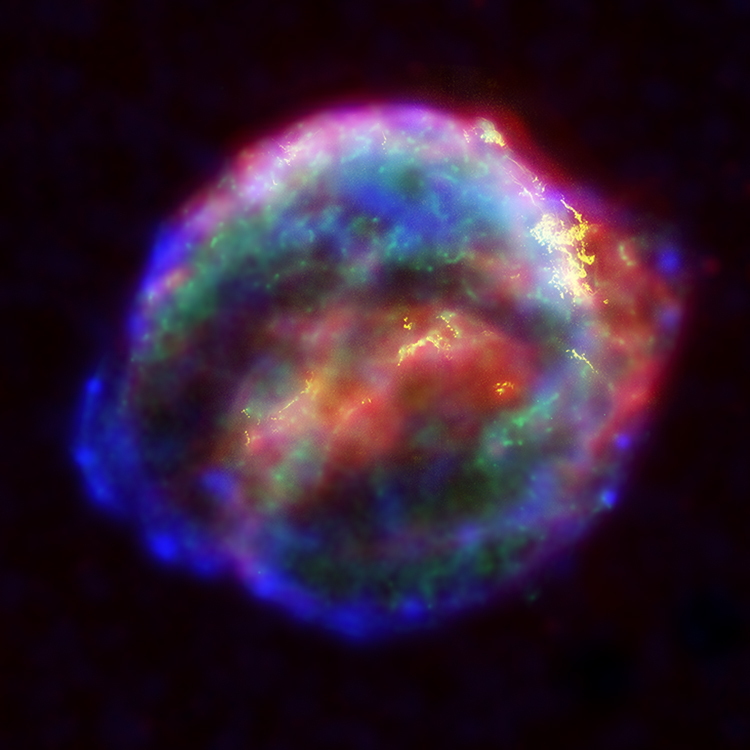
このエネルギーに満ちた宇宙雲を生み出した恒星爆発からの光が、地球上で初めて観測されたのは、わずか400年前の1604年10月のことでした。この超新星爆発は、17世紀初頭の空、へびつかい座に明るい新星を生み出しました。天文学者ヨハネス・ケプラーとその同時代人たちは、望遠鏡の恩恵を受けることなく、この天体の出現の謎を解明しようと研究しました。21世紀初頭の天文学者たちは、恒星進化に関する現代的な理解を武器に、拡大し続ける残骸雲の探査を続けていますが、現在では軌道上の宇宙望遠鏡を用いて、ケプラーの超新星残骸(SNR)をあらゆる波長域で観測することが可能になっています。この魅力的な合成画像では、NASAの天体観測所(チャンドラX線天文台、ハッブル宇宙望遠鏡、スピッツァー宇宙望遠鏡)が記録したX線、可視光線、赤外線が組み合わされ、依然として謎に包まれた超新星残骸のより包括的な姿が捉えられています。約1万3000光年離れたケプラー超新星は、私たちの銀河系内で観測された最も新しい恒星爆発です。
原文(English)
Light from the stellar explosion that created this energized cosmic cloud was first seen on planet Earth in October 1604, a mere four hundred years ago. The supernova produced a bright new star in early 17th century skies within the constellation Ophiuchus. It was studied by astronomer Johannes Kepler and his contemporaries, with out the benefit of a telescope, as they searched for an explanation of the heavenly apparition. Armed with a modern understanding of stellar evolution, early 21st century astronomers continue to explore the expanding debris cloud, but can now use orbiting space telescopes to survey Kepler's supernova remnant (SNR) across the spectrum. In this tantalizing composite image, x-rays, visible light, and infrared radiation recorded by NASA's astrophysical observatories - the Chandra X-Ray Observatory, Hubble and Spitzer space telescopes - are combined to give a more comprehensive view of the still enigmatic supernova remnant. About 13,000 light years away, Kepler's supernova represents the most recent stellar explosion seen to occur within our Milky Way galaxy.
\ この感動を宇宙仲間にシェア /
宇宙をXでシェア
© NASA / APOD