
🚀 宇宙の記憶・カレンダー検索
🚀 象徴的な写真:
APOD第1回
🚀 創造の柱
🚀 スピリット火星着陸
🚀 ハッブル超深宇宙
🚀 地球へようこそ|ブルー・マーブル
🚀 エンケラドス
🚀 ベテルギウス
🚀 火星着陸
🚀 青い夕焼け
🚀 冥王星のハート
🚀 皆既日食
🚀 アースライズ再構築
🚀 ブラックホール
🚀 ウェッブ初画像
🚀 アポロ11着陸
APOD30周年(2025年6月16日)
シャープレス249とクラゲ星雲
Sharpless 249 and the Jellyfish Nebula
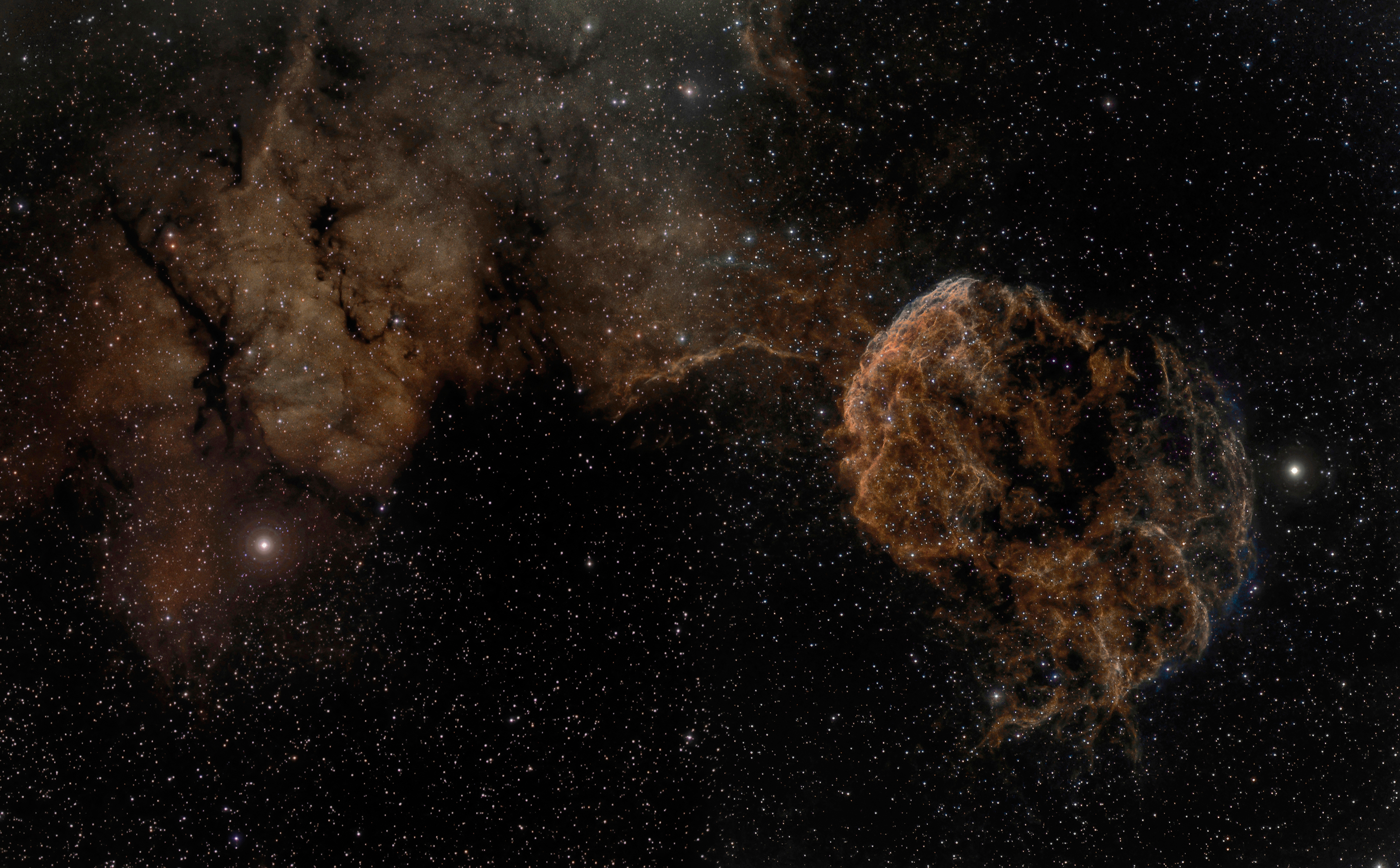
通常はかすかで捉えにくいクラゲ星雲が、この魅力的な望遠鏡モザイクに捉えられています。この光景は、天体の双子の足元にある2つの明るい星、μ星とη星によって左右に固定されており、クラゲ星雲は、中央の右下にある、垂れ下がった触手を持つ明るい弧状の放射の尾根です。実際、宇宙のクラゲは、爆発した巨大な星からの膨張する残骸雲である泡状の超新星残骸IC 443の一部です。爆発からの光が最初に地球に到達したのは3万年以上前です。天体物理学上のいとこであるかに星雲超新星残骸と同様に、クラゲ星雲は崩壊した恒星核の残骸である中性子星を宿していることが知られています。左上の視野は、シャープレス249としてカタログ化されている放射星雲で満たされています。クラゲ星雲は約5000光年離れています。その距離では、この狭帯域合成画像の幅は約300光年になります。
原文(English)
Normally faint and elusive, the Jellyfish Nebula is caught in this alluring telescopic mosaic. The scene is anchored right and left by two bright stars, Mu and Eta Geminorum, at the foot of the celestial twin while the Jellyfish Nebula is the brighter arcing ridge of emission with dangling tentacles below and right of center. In fact, the cosmic jellyfish is part of bubble-shaped supernova remnant IC 443, the expanding debris cloud from a massive star that exploded. Light from the explosion first reached planet Earth over 30,000 years ago. Like its cousin in astrophysical waters the Crab Nebula supernova remnant, the Jellyfish Nebula is known to harbor a neutron star, the remnant of the collapsed stellar core. An emission nebula cataloged as Sharpless 249 fills the field at the upper left. The Jellyfish Nebula is about 5,000 light-years away. At that distance, this narrowband composite image would be about 300 light-years across.
\ この感動を宇宙仲間にシェア /
宇宙をXでシェア
© César Blanco
González / APOD