
🚀 宇宙の記憶・カレンダー検索
🚀 象徴的な写真:
APOD第1回
🚀 創造の柱
🚀 スピリット火星着陸
🚀 ハッブル超深宇宙
🚀 地球へようこそ|ブルー・マーブル
🚀 エンケラドス
🚀 ベテルギウス
🚀 火星着陸
🚀 青い夕焼け
🚀 冥王星のハート
🚀 皆既日食
🚀 アースライズ再構築
🚀 ブラックホール
🚀 ウェッブ初画像
🚀 アポロ11着陸
APOD30周年(2025年6月16日)
これまで観測された中で最も遠い星の候補となる、偶然の閃光
Fortuitous Flash Candidate for the Farthest Star Yet Seen
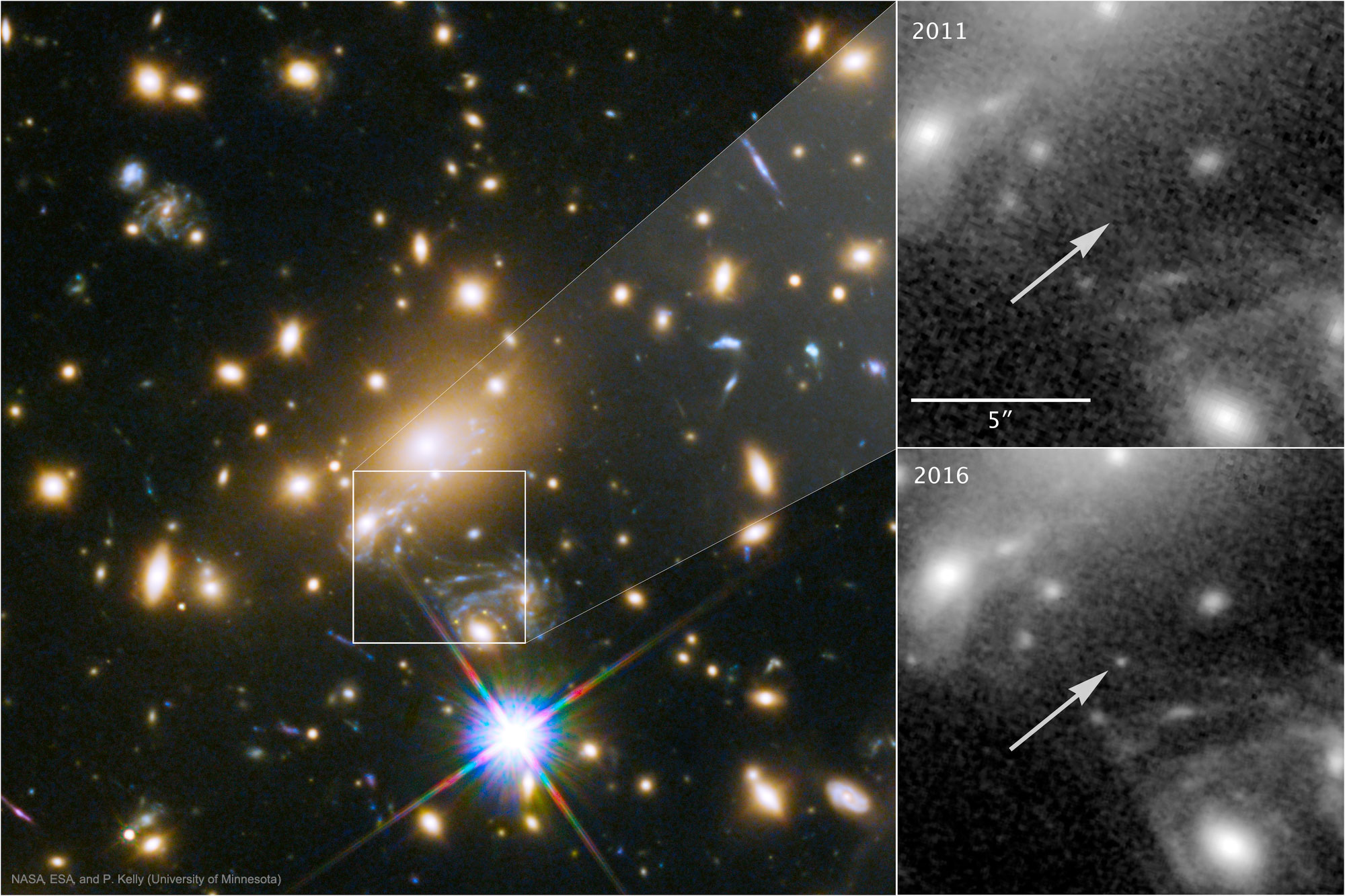
この閃光はこれまで観測された中で最も遠い星だったのだろうか?ハッブル宇宙望遠鏡の画像で偶然発見された予期せぬ閃光は、珍しい重力レンズ現象であるだけでなく、これまで個別に撮影されたどの星よりも100倍も遠い通常の星の画像であることが判明するかもしれない。特集画像は、左側に多くの黄色い銀河を含む銀河団を示しており、右側には2011年には明らかにならなかった2016年に出現した光源の拡大された四角形が示されている。この光源のスペクトルと変動性は、奇妙なことに超新星とは異なり、整列した重力レンズの合流によって約2000倍に拡大された通常の青色超巨星とより一致しているように見える。イカロスと名付けられたこの光源は、銀河団のはるか後方、宇宙のはるか彼方にある銀河にあり、赤方偏移は1.5である。レンズの解釈が正しく、イカロスが爆発星ではない場合、イカロスや同様に拡大された他の星のさらなる観測によって、銀河団および宇宙における恒星および暗黒物質の含有量に関する情報が得られる可能性がある。オープンサイエンス:天体物理学ソースコードライブラリにある1,600以上のコードを閲覧する
原文(English)
Was this flash the farthest star yet seen? An unexpected flash of light noticed fortuitously on Hubble Space Telescope images may prove to be not only an unusual gravitational lensing event but also an image of a normal star 100 times farther away than any star previously imaged individually. The featured image shows the galaxy cluster on the left complete with many yellowish galaxies, while on the right is an expanded square where a source appeared in 2016 that was not evident in 2011. The spectrum and variability of this source are strangely unlike a supernova, but rather appear more consistent with a normal blue supergiant star magnified by about a factor of 2000 by a confluence of aligned gravitational lenses. Dubbed Icarus, the source is in a galaxy well behind the galaxy cluster and far across the universe -- at redshift 1.5. If the lens interpretation is correct and Icarus is not an exploding star, further observations of it and other similarly magnified stars could give information about the stellar and dark matter content in the galaxy cluster and the universe. Open Science: Browse 1,600+ codes in the Astrophysics Source Code Library
\ この感動を宇宙仲間にシェア /
宇宙をXでシェア
© NASA / APOD