
🚀 宇宙の記憶・カレンダー検索
🚀 象徴的な写真:
APOD第1回
🚀 創造の柱
🚀 スピリット火星着陸
🚀 ハッブル超深宇宙
🚀 地球へようこそ|ブルー・マーブル
🚀 エンケラドス
🚀 ベテルギウス
🚀 火星着陸
🚀 青い夕焼け
🚀 冥王星のハート
🚀 皆既日食
🚀 アースライズ再構築
🚀 ブラックホール
🚀 ウェッブ初画像
🚀 アポロ11着陸
APOD30周年(2025年6月16日)
銀河中心における複数の特異点
A Plurality of Singularities at the Galactic Center
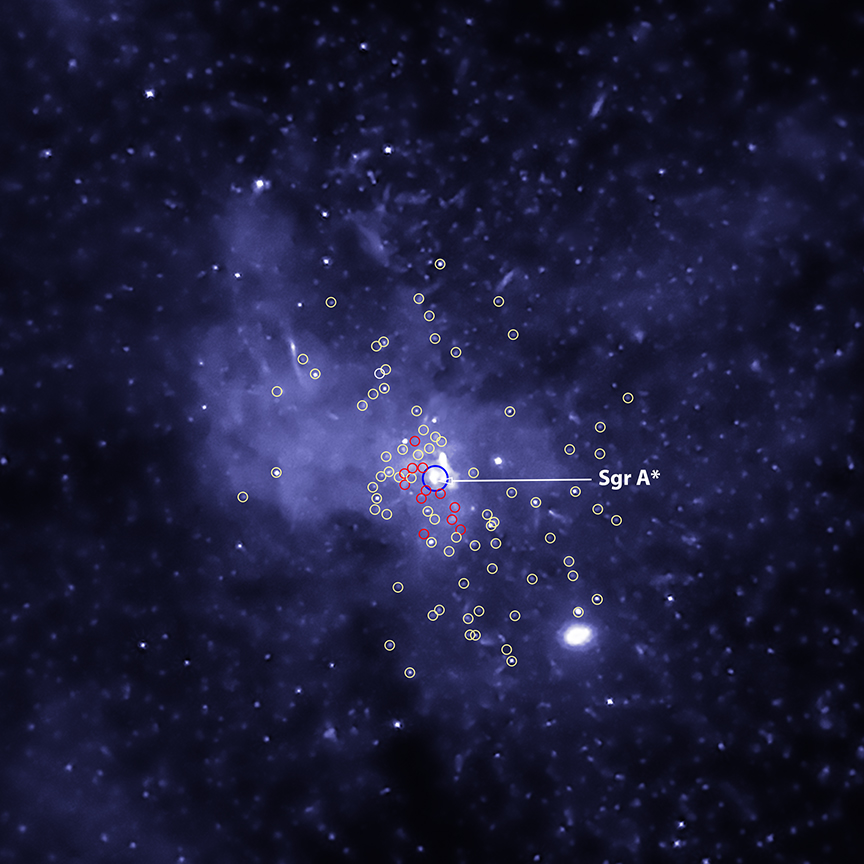
最近の非公式な調査によると、天文学者はまだブラックホールのグループを表す適切な集合名詞を持っていませんが、必要としています。チャンドラ天文台のこのX線画像にある赤い円は、連星系に属する12個のブラックホールのグループを示しています。太陽の5~30倍の質量を持つブラックホール連星は、いて座A*(Sgr A*)として知られる超大質量ブラックホールが存在する銀河の中心から約3光年以内に群がっています。黄色の円は、連星系にある質量の小さい中性子星または白色矮星である可能性が高いX線源を示しています。ブラックホールは単独では見えませんが、連星系の一部として、通常の伴星から物質を降着し、X線を生成します。銀河中心付近では、チャンドラX線観測衛星はこれらのブラックホール連星系のうち明るい方を点状のX線源としてしか検出できないため、まだ検出されていない、より暗いX線を放出するブラックホール連星が多数存在するはずだと推測される。
原文(English)
A recent informal poll found that astronomers don't yet have a good collective noun for a group of black holes, but they need one. The red circles in this Chandra Observatory X-ray image identify a group of a dozen black holes that are members of binary star systems. With 5 to 30 times the mass of the Sun, the black hole binaries are swarming within about 3 light-years of the center of our galaxy where the supermassive black hole identified as Sagittarius A* (Sgr A*) resides. Yellow circles indicate X-ray sources that are likely less massive neutron stars or white dwarf stars in binary star systems. Alone, black holes would be invisible, but as part of a binary star system they accrete material from their normal companion star and generate X-rays. At the distance of the galactic center Chandra can detect only the brighter of these black hole binary systems as point-like sources of X-rays, hinting that many fainter X-ray emitting black hole binaries should exist there, as yet undetected.
\ この感動を宇宙仲間にシェア /
宇宙をXでシェア
© NASA / APOD